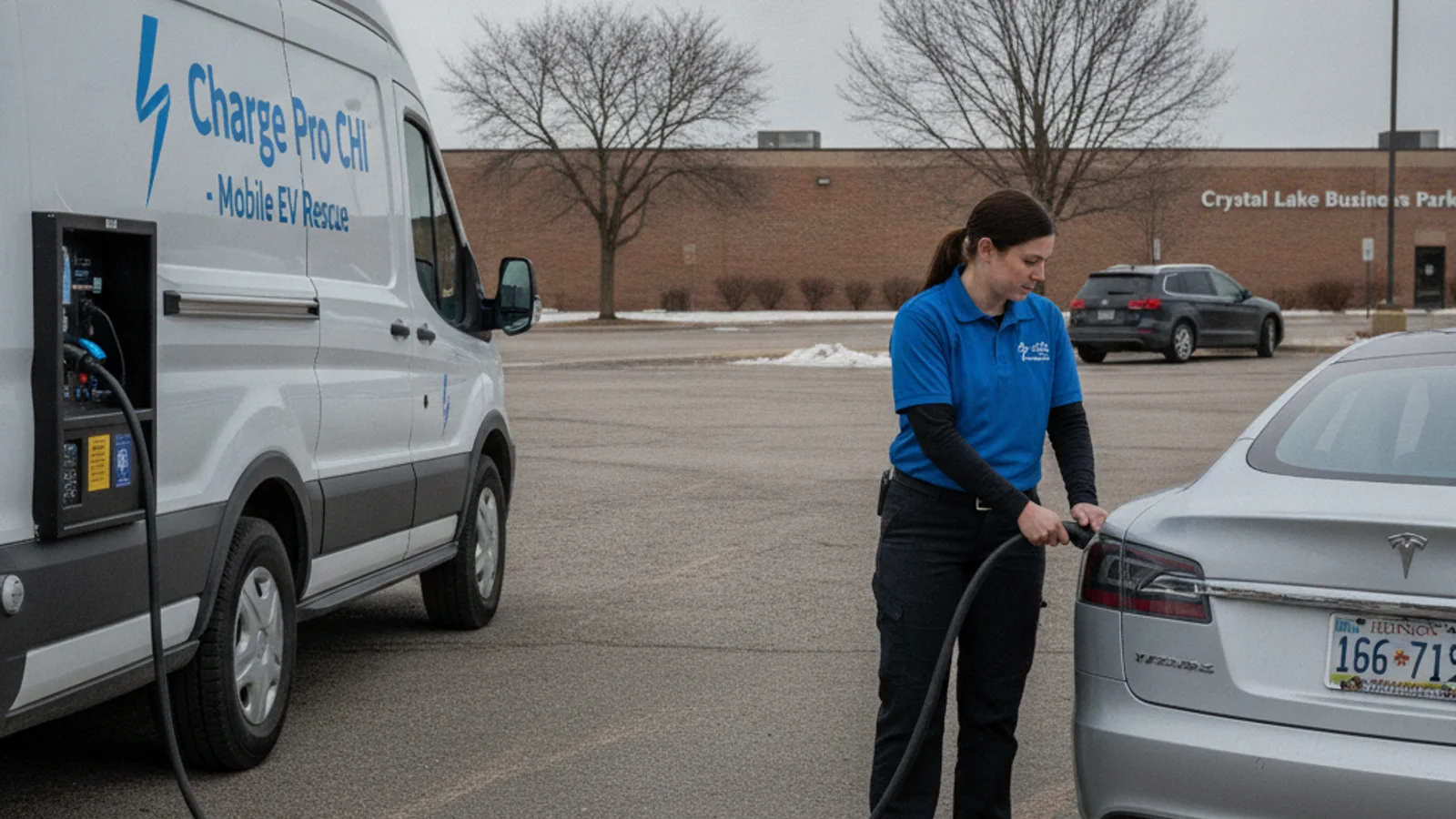
When your EV stalls in Crystal Lake, the day was already long. You were finishing a Chicago commute on US-14. Or you rolled off a far I-90 run and stopped short. EV roadside assistance in Crystal Lake is a local operator. They bring a 240V Level 2 source to the car. Charge Pro CHI matches you with that operator. We don’t own the truck, and we don’t set the price.
Crystal Lake is where the commute finally ends
Crystal Lake’s the largest city in McHenry County. Census figures put the population at 40,436. The 2024 city estimate sits at 41,513 people. The city covers 18.985 square miles in McHenry County. It sits at the outer edge of a comfortable Metra commute. The Union Pacific Northwest line is how a lot of workdays end. Then the car still has to get you the rest of the way home.
That’s the stall pattern on this last stretch. You sat downtown or by the lake longer than planned. Three Oaks Recreation Area holds people for hours on weekends. Downtown Crystal Lake does the same after dinner or a show. You start the car, and the estimated range looks thinner. ComEd still powers the house on these streets. It doesn’t help a pack that’s already empty.
The lakefront area and east Crystal Lake don’t drive the same way. Randall Road and Main Street carry the errand traffic. SR-31 and SR-176 cut through town as well. You’re not lost in open country out here. You’re in a real city that sits far from Chicago. That’s the whole point of this kind of call. Start with our Crystal Lake EV page if you want the local hub. This post’s the rescue version of that page.
US-14, Randall Road, and a far I-90 hangover
Northwest Highway, US-14, is the home stretch into town. Drivers coming northwest from closer-in suburbs ride it here. The dash can look fine until those last miles. Cabin heat on a McHenry County night pulls more than you budgeted. That’s not a defect in the car itself. That’s a long commute ending in Crystal Lake.
A lot of Crystal Lake drivers work closer in, then come home northwest. Range that looked fine at the office looks different at 6 p.m. Traffic on US-14 isn’t a mountain grade at all. It’s stop-and-go, cabin heat, and a long clock. That’s how a pack that should have made it doesn’t.
I-90, the Jane Addams, sits south of this city. A stall on that tollway is its own problem. We covered that in out of charge on I-90. Some drivers limp north and then stop in Crystal Lake. The operator still has to reach you here. Here’s where the metro starts to thin out. An operator sent to the exurbs is looking at a longer drive. Ask about timing when they quote the job. We don’t publish clocks, and we don’t guess them.
Randall Road’s the other long run through town. It ties this city to Algonquin and points south. A stall after grocery stops is common on that corridor. Main Street through downtown runs slower, with more parking that runs long. None of these roads need a story we can’t verify. They’re just the roads you were already on.
Empty pack, or a 12V that won’t wake the car
From the curb, two failures can look identical. The high-voltage pack may be empty after the drive. Or the 12V battery died and the car won’t wake. Teslas and most other EVs still use a small 12V. It runs computers, locks, lights, and the contactors. If that battery is dead, a healthy pack still sits unused.
A no-start with miles showing on the dash often means 12V. A charge-now warning that ran to zero often means the pack. If the car went dark with no warning, say that. Don’t guess the chemistry while you stand in the dark. The operator will check both systems on site.
Tesla, Hyundai, Ford, Chevy, Rivian, and Kia all stall here. The operator brings a native NACS plug for Tesla. CCS or J1772 adapters cover the non-Tesla EVs. You don’t need to name the adapter yourself. You need to name the make and the street.
What a mobile 240V boost actually does
Mobile EV charging means the operator brings 240V Level 2 to the car. They plug in right where you sit now. Typical charging time adds about 10 to 20 miles. That window is 15 to 30 minutes of charging. It’s charging time, not a promise about arrival. It’s usually enough to reach home or a public charger. It’s not a full pack by any means.
Charge Pro CHI’s a referral line, not a shop. We match stranded drivers with independent local operators. The operator quotes you before starting the job. They bill you directly after the work is done. We don’t employ the technicians who show up. We don’t own a fleet or a yard. The pros we connect you with handle Tesla and every major EV brand. They can also jump or replace a dead 12V on site.
For a Crystal Lake pin, that quote talk matters. You’re on the outer ring of the metro. The operator may be coming from closer-in McHenry County. They may be coming from farther south instead. Ask how the drive looks from where they are. Then take the quote, or wait on it. That’s honest out-of-charge recovery for this city.
If the 12V is the only problem, a jump may be the whole job. Sometimes the car then accepts a Level 2 feed. Sometimes the car only needed that small battery. Don’t book a flatbed until someone has checked both.
A boost versus a tow from the exurbs
A tow from Crystal Lake can mean a long flatbed ride. Many EVs need a flatbed, not a wheel-lift. A dead 12V makes loading harder, because the car may not roll. A mobile boost keeps the car on its own tires. You drive it once it has enough range.
Towing still has a place in this story. A real pack fault is a shop job. A crashed car or a frozen drivetrain is too. Rescue isn’t the same as a repair visit. If a jump and a 240V feed don’t wake it, stop. That’s a service center, not another roadside boost. For an empty pack after a US-14 commute, a boost is the first call.
Operators don’t set ComEd policy, and neither do we. The utility runs the grid in this city. That doesn’t move a car already sitting on Main Street. Home backup’s a different question for another day. If the house is the worry, read home battery backup in Crystal Lake. This page’s about the car in the street.
Algonquin, McHenry, Huntley, and the next town over
Crystal Lake doesn’t stall in isolation from its neighbors. Cary and Woodstock sit next door on the map. Algonquin, McHenry, and Huntley share the same outer-ring commute. A weekend by the lake can end in a dark lot. A long wait in the Metra lot downtown can do the same on a weeknight.
If you stopped just over the city line, say so. The operator still needs a clear pin drop. Downtown, the lakefront, east Crystal Lake, and Randall Road are all in play. ZIPs 60012, 60014, 60098, and 60156 cover the area. A cross street on US-14 or SR-31 is more useful than a ZIP. For the Algonquin version of this stall, see mobile EV rescue in Algonquin.
What to tell the operator, then call
Stay with the car if it’s safe to do so. Turn the hazards on, if the 12V still has enough to light them. Give the make, the model, and a cross street. Say whether the dash showed zero or a no-start. Say whether you’re on US-14, Randall Road, or a side street. Mention if you’re in a lot at Three Oaks or downtown.
If you’re in a lot, stay in the car and keep the pin accurate. If you’re on US-14, get as far off the travel lane as you can. Don’t stand behind the bumper in moving traffic.
Ask for the quote before anyone rolls out. Ask about timing, because this is a long-haul call. Charge Pro CHI will match you with a local operator. Call (858) 925-5546 and get that match. The operator quotes you before they start work. They bill you directly for the job. That’s the whole job from our side.