Tesla roadside assistance comes with a new Tesla for a set period and runs out after that. It covers some kinds of help but not all, and an empty high-voltage pack is the case it does not handle on its own in this metro.
What Tesla’s program covers
Tesla’s roadside program is a national dispatch service. When you call, the line routes you to a contracted tow and lockout vendor. That vendor can jump a dead 12-volt, swap a tire, deliver fuel for a gas car, or tow to a Tesla service center. Coverage is included on a new Tesla for a fixed term that depends on the model year and the package you bought.
The program does not publish hours as a customer promise. Dispatch depends on the vendor’s truck availability in your county. Cook, DuPage, Lake, Will, Kane and McHenry counties all have contracted coverage, but the wait is whatever the dispatch queue says when you call. Anyone who tells you the wait in advance is guessing.
What Tesla’s program does not cover
A Tesla on empty is the gap. The contracted vendor does not bring a Level 2 source or a DC fast charger to your car. They bring a flatbed. The tow moves the car to a charger or a service center. You still pay the tow miles and the time on the hook. A driver stuck on the shoulder of the Kennedy or in a downtown garage usually cannot drive a flatbed Tesla to a working charger without a second leg.
If the 12-volt is dead, the contracted vendor can sometimes jump it on site. That depends on the model and the technician. Newer Teslas use a lithium 12-volt, and the jump procedure is not the same as a gas car. The technician may say no and tow instead. Either way, the car leaves your curb on a flatbed.
What an empty pack actually needs here
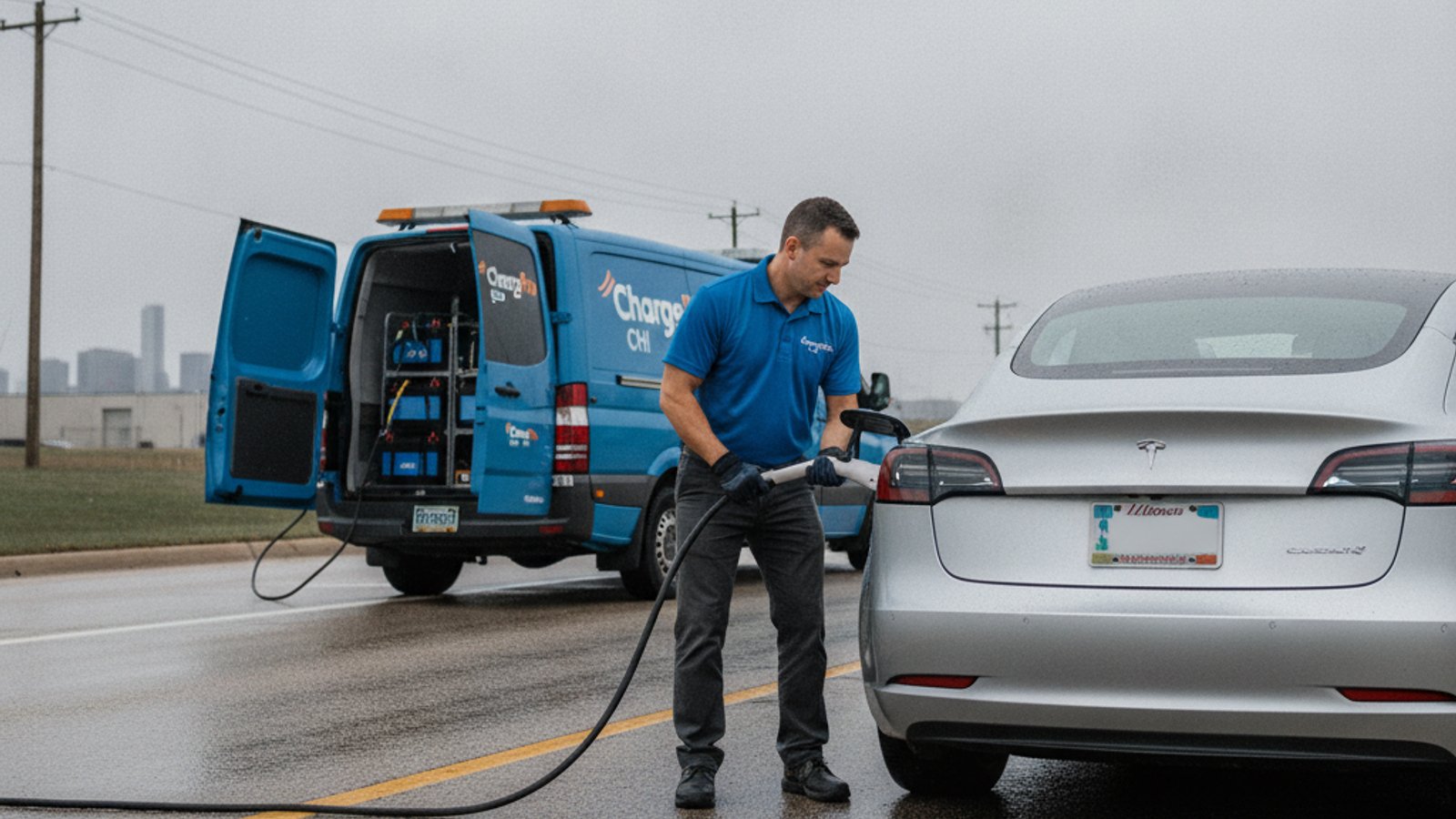
An empty pack needs a 240-volt Level 2 source brought to the car. The independent operator we connect you with carries a mobile Level 2 unit. The operator drives to your location, sets up at your bumper, and charges enough to get you to a working charger or home. The operator typically adds 10 to 20 miles of range in 15 to 30 minutes of charging. That is charging time, not an arrival promise.
A typical call is a Model Y that ran the pack down overnight on a Chicago street. The owner parked at 30 percent in Logan Square, the temperature dropped to single digits, and the morning started with a dead pack and a locked charge port. The contracted tow would flatbed the car. The local operator brings 240 volts and clears enough range to drive home in an hour or so.
When you would still call Tesla first
Call Tesla first if your car is in warranty work, if the dash shows a high-voltage fault, or if the pack will not accept any charge from any source. Those cases go to a service center, not to a roadside operator. The roadside number is on the Tesla app under Roadside.
If the screen shows a 12-volt warning, the door handles will not present, and the pack has plenty of charge, you are looking at a 12-volt issue. A local operator can often jump that 12-volt on site in this metro. The contracted tow may not have the right equipment for a lithium 12-volt.
How the local option works
The operator we send is an independent local business, not a Tesla employee. The operator quotes before any work starts and bills the driver directly. Charge Pro does not set the price. The operator brings NACS as the native plug for Teslas and CCS or J1772 adapters for non-Tesla EVs.
If you are stuck anywhere in Chicagoland, call (858) 925-5546 and we connect you with an operator who can quote the work. The operator decides whether to jump, replace a 12-volt, or bring a Level 2 truck for an empty pack. You stay in the driver’s seat of the decision.