A Kia Niro EV that won’t start on a Chicago street is usually a 12-volt issue, not a depleted high-voltage pack. The Niro uses a small 12-volt to wake the car and run the computers. A cold night pulls that 12-volt down and the car looks completely dead.
The two-battery layout the Niro uses
Every Niro EV in this metro carries two separate batteries. The high-voltage pack drives the motors and lives under the floor. The 12-volt wakes the car, locks the doors, and runs the contactors. A DC-DC converter recharges the 12-volt once the car is awake, but it cannot wake a dead 12-volt on its own.
The 12-volt sits under the hood in most Niro EV model years. A cold snap in Chicago, an Evanston street park, or a Berwyn apartment lot can drain the 12-volt over a long weekend. The owner comes back to a black dash and a silent start button. The pack can sit at 50 percent and the car still won’t move.
What to try before you call
Run through these checks in order. The goal is to confirm the 12-volt is the cause.
- Look for any sign of life when you press the start button. A click with no dash lights means the 12-volt is too weak. Total silence with no clicks usually means the same.
- Try the fob mechanical key to get into the car. The Niro hides a key blade in the fob for entry when the 12-volt is flat.
- Turn the headlights on with the car off. Dim or missing headlights point to the 12-volt, not the high-voltage pack.
- Open the hood and look at the 12-volt. A swollen case or a faint sulfur smell means the 12-volt has failed and needs replacement.
If you see them instead, your Niro has a high-voltage fault and needs a flatbed to a dealer service center. Don’t try to drive it.
What an on-site operator does here
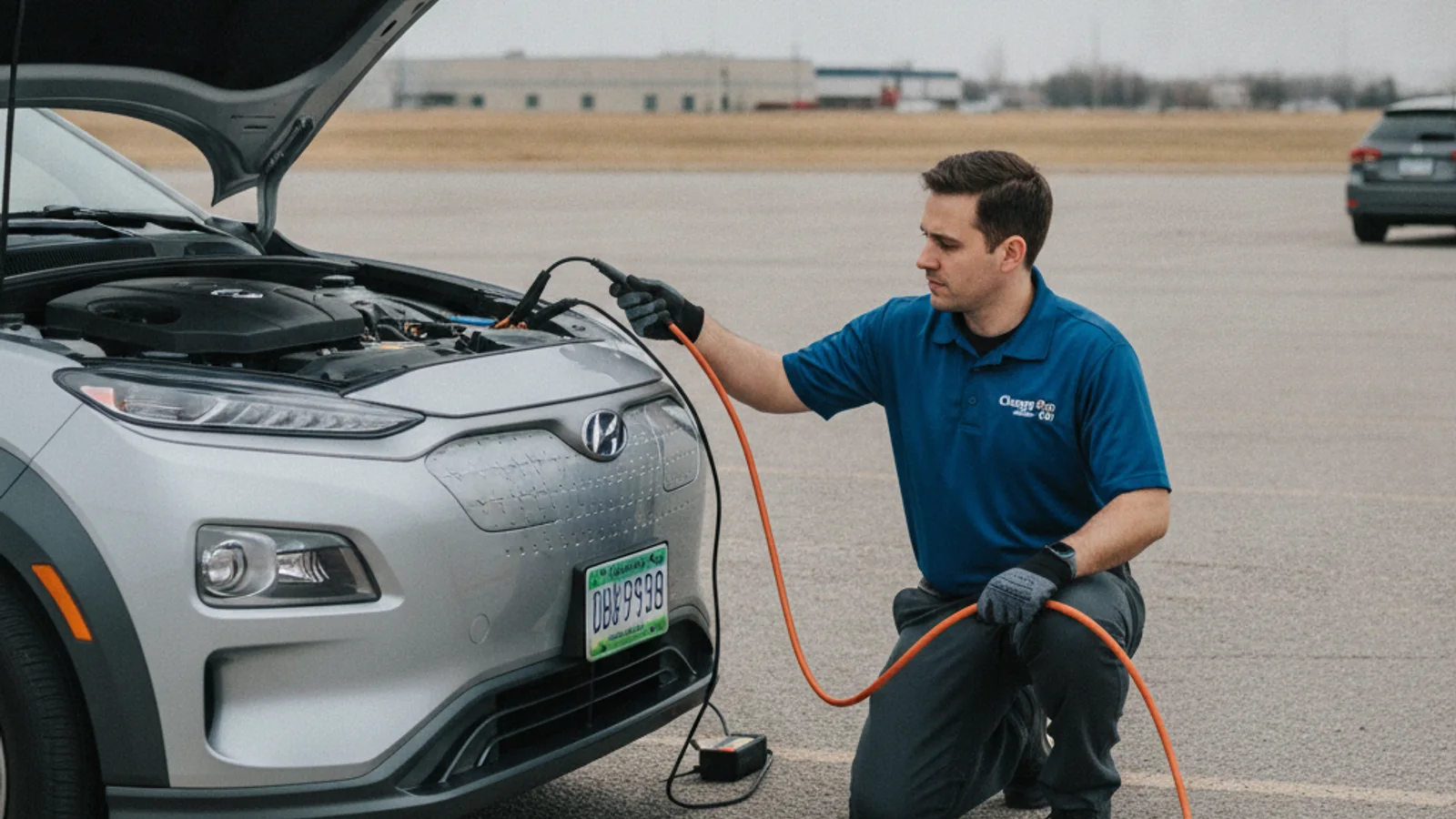
The independent operator we send brings a portable 12-volt booster and the correct under-hood jump points for a Niro EV. The booster wakes the car without the spiky voltage a gas-car jump can put on a lithium 12-volt. The operator clips on, lets the booster charge the 12-volt, and tries the start.
If the 12-volt is too far gone, the operator carries a replacement and swaps it on site. That returns the Niro to normal operation without a flatbed tow. The operator quotes before any work and bills the driver directly. Charge Pro does not set the price.
Where this hits in Chicagoland
Niro EV owners in Cicero and Berwyn sit at the sharp end of the no-home-charging pattern. Pre-1980 housing in Cicero is 90.2 percent. In Berwyn it is 90.0 percent. Most residents park on the street and have no way to keep the 12-volt warm through a Chicago winter. The same pattern shows up in Oak Lawn at 58.4 percent pre-1980 and in Chicago Heights at 74.3 percent.
If your Niro sits dead anywhere in Cook, DuPage, Lake, Will, Kane, or McHenry county, call (858) 925-5546. We connect you with an independent operator who can quote a 12-volt jump or replacement on site.