A Mercedes EQS that won’t wake may have a dead 12V that looks like a failed high-voltage pack. The big pack still holds energy. The contactors won’t close. The MBUX screen stays dark. Try these checks on the spot before you call for a flatbed or a dealer trip.
Why a dead 12V looks like a dead pack
The Mercedes EQS carries a small 12V battery that powers the computers, locks, contactors, and the MBUX screen. When that battery drops, the car refuses to wake. The high-voltage pack still has range. You just can’t reach it. A 12V that won’t close the contactors feels the same from outside as a failed pack.
Cold weather is the most common reason a 12V drops below what the EQS needs to start. January in Chicagoland has averaged a high of 31.6F and a low of 18.8F. The polar vortex of January 2019 sat at -23F at O’Hare on January 30. The January 2024 cold snap hit about -10F at O’Hare on January 14 and 15. Any EQS parked outside during those stretches loses 12V capacity.
Pre-1980 housing stock across most Chicago and inner suburbs runs 60% to 90%. Many EQS owners here don’t have a garage. They park outside and let the 12V drain overnight. The car looks fine in the morning. It just won’t start.
First checks on the spot
Before you dial the referral line, walk the easy steps. They cost nothing but a few minutes.
Unlock with the physical key. Mercedes hides a mechanical blade in the fob. Pop the cover near the door handle and slide the blade in. This wakes some EQSs even when the fob signal is dead.
Try the charge port door. If the door won’t open, that’s the 12V, not the pack. A frozen latch and a dead 12V feel the same from outside. Don’t yank a stuck cable. Don’t pour hot water on a frozen door.
Look at the MBUX screen or the Mercedes me app. If the app shows range and the car shows nothing, the 12V is the suspect. If the app shows zero range, the big pack is empty. Both jobs land on the operator we connect you with. They’re different visits.
If the high-voltage pack is truly empty, leave the car where it is. The operator brings a 240V Level 2 source. CCS handles the EQS on the high-voltage side. They quote before they start. They bill you directly.
What the operator we connect you with does
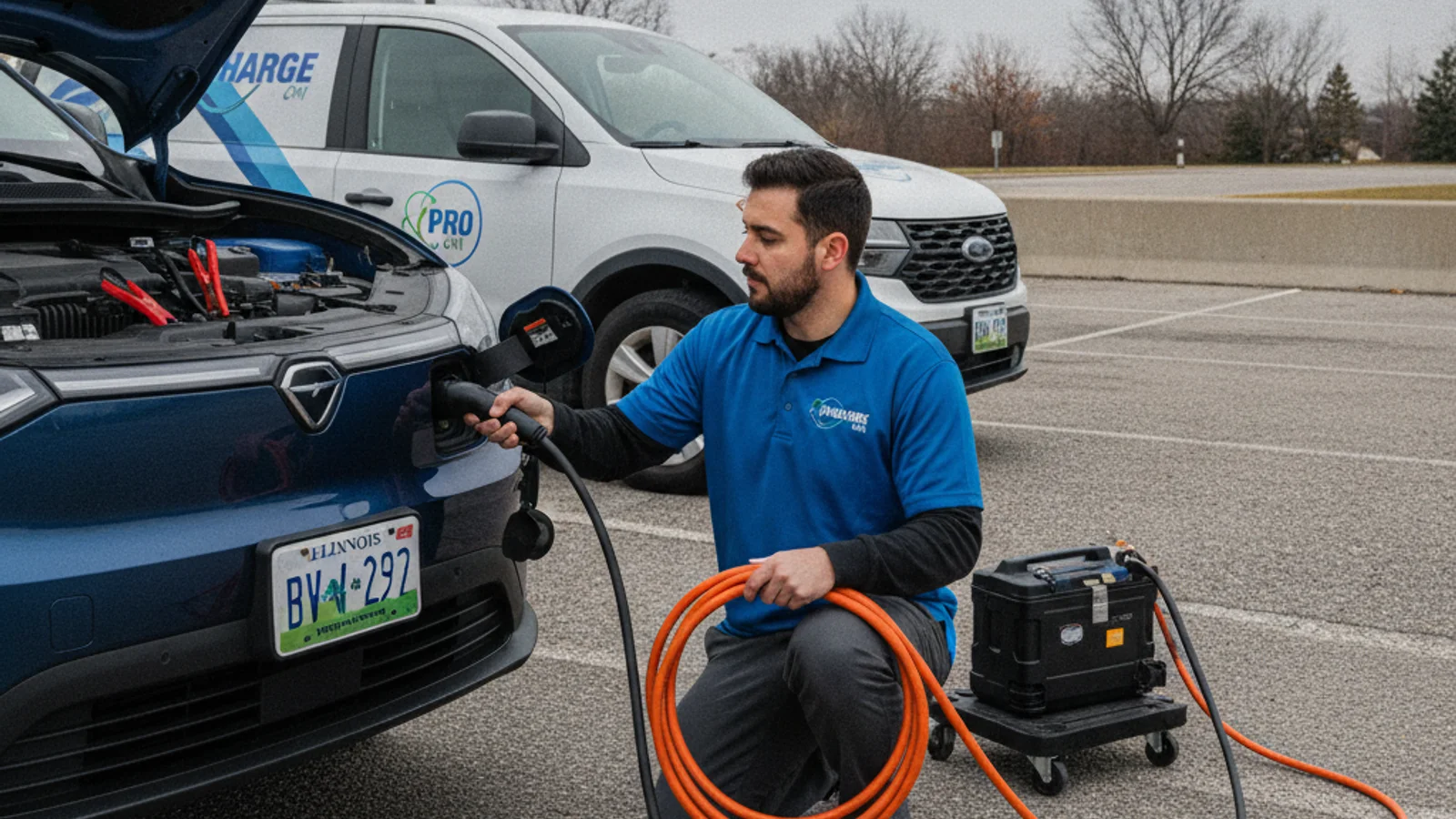
Charge Pro CHI is a referral line. We match you with independent local operators. The pros we send bring a 240V Level 2 source and a 12V jump kit. CCS handles the EQS on the high-voltage side. Jumper cables cover the small battery. Same visit, sometimes.
If the 12V is the only problem, the operator can swap it on site in many cases. If the big pack is the real problem, a boost takes 15 to 30 minutes and adds about 10 to 20 miles of range. That’s plug time, not a clock about when someone shows up. Use those miles to drive home or to a working charger.
We don’t publish hours. We don’t promise an arrival window. The operator tells you what they can do on the call. If you don’t like the quote, you don’t have to take the job.
Why a dealer visit isn’t always the right first move
A dealer visit costs a tow and a wait. Most dealer visits for a 12V problem result in a battery swap and an invoice. The tow alone can damage the underbody. The EQS sits low and has a long wheelbase. A wrong tow can cost more than the 12V.
A mobile 12V jump gets the car awake. Once awake, the car charges itself from the big pack as you drive. You drive to a service appointment or back to your garage. You don’t tow the car to learn what you could’ve learned in the driveway.
If the 12V drops again after a jump, that’s a real signal. The battery is at end of life. The operator may carry a replacement 12V for your model. They swap it on the spot. That saves the dealer visit.
Common EQS 12V locations and what to ask for
Ask the operator where your 12V sits before they dispatch. The Mercedes EQS has the 12V under the hood on the driver side. The owner’s manual walks through the jump points. Read your own copy. Don’t guess at a random terminal. The contactors live there. The wrong clip can damage them.
If you’ve replaced the 12V before, say so. AGM and lithium 12V packs in newer EQSs need different wake procedures. Old-style lead-acid 12V packs take a more standard jump. Tell the operator the year and what the dash did. That tells them which kit to bring.
If your fob won’t unlock the car, the fob battery is the simpler problem. A CR2032 coin cell swaps in. Fobs die in cold snaps too. That’s a $5 fix at a hardware store. Don’t confuse it with the car’s 12V.
Winter habits that keep the EQS starting
Precondition while still plugged in. The cabin warms from grid power, not the pack. Battery temperature moves with the cabin, not against it. A warm pack accepts charge faster when you do plug in.
Set a departure time in the Mercedes me app. The EQS wakes itself before you leave. It pulls from the wall, not from the 12V. A cold start at 7 a.m. is easier when the car warmed itself at 6:45.
Seat heat and steering wheel heat use less energy than cabin heat. On a 20F morning, those can keep you comfortable while the pack carries less load. Reserve cabin heat for the defrost cycle. Heat-pump EVs hold about 10% more range than resistive-heat EVs in the cold. Recurrent Auto puts cold-soak range at about 78 to 80% of rated range at 32F and about 70% at 20F with cabin heat on.
Don’t let the car sit for a week without driving. The 12V still drains from background systems. A short drive or a scheduled charge cycle tops it back up. A long sit plus a cold snap is how 12Vs die here.
What to do when the EQS won’t wake
Get the car to a safe spot if it still rolls. Hazards on. Don’t sit in a live lane.
Read the dash or the MBUX screen. Take a photo if you can. A dark screen with a pack that still shows miles is a 12V. A dead display with zero range is a pack. Both are jobs for an operator. They’re not the same visit.
Pin the map. Add the nearest cross street and the city. Northbrook, Hinsdale, Glenview, Barrington, or wherever the stall lands. A street name plus a landmark beats a vibe.
Call for the match when you’re ready. Stay with the car unless you need to get out for safety.
Hear the quote. 15 to 30 minutes of charging is typical. That usually adds about 10 to 20 miles. That clock is charging, not travel.
Frequently asked questions
Can a dead 12V look like a failed EQS pack?
Yes, from the outside. The car won’t wake. The screen stays dark. The contactors won’t close. The big pack still has energy. An operator tests the 12V first. If the 12V recovers, the car usually drives. If it doesn’t, the operator diagnoses further.
How do I know the 12V is the problem before calling?
Open the Mercedes me app on your phone. If the app still shows range and the car’s screens stay dark, the 12V is the suspect. If the app shows zero range too, the big pack is empty. Either way, an operator handles it on site.
Can the operator replace the EQS 12V on the spot?
Often yes. They carry common 12V sizes for the EQS. Tell them the year and any warnings you saw. They bring the right replacement. If the battery is special-order, they jump it so you can drive to a service appointment.
Will a jump hurt the EQS electronics?
No, if the operator uses the proper jump points and a regulated booster. Don’t let a stranger with a random jumper pack clip onto the wrong terminal. The contactors and computers don’t like reversed polarity. A trained operator works EVs every week.
When the EQS won’t wake and you’ve checked the easy steps, call Charge Pro CHI at (858) 925-5546. An independent operator quotes the work. You decide. They bill you directly.