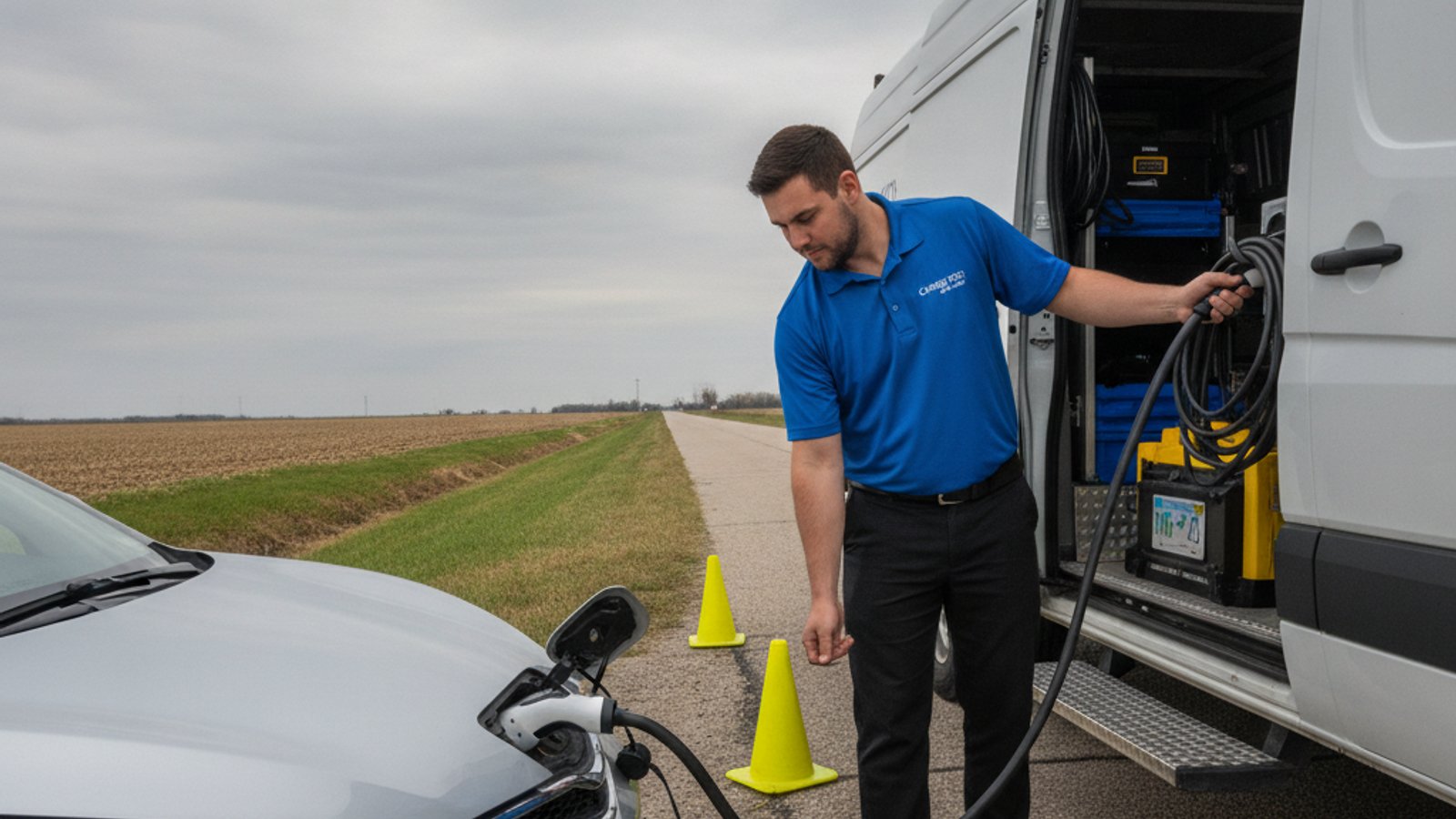
A mobile EV charger for roadside use is a 240V Level 2 source on a service truck. It brings energy to your car at the curb. Typical added range is about 10 to 20 miles. Typical charging time is 15 to 30 minutes. That clock is plug time, not a promise about when the truck arrives.
What a roadside mobile EV charger actually is
The truck is a service van with a generator and an EV charger. The generator makes AC power. The charger turns it into the kind of current an EV can drink. A native NACS plug handles Tesla. CCS or J1772 adapters handle non-Tesla EVs. That’s the kit.
It isn’t a DC fast charger. It isn’t a Supercharger. It doesn’t deliver 150 kW or 250 kW. It delivers Level 2 power, the same speed your garage wall box delivers. That gives the car a steady sip, not a gulp. It’s enough to add miles at the curb.
A typical mobile booster puts out between 6 kW and 19 kW depending on the truck and the cable. At that power, the car adds about 10 to 20 miles of range in 15 to 30 minutes. That’s enough for a slow crawl to the next charger, a run to home, or a way out of a parking lot.
What it adds in real Chicagoland weather
Cold cuts range. Heat cuts range. Headroom gets eaten on the highway. The numbers above assume a pack that’s already at the curb and a cabin that’s already cold. If you’ve been running heat for an hour, expect less.
Recurrent Auto puts cold-soak range at about 78 to 80% of rated range at 32F and about 70% at 20F with cabin heat on. AAA’s SAE J1634 work from 2019 showed about a 41% range drop at 20F with the heater on. AAA’s 2026 update shows about 39%. A boost in the same weather still gives the same energy, but your starting number is lower.
Wind off Lake Michigan eats range too. A run up the lake on I-94 or Lake Shore Drive hits headwind. Cabin heat on top of that cuts more. The truck adds the same number of miles either way. The math is just less forgiving when you start cold.
When a roadside mobile EV charger is the right tool
The right cases all look the same from outside. The car won’t roll. The dash is dark or showing zero. You need a sip of energy, not a full fill. The truck gives you that sip in the space you’re already in.
Empty pack in a parking lot is the cleanest case. You’re at the mall, the office, or a friend’s curb. You walked away from a full day and the pack wasn’t enough. The truck comes to the car. You don’t move the car.
12V no-start is a different case that often travels with the empty pack. The operator can jump the 12V on the same visit. That wakes the car so the boost can flow. A 12V-only stall doesn’t need a 240V boost. It needs the small battery handled.
Long-dwell parking after a gig, a shift, or a meeting is another common case. The car sat too long. Cabin climate and battery thermal management ate the pack. The truck adds what you need.
Commute stall on a tollway is the dangerous case. Get out of a live lane if the car will still roll. Hazards on. Tell the operator which expressway, which exit, and which direction. Shoulder safety is ordinary. Don’t sit in a live lane because the truck is on the way.
When a roadside mobile EV charger won’t help
A truck won’t help a car that won’t accept a charge. That happens with a damaged high-voltage system, a flooded pack, or a software lockout that the truck can’t clear. The truck can read the car’s state. The operator tells you on the call.
A truck won’t help a flat tire. A mobile EV charging truck isn’t a tire service. If your tire is flat, that’s a separate call. A wrong tire can be damaged further by the truck trying to move it.
A truck won’t help a locked key inside. That’s a locksmith call. An EV with a dead 12V may also have locked keys inside. The operator jumps the 12V first. The locks release. Then you grab your keys.
A truck won’t help a car on fire. Step away. Call 911. The truck won’t arrive while the car is burning. Once it’s safe and the fire is out, a tow handles the rest.
A truck won’t help if you need a real repair. The mobile charger adds energy. It doesn’t fix a broken module, a bad sensor, or a damaged inverter. The operator tells you when a job is a charge and when it is a repair. The repair goes to a shop.
Why a tow still leaves you with the same problem
A tow moves the car. It doesn’t add energy. After the tow, you still need a charger. The car still won’t drive without that charger. A boost leaves the car where it is and adds the energy to drive it. That saves the tow cost and the underbody damage.
Many EVs also need a flatbed so the drive units don’t drag. A wrong tow can damage the motor mounts or the underbody. The tow’s flatbed doesn’t add range. The mobile charger does.
How the call actually works
Call Charge Pro CHI. Tell the operator what the car is doing. Pack still shows miles, screens dark is a 12V. Pack at zero is a boost. Tell them make, model, and year. Tell them where you are, including the nearest cross street and the city. A street name plus a landmark beats a vibe.
The pros we send quote before they start. They bill you directly. If you don’t like the quote, you don’t have to take the job. We don’t promise an arrival window. We don’t publish hours.
They bring a 240V Level 2 source. They bring the right adapter. They bring a 12V jump kit. They tell you on the call what they can add and how long the plug will run.
What you can do before the truck arrives
Get the car out of traffic if it still rolls. Hazards on. Stay belted unless you’re in danger. Pin the map. Add the nearest cross street and the city.
Read the dash or the app. A dark screen with a pack that still shows miles is a 12V. A dead display with zero range is a pack. Take a photo if you can. That tells the operator which kit to bring.
Stay with the car unless you need to get out for safety. Don’t keep stabbing the start button. A weak 12V gets weaker with every press.
Frequently asked questions
How much range does a mobile EV charger actually add?
Typical added range is about 10 to 20 miles. Typical charging time is 15 to 30 minutes. The truck delivers Level 2 power, the same kind as a home wall box. The clock is plug time. It isn’t a clock about when the truck arrives.
Does a roadside mobile EV charger work on Tesla?
Yes. The truck carries a native NACS plug for Tesla. They use a CCS or J1772 adapter for non-Tesla EVs. The adapter is the operator’s problem. Your job is to name the car.
Is a mobile charger the same as a DC fast charger?
No. The truck delivers Level 2 power, not DC fast. It sips energy into the pack, the same speed as a garage wall box. A DC fast charger delivers 50 kW to 350 kW depending on the stall. The truck is for at-the-curb emergencies, not full top-offs.
What if the pack is fully empty?
A fully empty pack still takes a boost. The car needs a wake signal first. The operator handles that with the 12V jump. Once awake, the pack accepts the Level 2 charge. Plug time starts after the wake. It still adds the same 10 to 20 miles.
When you need the match, call Charge Pro CHI at (858) 925-5546. An independent operator quotes the work. You decide. They bill you directly.