St. Charles and Fox Valley home-charging towns still need a mobile boost when the EV pack is empty. A home battery backup is for the house. A mobile EV boost is for the car. They solve different problems. Most St. Charles drivers want both.
What a home battery backup actually does
A home battery backup is a stationary storage unit. It pairs with rooftop solar or charges from the grid. It powers part of the house during a grid outage. Refrigerators, lights, internet, and a few outlets keep running. Some units can also power an EV charger for a short window.
The size of the unit is in kilowatt-hours. A typical whole-home battery is 10 to 20 kWh. That’s enough to power essential loads for a day or two. It doesn’t replace the grid for long. It bridges you through an outage.
A home battery doesn’t charge your EV when the car is dead. The car needs the grid or a generator to take a charge. A 10 kWh battery might add a few miles to a Tesla. It isn’t a substitute for the wall box.
What a mobile EV boost actually does
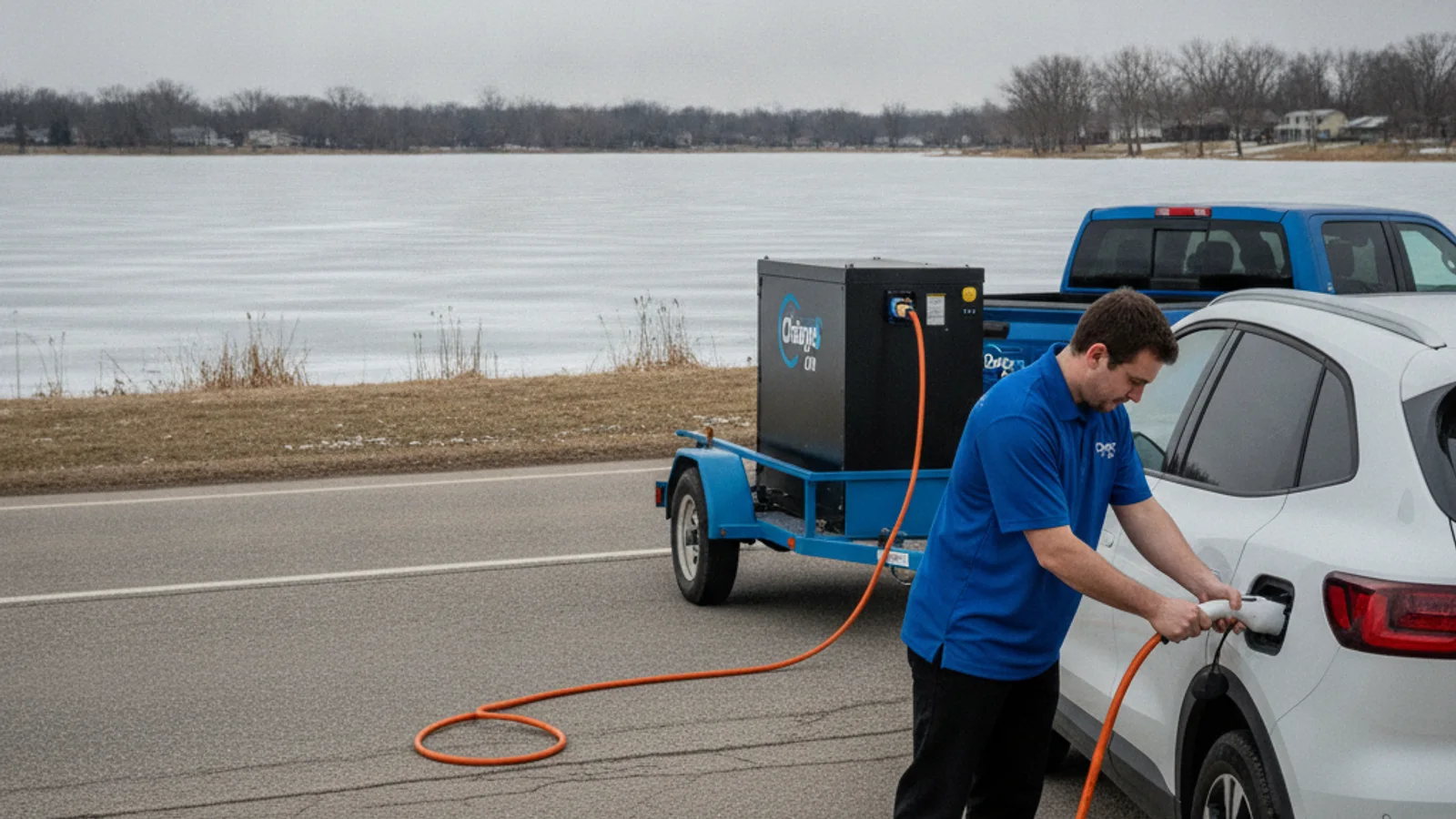
A mobile EV boost is a 240V Level 2 truck that comes to your car. The truck carries a generator and a charger. The generator makes AC power. The charger turns it into the kind of current an EV can drink. The cable reaches your car at the curb, in a parking lot, or on a shoulder.
Typical added range is about 10 to 20 miles. Typical charging time is 15 to 30 minutes. That’s plug time, not a clock about when the truck arrives. You use those miles to reach home, a charger you confirmed, or a service appointment.
A mobile boost doesn’t power your house. It doesn’t back up your fridge. It adds energy to your EV at the curb. It’s the right tool for a dead pack.
Why Fox Valley drivers stall more than the map suggests
St. Charles sits in the Fox Valley. The 2024 population is 33,482. Geneva and Batavia sit beside St. Charles. The housing stock skews newer than the south suburbs. Pre-1980 housing is moderate across the Fox Valley. Many residents already charge in the garage.
St. Charles, Geneva, and Batavia run their own municipal electric utilities. They aren’t on ComEd. That doesn’t change how an EV charges. It does mean time-of-use rates differ from ComEd’s.
January in Chicagoland has averaged a high of 31.6F and a low of 18.8F. The polar vortex of 2019 sat at -23F at O’Hare on January 30. The January 2024 cold snap hit about -10F at O’Hare on January 14 and 15. A car parked outside during those stretches loses range and 12V capacity.
A St. Charles driver thinks they’re covered. Many are, most nights. Then someone skips a plug after a late return. Morning is a brick in the driveway. That’s still a mobile call if you need to leave.
When a home battery is the right tool
A home battery is right for the house. A grid outage is the use case. A winter storm knocks out ComEd. The fridge runs. The sump pump runs. The Wi-Fi router runs. The car charger may run for a short window, but the car is full overnight anyway.
A home battery is right for solar owners who want backup. Solar without a battery doesn’t run at night. Solar with a battery runs through an outage. The math is house-level, not car-level.
A home battery is right for off-peak charging arbitrage on some utility tariffs. Charge the battery from the grid at off-peak. Discharge during peak hours. The math depends on your utility and your tariff. St. Charles, Geneva, and Batavia have their own municipal tariffs. We’re not going to invent a number for them.
When a mobile EV boost is the right tool
A mobile EV boost is right for a dead pack. You wake up to a brick in the driveway. You overslept and missed a plug. You stretched range to a meeting and the meeting ran long. The boost adds the miles to get home or to a charger.
A mobile boost is right for a 12V no-start. The pack still has range. The car won’t wake. The operator handles that on the same visit. The car drives once the 12V is awake.
A mobile boost is right for a tollway shoulder stall. The car stopped on I-88 or a local arterial. The truck reaches the shoulder. The car gets 10 to 20 miles. The driver pulls off the shoulder at the next exit.
What you do before either call
For a home battery backup, talk to your installer. Ask about size, transfer switch, and whether the unit powers your charger. Read your utility’s tariff. St. Charles, Geneva, and Batavia publish their own rates. Don’t plan around a number from a forum.
For a mobile EV boost, get the car out of traffic if it still rolls. Hazards on. Stay belted unless you’re in danger. Pin the map. Add the nearest cross street and the city.
Read the dash or the app. A dark screen with a pack that still shows miles is a 12V. A dead display with zero range is a pack. Take a photo if you can. That tells the operator which kit to bring.
How the call actually works
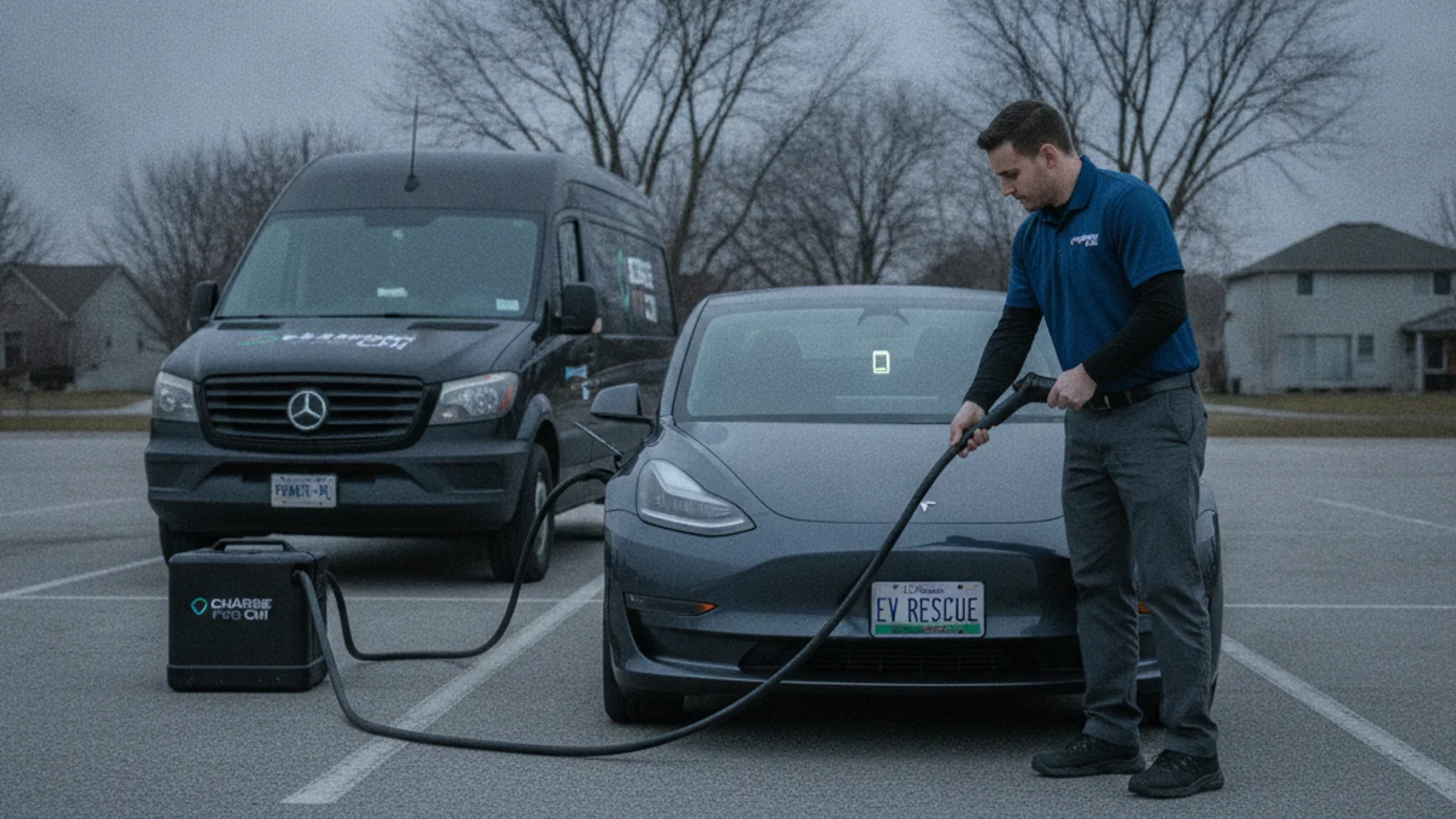
Charge Pro CHI is a referral line. We match you with independent local operators. The pros we send bring a 240V Level 2 source to your curb. They bring the 12V jump kit too. NACS handles Tesla. CCS or J1772 adapters handle non-Tesla EVs. Same visit, sometimes.
Tell the operator what the car is doing. Pack still shows miles, screens dark is a 12V. Pack at zero is a boost. Tell them make, model, and year. Tell them where you are, including the nearest cross street and the city.
The pros we send quote before they start. They bill you directly. If you don’t like the quote, you don’t have to take the job. We don’t promise an arrival window. We don’t publish hours.
Frequently asked questions
Can a home battery backup charge my EV?
It can, briefly. A 10 kWh battery might add a few miles to a Tesla. It isn’t a substitute for the wall box. The car needs grid or generator power to take a real charge. A home battery is for the house.
How much range does a mobile EV boost add?
Typical added range is about 10 to 20 miles. Typical charging time is 15 to 30 minutes. The truck delivers Level 2 power, the same as a home wall box. The clock is plug time. It isn’t a clock about when the truck arrives.
Should I get a home battery in St. Charles?
That depends on your house, your outage history, and your utility tariff. St. Charles runs its own municipal electric. Talk to your installer. Read your tariff. We’re not going to invent a payback period for you.
Does the mobile boost work on Tesla?
Yes. The truck carries a native NACS plug for Tesla. CCS or J1772 adapters handle non-Tesla EVs. The adapter is the operator’s problem. Your job is to name the car.
When you need the match in St. Charles, call Charge Pro CHI at (858) 925-5546. An independent operator quotes the work. You decide. They bill you directly.