A dead Tesla 12V in a Chicago winter sometimes takes a jump. Often it takes a replacement. Local operators carry both and quote before starting. The right call depends on how far gone the 12V is and what the car is doing.
When a jump is enough
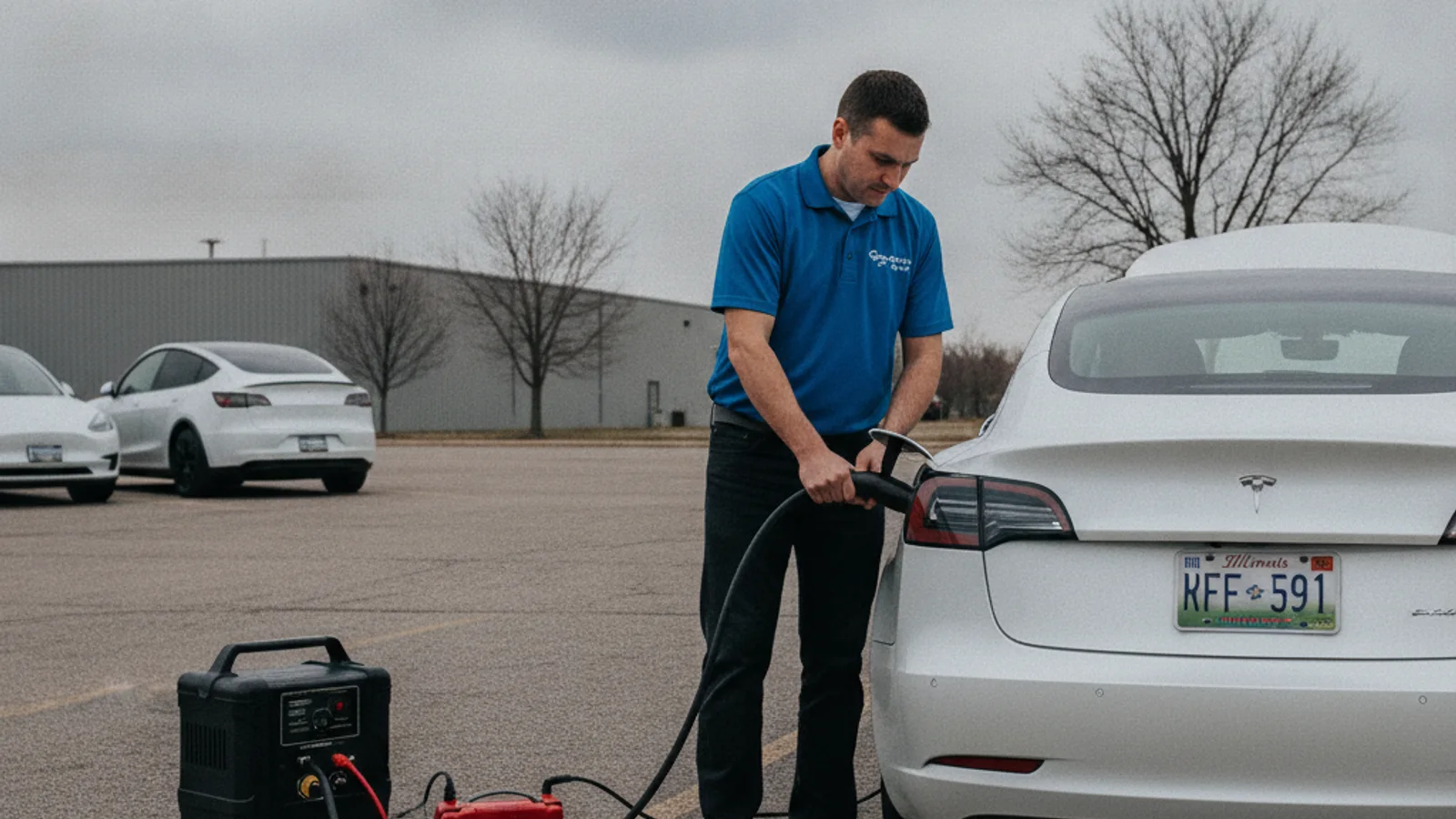
A jump is enough when the 12V still has some charge left and just needs a wake. The operator clips a portable 12V booster onto the under-hood jump points and lets the booster charge the 12V for a few minutes. The car wakes. The DC-DC converter recharges the 12V from the high-voltage pack. The car drives normally after that.
A jump is not enough when the 12V is below the recovery threshold. The cells inside have failed. The booster cannot revive a dead cell. The 12V takes a charge for a few seconds and then drops again. The operator tests the 12V with a multimeter before deciding.
When a replacement is the right call
A replacement is the right call when the 12V has failed internally. The operator carries a matching 12V in the truck and swaps it on site. The new 12V wakes the car. The DC-DC converter recharges it from the high-voltage pack. The car drives normally after that.
A replacement costs more than a jump. The operator quotes both before starting. The driver can take the cheaper option if the 12V is still alive. The driver takes the replacement if the 12V is dead.
What kind of 12V your Tesla uses
Older Teslas use a lead-acid 12V. Newer Teslas use a lithium 12V. The lithium 12V is lighter and lasts longer, but it has the same failure modes in extreme cold. The operator carries the right 12V for the model year. A Model 3 built before 2021 takes lead-acid. A Model 3 built after 2021 takes lithium.
A lithium 12V takes a different jump procedure than a lead-acid 12V. The voltage and current limits are tighter. The operator uses a booster matched to the lithium chemistry. The wrong booster can damage the cells.
Where this hits in the metro
The Chicago cold is the trigger. January average high is 31.6F and average low is 18.8F. The polar vortex of January 2019 sat at -23F at O’Hare. The January 2024 cold snap hit about -10F at O’Hare. A Tesla parked outside through those stretches loses 12V capacity.
Street-parking towns are the worst case. Berwyn pre-1980 housing is 90 percent. Cicero is 90.2 percent. Oak Park is 78.6 percent. Most residents park on the street. The 12V sits in the cold for hours.
If your Tesla is dead anywhere in Cook, DuPage, Lake, Will, Kane, or McHenry county, call (858) 925-5546. We connect you with an independent operator who can quote a 12V jump or replacement on site.