A Tesla that looks completely dead in Chicagoland winter is almost always the 12-volt battery, not the traction pack. The big pack under the floor is what moves the wheels. The small 12V wakes every computer, latch, and screen. When that small battery flattens, the car looks bricked. The traction pack can still be full.
Why a cold street car still flattens the 12V first
Lead-acid and lithium 12V batteries both lose punch below freezing. A January night on a Chicago block or in an older Oak Park garage drives that loss harder than a Naperville attached bay. Recurrent Auto data shows an EV holds about 78 to 80 percent of rated range at 32F, and closer to 70 percent at 20F with cabin heat running. A weak 12V can’t run the heater, the Sentry cameras, or the wake cycles without help from a charger.
January 2024 dipped to about -10F at O’Hare on the 14th and 15th. Some suburban Superchargers wouldn’t accept a charge from cold packs that day, which is a separate problem from a flat 12V. Two different systems, two different symptoms.
Tell a dark car from a low pack
Run this check before you book anything.
- Black screen, no app response, handles won’t present: start with the 12V.
- Dim cabin lights or flickering interior lamps: still the 12V.
- Doors work and the display warns about range: that’s the high-voltage pack.
- Car wakes, shifts, then dies again: a 12V that needs replacement, not a pack.
When the traction pack is empty, the car still talks to you. You see a warning. You read a number. When the 12V is gone, the car looks asleep. The airport-lot lockout is the classic version of that.
What the 12V actually powers
The high-voltage traction pack runs the motors. Computers, cameras, latches, and the touchscreen run on 12V. The contactors that connect the traction pack close on 12V power. No 12V, no contactor close, no drive. That’s the chain that keeps the car from waking itself.
A DC-DC converter charges the 12V from the traction pack while you drive or plug in. While the car is parked, the small battery carries the entire background load. That load includes the radios that talk to the Tesla app. A weak 12V can sag under that sit even with a full pack.
Cold weather reality for the Chicago area
January average high here is 31.6F. Average low is 18.8F. Annual snowfall is 38.4 inches. NOAA and NWS Chicago publish those 1991 to 2020 normals. A Model 3 or Y left at O’Hare for a week lives on the 12V that whole time. A Model S on a Waukegan street during a January cold snap is in the same boat. The chemistry of the 12V changes between models, but the cold doesn’t.
The U.S. Department of Energy has a plain overview of how electric vehicles work. It describes this split without naming one brand.
What a local operator does for the 12V
The operators we connect you with jump or replace a dead 12V on site. They confirm the model, the year, and the chemistry before they touch anything. Lead-acid and lithium 12V packs aren’t jumped the same way. A wrong clamp can damage body modules.
A jump wakes the car. It doesn’t rebuild a battery at the end of its life. If the Tesla goes dark again the next morning, that’s a replacement talk with the operator, not a third jump.
What a local operator does for an empty pack
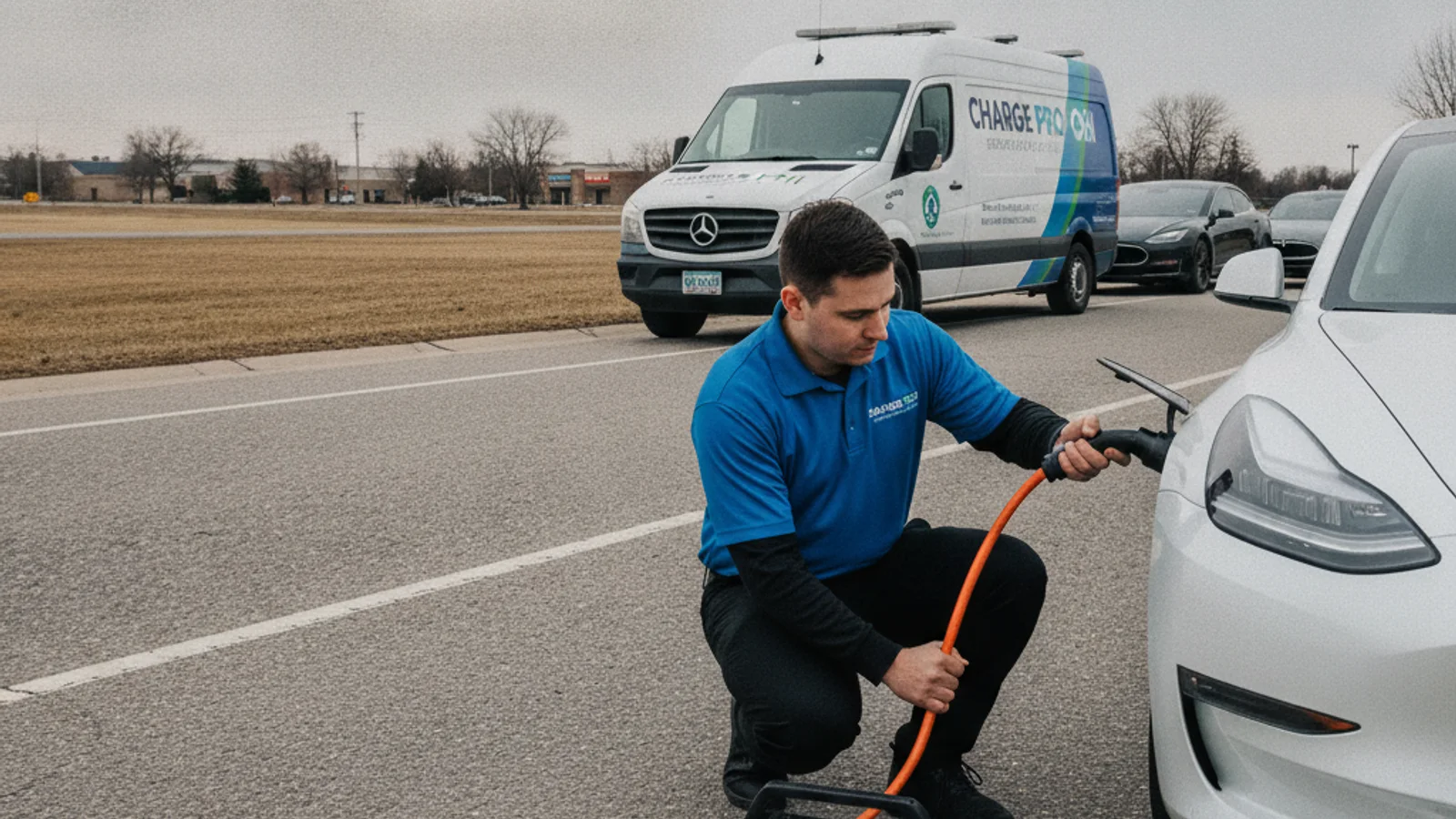
Independent operators we send bring a 240-volt Level 2 source to the car. Tesla gets a native NACS plug. Other brands use a CCS or J1772 adapter. That typically adds 10 to 20 miles of range in 15 to 30 minutes of charging. That’s charging time, never a promise of when someone arrives.
That range is often enough to reach a home wall connector or a Supercharger. It’s a different tool from a flatbed. If the issue is a flat 12V, the operator jumps it. If the issue is an empty pack, the operator brings a 240V truck.
Don’t copy a procedure from the wrong year
A driveway workaround for one year can be wrong on another. Tesla made mid-production changes to the 12V layout. Use your owner’s manual for that exact car. Tesla’s current service documentation is the second reference. Both outrank a forum post, including this one.
If you’re unsure which chemistry you have, say that when you request help. A guess is worse than a blank.
How we connect you with help
Charge Pro CHI connects Chicagoland drivers with independent local operators. We don’t own trucks. We don’t hold a trade license. We don’t employ technicians. We don’t set prices, and we don’t promise when someone arrives. The operator quotes you before starting and bills you directly.
We serve Chicagoland. That includes Chicago, Evanston, Naperville, Schaumburg, and the other cities and communities on this network.
When to make the call
Call when the Tesla is dark and the last range reading looked fine. That mismatch usually points at the 12V system, not an empty pack.
Call Charge Pro CHI at (858) 925-5546. We’ll match you with a local operator who handles Tesla and every major EV brand. They quote before they start.