A Tesla Model 3 keeps two batteries in two different places. The high-voltage traction pack sits under the floor, between the front and rear wheels. The 12-volt battery sits in the front trunk, under the carpet and a foam pad. You need the 12V location in a tight downtown garage or on a shoulder where a flatbed has no room to drop the ramp.
Two systems, two jobs
The traction pack moves the wheels. It runs at several hundred volts. The motors need that level of supply. The 12V battery wakes every computer, latch, camera, and the touchscreen. Without 12V power, the contactors that connect the high-voltage pack never close. The car stays inert.
This isn’t a Tesla quirk. Nearly every production EV keeps a low-voltage battery beside the traction pack. The U.S. Department of Energy has a plain overview of how electric vehicles work. It describes this split without naming one brand.
Where the 12V lives in a Model 3
The 12V battery is in the front trunk, also called the frunk. Open the hood. Lift the carpet and the foam insert. You’ll see a small lead-acid or lithium 12V battery with red and black terminals. The positive post has a red cover. The negative is black.
If the frunk won’t open because the 12V is dead, the car gives you an alternative path. There’s a small rectangular cover on the front bumper, on the driver’s side lower corner. Pry it at the notch. You’ll see a red positive post and a chassis ground nearby. Use those bumper posts to jump the car.
Don’t copy a procedure from a different year. Tesla made mid-production changes. Newer Model 3 cars may use a lithium 12V, not lead-acid. The jump points still matter, and the chemistry still hates a long cold sit.
Where the traction pack sits
The traction pack is under the floor. It’s a long rectangular unit bolted to the chassis between the front and rear wheels. You don’t open it for a roadside call. You don’t open it for a jump. You open it at a service center, with the high-voltage system safely de-energized by a trained technician.
What matters for a stall is what that pack can and can’t do. If the pack is empty, the car still wakes. You see a range warning. A 240V boost can add miles. If the 12V is dead, the car looks asleep. A jump is the right answer.
Tell the two apart before you book
Run this check before you decide which truck to send.
- Black screen, no app response, handles won’t present: 12V.
- Doors work and the display warns about range: traction pack.
- Car wakes, then dies again right away: a 12V that needs replacement.
Two different systems, two different trucks. A jump on the 12V doesn’t refill the big pack. A 240V boost doesn’t wake a dead 12V.
Cold weather reality for Chicago area drivers
January average high here is 31.6F. Average low is 18.8F. Annual snowfall is 38.4 inches. NOAA and NWS Chicago publish those 1991 to 2020 normals. A Model 3 on a Chicago block or in an older Oak Park garage sees more cold than one in a Huntley attached bay.
Recurrent Auto data shows an EV holds about 78 to 80 percent of rated range at 32F, and closer to 70 percent at 20F with cabin heat running. The traction pack can hold less, and the 12V can sag more. Both drop together on a cold night.
What a local operator does
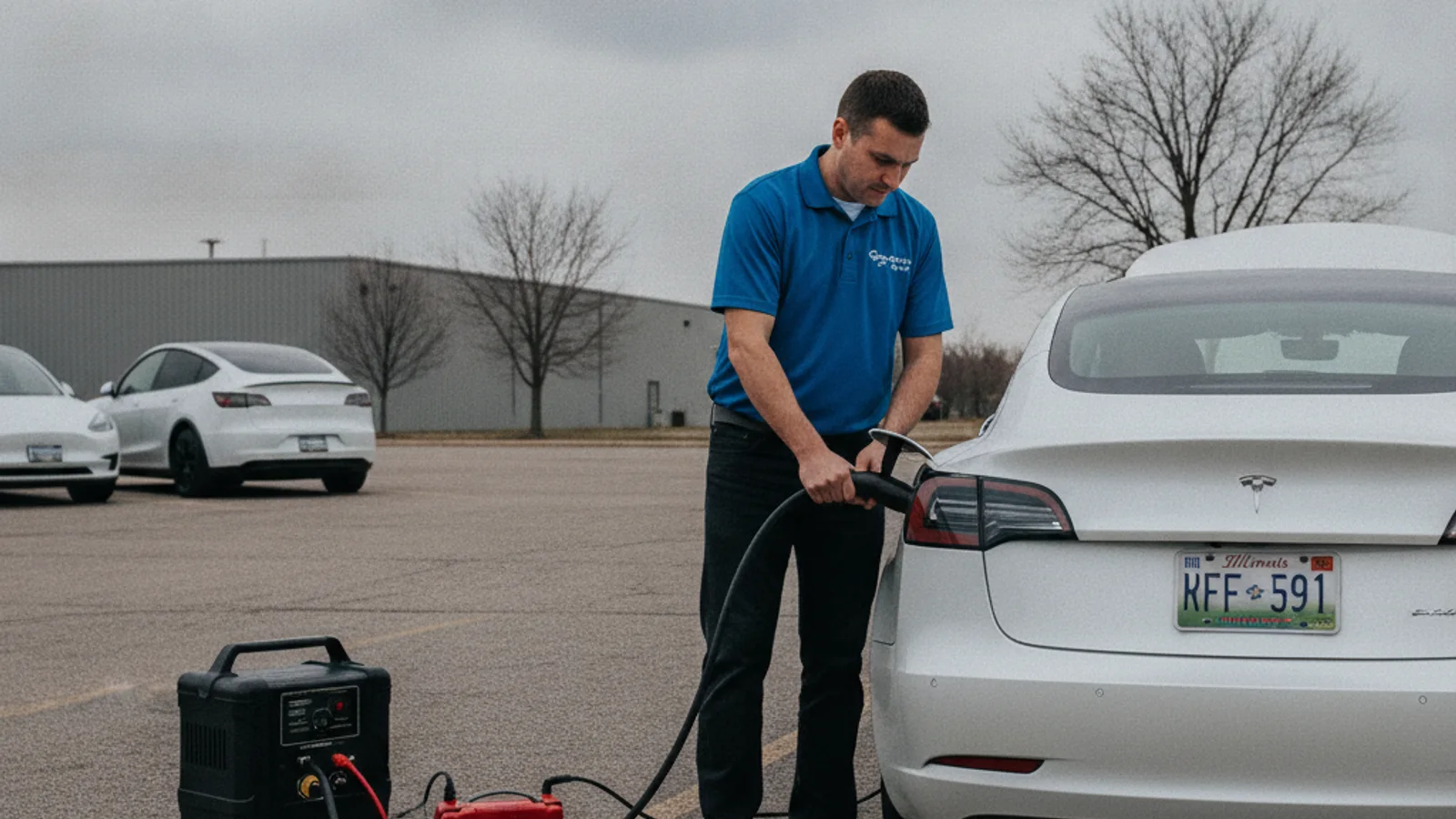
The operators we connect you with jump or replace a dead 12V on site. They confirm the model, the year, and the chemistry before they touch anything. A wrong clamp can damage body modules. They also bring a 240-volt Level 2 source when the traction pack is low. Tesla gets a native NACS plug. That typically adds 10 to 20 miles of range in 15 to 30 minutes of charging. That’s charging time, never an arrival promise.
Charge Pro CHI connects Chicagoland drivers with independent local operators. We don’t own trucks. We don’t hold a trade license. We don’t employ technicians. We don’t set prices, and we don’t promise when someone arrives. The operator quotes you before starting and bills you directly.
How we serve the network
We serve 49 cities and communities across 8 regions. That includes Chicago, Evanston, Naperville, Schaumburg, Joliet, Aurora, Waukegan, and the other cities on this network. Coverage spans Chicago and the Lakefront, the North Shore and Lake County, the Northwest Suburbs, the West Suburbs and DuPage, the Fox Valley and the Far West, the Southwest Suburbs and Will County, the South Suburbs, and McHenry County and the Exurbs.
When to make the call
Call when the Model 3 is dark and the last range reading looked fine. Call when the car wakes, the pack is low, and you want a 240V boost quoted on the spot.
Call Charge Pro CHI at (858) 925-5546. We’ll match you with a local operator who handles Tesla and every major EV brand. They quote before they start.