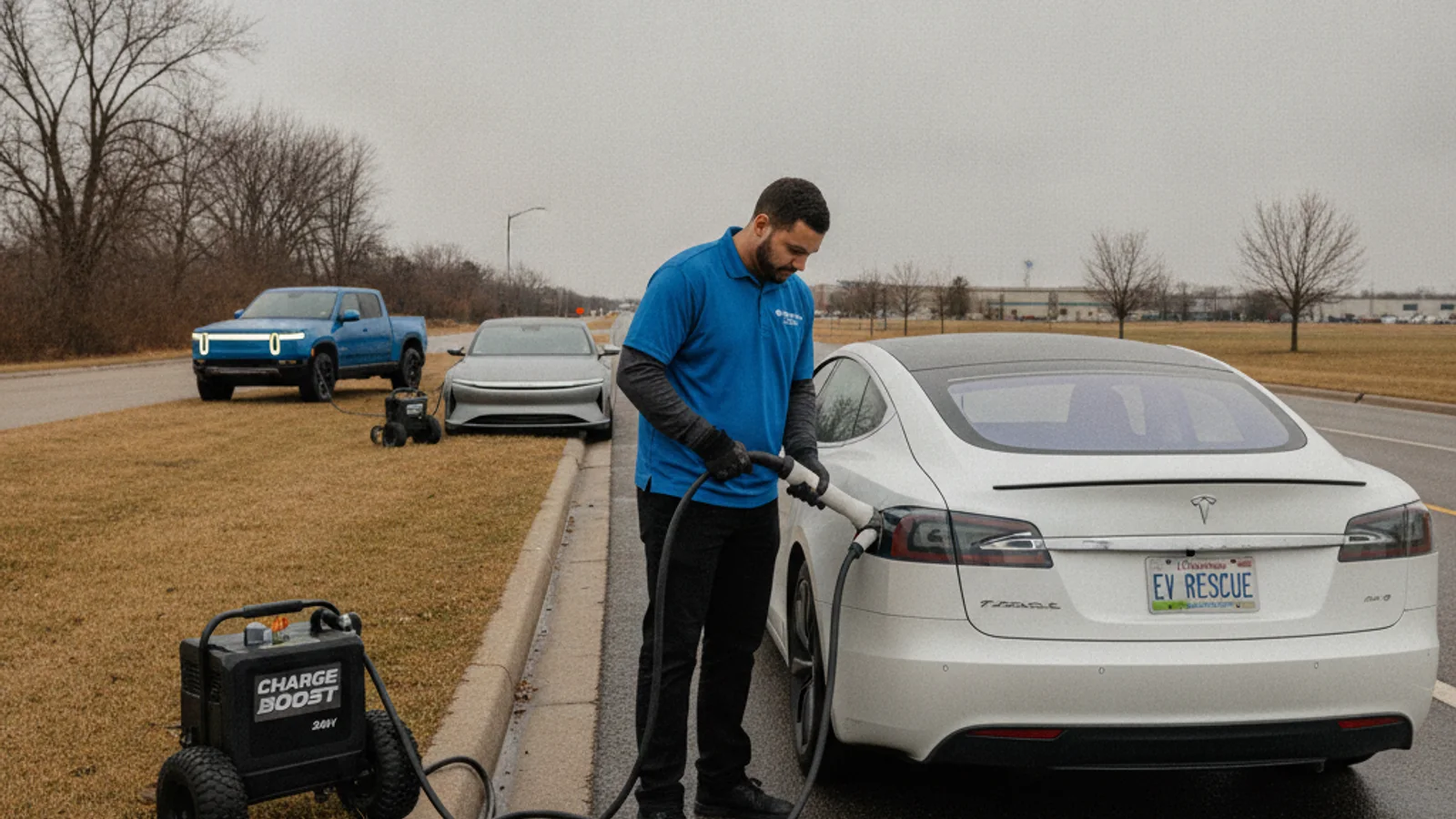
Tesla, Rivian, and Lucid each run their own national roadside program. Each dispatches a contracted tow vendor. None of them brings a Level 2 truck, so an empty pack on a Chicagoland shoulder still needs a local mobile boost.
What the three OEM programs cover
Tesla’s program runs through the Tesla app and a national dispatch line. Coverage is included on a new Tesla for a set period and runs out after that. Rivian runs a similar setup through its app and an in-car button. Lucid runs the same model. Each program handles 12V jumps, tire swaps, lockouts, and tows to the OEM service network. None of them bring a mobile Level 2 source.
Each vendor charges the OEM for the included work. A driver with active coverage pays nothing for a covered tow up to the published distance. Past that distance the driver pays the per-mile fee. The vendor does not bring a Level 2 truck in any of the three programs.
What the three programs do not cover
An empty high-voltage pack is the gap in all three. The contracted vendor brings a flatbed. The car moves to a charger or a service center. The driver pays the tow miles. The destination charger has to be open and compatible. The driver still needs a plan after the drop.
A dead 12V is sometimes handled on site by the contracted vendor and sometimes flatbedded. Newer Rivians and Lucids use lithium 12-volts that need a careful jump. A vendor technician may say no and tow instead. Either way, the car leaves your curb on a flatbed.
How a local 240V boost fits
The independent operator we connect you with brings a 240V Level 2 truck. The operator carries NACS for Teslas, CCS for most other EVs, and J1772 adapters where needed. The operator typically adds 10 to 20 miles of range in 15 to 30 minutes of charging. That is charging time, not an arrival promise.
A typical call is a Rivian R1T on the Jane Addams shoulder with 4 percent and a cold pack. The Rivian app routes a tow. The local operator pulls up, opens the charge port with a 12V jump, and starts a 240V charge. The operator quotes before any work starts and bills the driver directly. Charge Pro does not set the price.
Where this hits in the metro
The Jane Addams (I-90), the Reagan (I-88), the Tri-State (I-294), and the Veterans (I-355) are the tollway corridors where premium EVs strand most. A weekend drive to Galena or a work commute from St. Charles is the typical pattern. The Tri-State through the northern suburbs runs in construction with limited shoulder, so a stranded car blocks traffic.
If you are stuck anywhere in Chicagoland in a Tesla, Rivian, Lucid, or any other EV, call (858) 925-5546. We connect you with an independent operator who can quote the work, bring a Level 2 truck, and clear the empty pack on site. The operator bills you directly.