Tesla’s phone and app paths both reach a dispatcher. Neither path is a 240V truck, so empty-pack calls still go local. Here’s how each path actually works, and what to do when neither offers a charge.
What the app path actually does
The Tesla app ties to the car’s VIN. The request goes through Tesla’s own system, which routes to a provider in their network. For a flat tire, a lockout, or a tow to a service center, that path works.
For an empty traction pack, the app may not include a 240V boost. We couldn’t confirm a current, complete list of every request Tesla accepts. Tesla’s app and Tesla’s own support pages are the sources that count. Read the terms shown for your VIN and location before you submit a request.
Coverage also isn’t the same as cost. We couldn’t confirm that Tesla pays for every request, every suburb, or every type of work. Ask who bills you if the displayed terms skip a Level 2 boost.
What the phone path actually does
The Tesla support line also reaches a dispatcher. The dispatcher routes through Tesla’s network. The provider they send is the same kind of truck the app would dispatch. The path is different, but the work is the same.
Have a precise location ready before you tap submit or dial. On I-90 isn’t enough. Note the Jane Addams or Kennedy name, the direction, the nearest exit, and whether you’re in a lane, on a shoulder, in a garage, or in a lot. In Elk Grove Village or Hoffman Estates, a building name and a lot letter beat a street number.
Take screenshots of the request and any confirmation. Save the provider name, the terms, and the next step shown on your screen. If the request stalls or disappears, go back to Tesla’s current official support channel.
Why neither path is a 240V truck
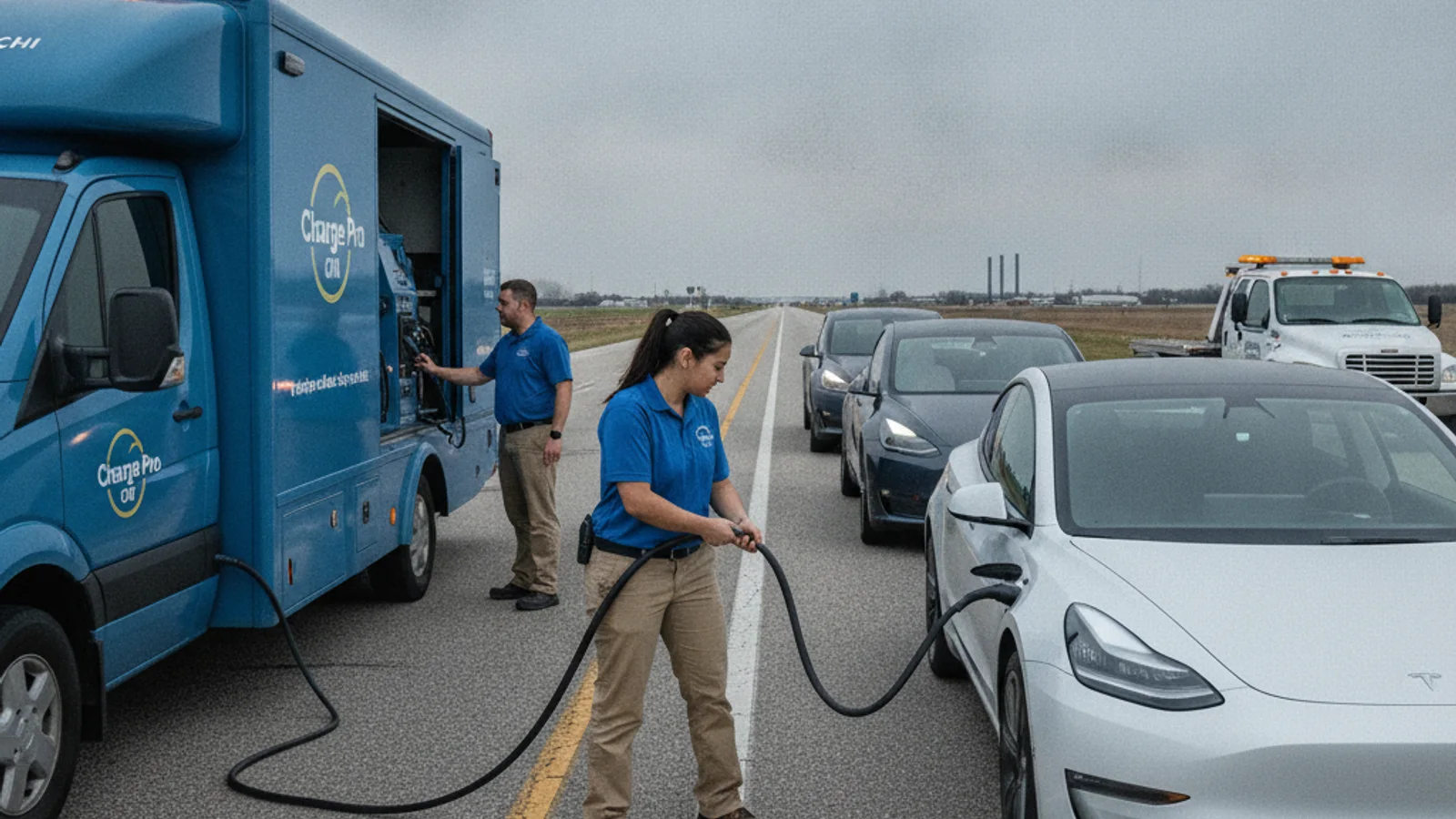
Tesla’s network is built for tires, lockouts, and tows. A 240V boost is a different truck, with different gear. Independent local operators we connect you with bring a 240-volt Level 2 source to the car. Tesla gets a native NACS plug. That typically adds 10 to 20 miles of range in 15 to 30 minutes of charging. That’s charging time, never an arrival promise.
Charge Pro CHI connects Chicagoland drivers with independent local operators. We don’t own trucks. We don’t hold a trade license. We don’t employ technicians. We don’t set prices, and we don’t promise when someone arrives. The operator quotes you before starting and bills you directly.
Run this check before you dial
- Tire shredded, screens on, pack has range: tire job.
- Screens on, pack low, no visible tire damage: 240V boost.
- Black screen, no app response, handles won’t present: 12V.
- Car wakes, then dies again right away: 12V that needs replacement.
- Display shows collision, smoke, or visible damage: 911 first, then Tesla.
Two different systems, two different trucks. A 240V boost on a shredded tire doesn’t help. A plug on an empty pack doesn’t add miles.
When the answer is both
A Model Y with a flat and a low pack on the Reagan needs both jobs. The provider handles the tire first, then the operator handles the pack. They may not be the same truck. Don’t expect one provider to do both.
If the car can’t move, the tire job is the first priority. A boost can’t happen on a car sitting on a flat. Once the tire is swapped or plugged, the operator can run a 240V cable.
Cold weather reality for the Chicago area
January average high here is 31.6F. Average low is 18.8F. Annual snowfall is 38.4 inches. Those NOAA and NWS Chicago numbers are 1991 to 2020 normals. January 2024 dipped to about -10F at O’Hare on the 14th and 15th. Some suburban Superchargers wouldn’t accept a charge from cold packs that day.
Recurrent Auto data shows an EV holds about 78 to 80 percent of rated range at 32F, and closer to 70 percent at 20F with cabin heat running. The traction pack holds less. The 12V sags more. Both drop together on a cold night.
IDOT’s Emergency Traffic Patrol, called the Minutemen, covers the major Chicago expressways. Dial *999. They help stalls, debris, and tires. They don’t publish EV charging.
Illinois Tollway H.E.L.P. patrols the tollways Monday to Friday from 4:00 a.m. to 8:00 p.m. They list 12V boosts, not EV charging. A stranded Tesla on I-90, I-88, or I-294 can call *999 for the patrol.
What you tell the operator
State whether the screens are active, whether the car shifts into gear, and what message is on the display. Mention visible tire damage, smoke, unusual heat, collision damage, or a blocked traffic lane. Don’t open electrical covers or try repairs beside moving traffic.
The U.S. Department of Energy has a plain overview of how electric vehicles work. It describes this split without naming one brand.
How we serve the network
We serve 49 cities and communities across 8 regions. That includes Chicago, Evanston, Naperville, Schaumburg, Joliet, Aurora, Waukegan, and the other cities on this network. Coverage spans Chicago and the Lakefront, the North Shore and Lake County, the Northwest Suburbs, the West Suburbs and DuPage, the Fox Valley and the Far West, the Southwest Suburbs and Will County, the South Suburbs, and McHenry County and the Exurbs.
When to make the call
Call Tesla first through the app or the support line. Call Charge Pro CHI if the miss is range and you need a 240V boost on site.
Call (858) 925-5546 and we’ll match you with a local operator who handles Tesla and every major EV brand. They quote before they start.