Slush and road salt get into a charge port. Frozen water locks the latch. Local operators thaw the port without damage and get the cable released. Don’t yank the cable. Don’t pour hot water. Here’s what to do instead.
Why charge ports freeze
The charge port sits behind a powered door on the side or rear of the car. Water from lake-effect snow, freezing rain, or road slush gets in around the door seal. The latch sits flush with the bodywork. The water freezes overnight and the latch sticks.
January in Chicagoland has averaged a high of 31.6F and a low of 18.8F. The polar vortex of January 2019 sat at -23F at O’Hare. The January 2024 cold snap hit about -10F at O’Hare. An EV parked outside during those stretches loses range and 12V capacity. The same cold freezes the latch.
What you should not do
Do not yank the cable. The connector is latched into the port by a pin. The cable does not come out until the car releases the pin. Pulling hard damages the port, the cable, or both. Do not pour hot water on the latch. The thermal shock can crack the door or the seal.
Do not try to force the door open with a tool. The powered door has a small gear motor that releases on command. Forcing it bends the gear or breaks the door.
What you can try first
Walk the car through its release sequence. Most modern EVs have a manual release inside the frunk or behind a panel in the cargo area. Check the owner’s manual for the location. Pulling the manual release may be enough to free the cable.
Try the app on your phone. Most EV apps have a release button for the charge port. Tapping it sends a wake signal to the car. The latch releases if the 12V is still alive.
What the operator does
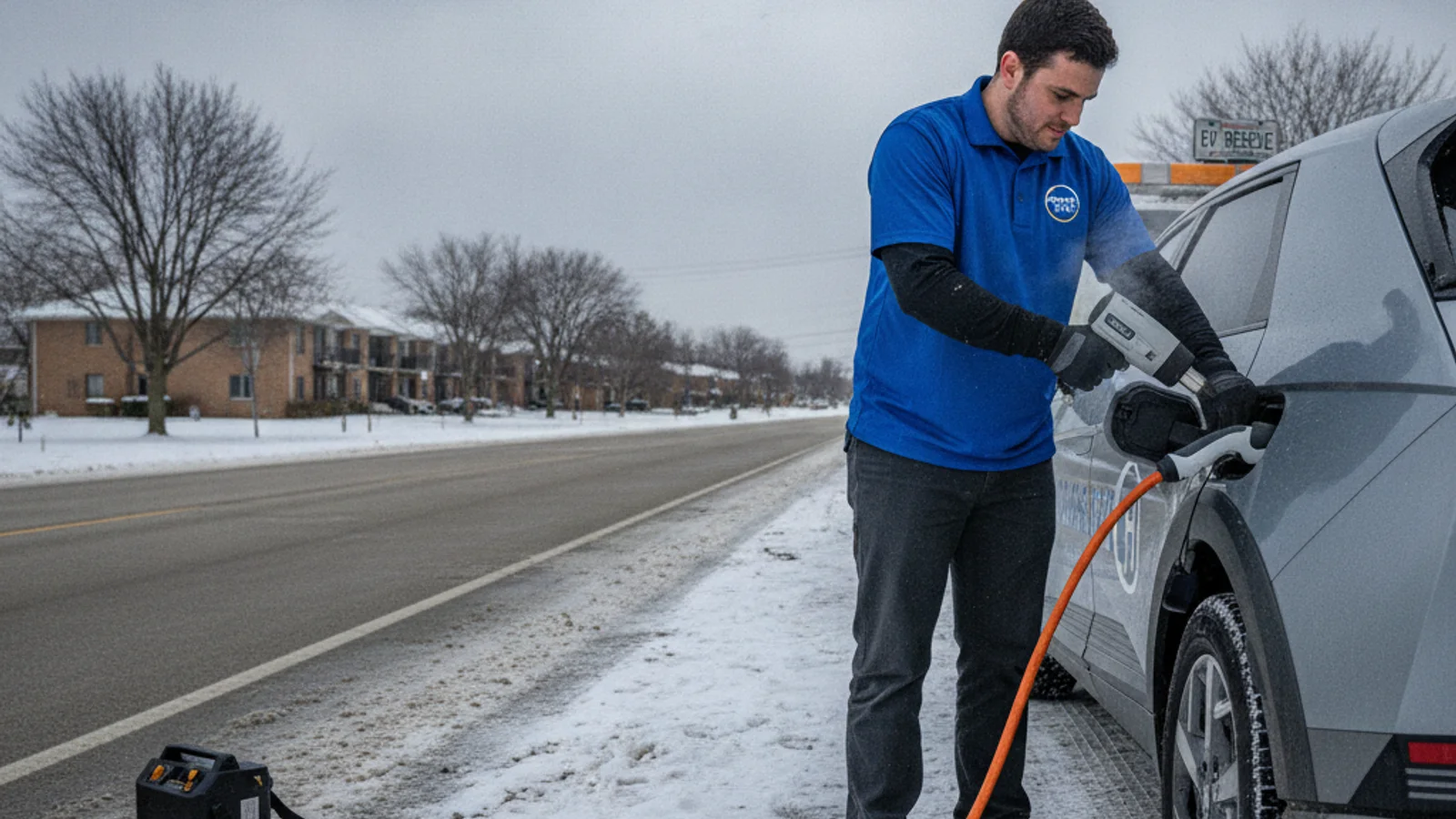
The independent operator we connect you with warms the latch with a controlled heat source. The operator checks the cable release through the app first. If the car is awake and the cable is still latched, the operator opens the port manually with the emergency release inside the frunk.
The operator carries a 12V booster for any 12V that has died alongside the latch. The operator carries a 240V Level 2 truck for any pack that has drained during the freeze. The operator typically adds 10 to 20 miles of range in 15 to 30 minutes of charging.
Where this hits in the metro
The lake-effect snow belt hits the North Shore towns hardest. Evanston, Wilmette, Highland Park, and Lake Forest all see lake-effect bands that drop a foot of snow in a few hours. An EV parked outside through one of those storms comes out with a frozen port. The road-salt belt hits the city streets and the expressways the same way.
If your EV has a frozen port anywhere in Cook, DuPage, Lake, Will, Kane, or McHenry county, call (858) 925-5546. We connect you with an independent operator who can quote the work and thaw the latch without damage.