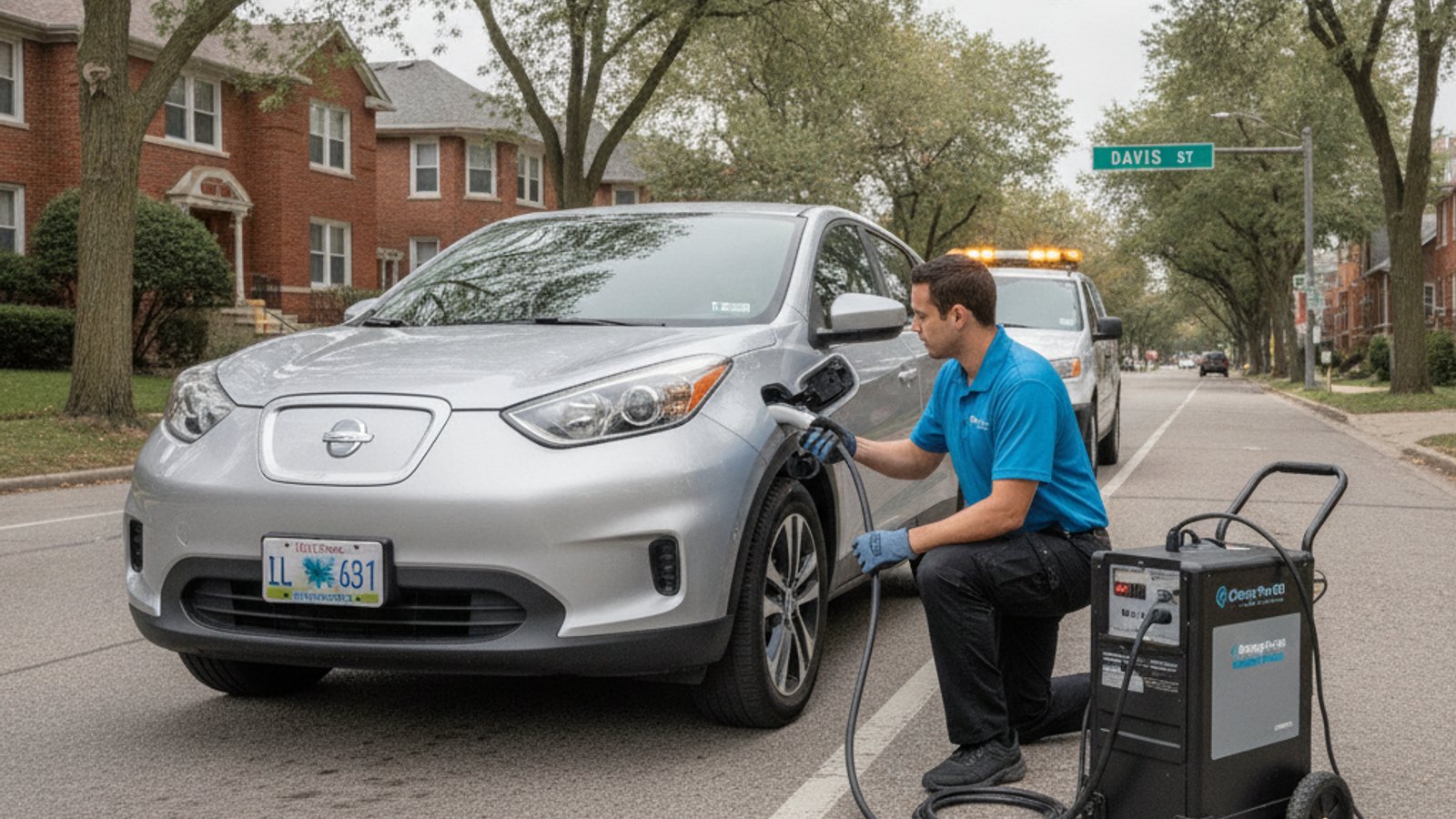
When your EV dies on an Evanston rental street, you need a mobile charge. The curb is the usual stall, not a garage. This city is small, dense, and old. A large share of drivers rent and park on the street. They never had a dedicated home plug. EV roadside assistance in Evanston means a local operator at the car. They bring 240V Level 2 power, or they jump a 12V that won’t wake. Charge Pro CHI is the referral line that matches you with that operator. It doesn’t own trucks. It doesn’t do the work.
Older blocks, rentals, and a campus without a home plug
Evanston is a Cook County city on 7.779 square miles. The ACS 2019-2023 population is 76,552. The 2024 estimate is 76,006. ZIP codes 60201, 60202, and 60208 cover the map. That many people on that little land is the whole story. Cars live at the curb because the buildings leave them there.
The Census says 71.2% of housing here was built before 1980. A pre-1980 building on Ridge Avenue often lacks a path to a dedicated charger. Owners still end up on the street. Renters almost always do. Dense North Shore rental streets leave many EVs without a home charger. That’s the local pattern, not a generic EV rant.
Northwestern University sits on the lakefront campus. Students and staff keep cars in town. They still have nowhere private to plug in overnight. Downtown Evanston repeats the pattern on mixed blocks. South Evanston and northwest Evanston do too. The lakefront is a real edge of the city. It doesn’t add a driveway for every car.
ComEd is the electric utility. This page doesn’t publish a ComEd EV rate. Confirm any overnight price with ComEd before you plan around it. If a number isn’t on ComEd’s site, it isn’t a fact you should trust.
Compare the housing age with the towns next door. Glenview’s pre-1980 share is 40.3%. Northbrook’s is 39.1%. Evanston’s 71.2% is closer to Skokie at 72.0% and Wilmette at 74.3%. Wilmette is smaller, with a 2024 estimate of 27,443 people. Evanston packs old housing next to a university. That’s the difference a swapped city name would miss.
Gurnee’s pre-1980 share is 9.5%. Naperville’s is 11.7%. Schaumburg’s is 15.9%. Those suburbs aren’t this map. A driver from a new subdivision still has to relearn Evanston’s curb.
Park Ridge sits at 67.1% pre-1980. Oak Park sits at 78.6%. Chicago sits at 68.6% with a much bigger footprint. Inner Cook County is full of old housing. Only Evanston puts Northwestern and the Purple Line terminal on this 7.779 square mile map. The 71.2% pre-1980 stock sits on the same small land.
Where stalls actually cluster
Research for this city is blunt. Calls cluster around the downtown blocks and the campus. Winter mornings are the other pile-up. A street-parked EV can lose range overnight in the cold. You walk out, and the estimate is already worse than bedtime.
Sheridan Road follows the lake. Green Bay Road, Ridge Avenue, Dempster Street, and Chicago Avenue cut the interior. The Edens spur on I-94 sits nearby. The CTA Purple Line terminal drops people into downtown. Those are real corridors. They aren’t a charger inventory. This page won’t guess the nearest plug. It also won’t call any stretch a desert.
If you live in Skokie, the housing age looks familiar. Wilmette is the quieter lake neighbor. Chicago is the huge city on the south edge. Glenview sits west with a younger housing mix. An operator working Evanston is working tight blocks, campus lots, and curb cuts.
A long sit near campus can drain a pack you meant to save. Same after a night parked downtown. That isn’t a claim about missing stations. It’s a claim about cars that sit still, then need to move.
Downtown errands stack up. You park, you walk, you forget the gauge. Campus days do the same. The car is legal. It’s just not plugged in. By the time you need Sheridan or Dempster, the estimate has already moved.
Winter is the amplifier. Cabin heat, a cold pack, and a night at the curb stack. You don’t need a published percent drop for that to be real. You need a plan for the morning the car won’t make Green Bay Road.
What the operators we send actually bring
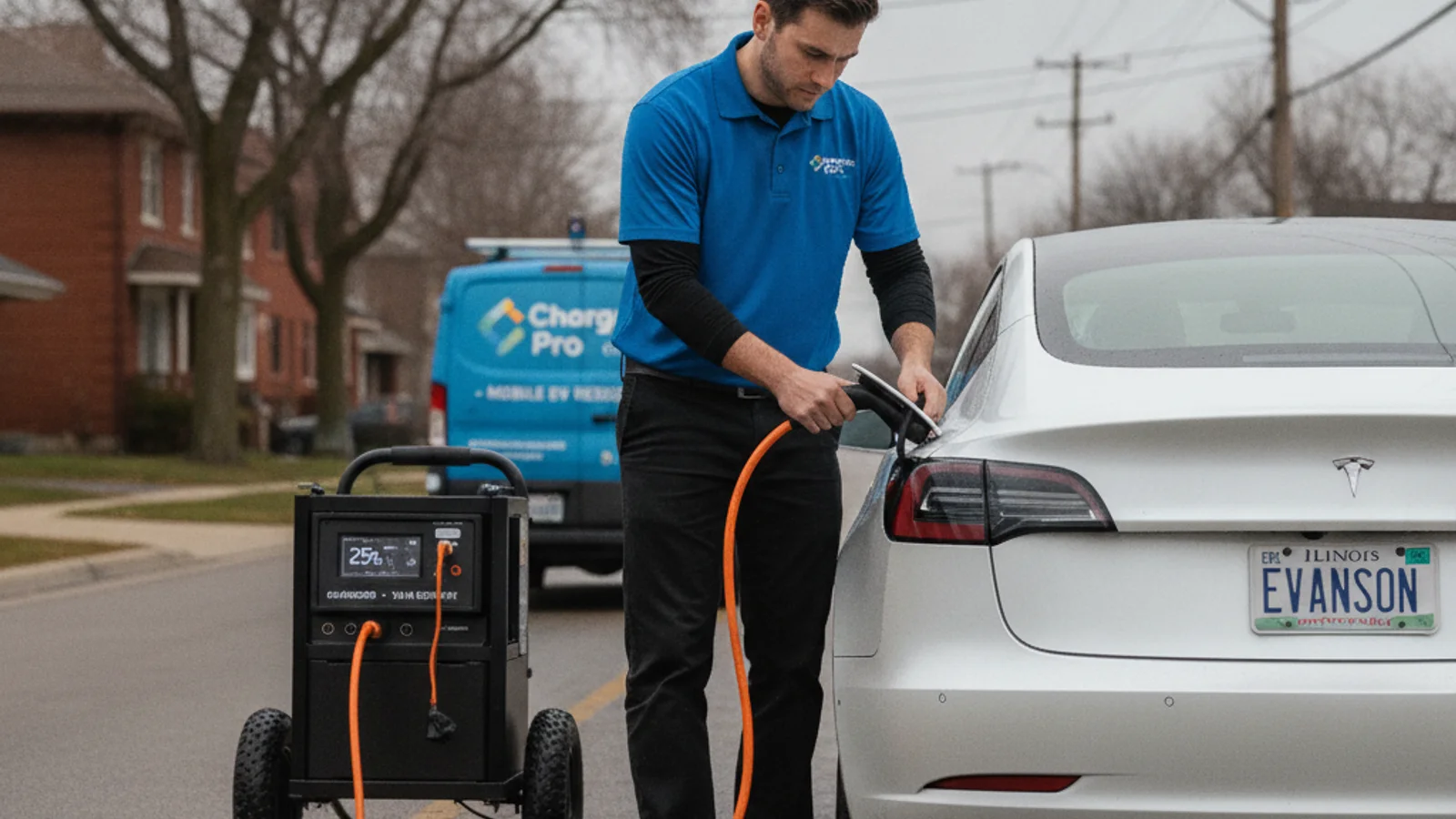
Charge Pro CHI connects you with independent local mobile rescue operators. Those operators bring a 240V Level 2 source to the car. Teslas take a native NACS plug. Other EVs take a CCS or J1772 adapter. That’s Level 2 at the bumper, on your street.
A typical session adds 10 to 20 miles of range. That’s 15 to 30 minutes of charging time. It isn’t an arrival time. It isn’t a clock on when someone shows up. The operator quotes you before they start. They bill you directly.
Mobile EV charging is the name for that curb boost. Out of charge recovery is the same work when the gauge is already at zero. You choose the next stop. A public charger you already use. Home if home can take a plug. Not a mystery destination across Cook County.
There’s no fee printed here. There’s no published wait. Ask the operator for the quote on your block. If the quote doesn’t work, you don’t take the job. That’s the whole commercial relationship.
The operators handle Tesla and every major EV brand. They aren’t a body shop. They aren’t a dealer. They’re there to add enough energy to leave. They can also wake a 12V that’s gone quiet.
Say the make and the connector if you know it. NACS, CCS, and J1772 aren’t interchangeable guesses. Operators carry the adapters. The quote still depends on where you are and what the car will accept.
A mobile 240V boost isn’t DC fast charging. It isn’t a 120V household trickle either. It’s the same family as a home Level 2 session, brought to the car. The 10 to 20 miles is a bridge. Plan the next plug before they unclip.
Empty pack or a 12V that won’t wake
Two failures look identical from the sidewalk. One is an empty high-voltage pack. The other is a dead 12V. You need to tell them apart, or at least describe what you see.
The 12V runs locks, screens, and the computers that boot the big pack. If that small battery is gone, the car can look fully dead. Last night’s range number doesn’t matter. The high-voltage pack can still be fine. Operators can jump or replace that 12V on site.
Tesla owners see this in the cold. Other brands see it too. Tesla 12V battery jump is the Tesla path. Non-Tesla EV rescue covers Ford, Hyundai, Kia, Rivian, Chevy, and BMW. Adapters are part of that job.
Black screens, no unlock, and no charge lights often point at 12V. A car that wakes and creeps a few feet is a clue. If it then dies on the estimate, the pack is more likely empty. If you’re not sure, say the make. Give the last range you trust. Say whether the doors still work.
Winter makes both worse. Cabin heat, a cold pack, and a night on the street will chew the estimate. A weak 12V hates the same morning. How to care for an EV battery through an Evanston winter is the seasonal habits piece. This post is the stall itself.
Don’t keep jumping a 12V that dies again the next dawn. That’s a replacement conversation, still on site if the operator can do it. A Level 2 boost to the big pack won’t fix a 12V that’s already failed.
Newer Teslas use a lithium 12V. Older ones use a lead-acid unit. The jump procedure isn’t identical. Tell the operator the model year if you have it. Don’t open high-voltage orange cables. That’s not a curb hobby.
If the car is locked and the phone app is dead, think 12V first. That’s more common than a hidden empty pack in that moment. If the app still shows a healthy percent, look at the estimate again. A car that won’t move far may still have a pack problem. Zero percent is a pack story. A car that never wakes is often the little battery.
When a tow is the right tool, and when it isn’t
Many EVs need a flatbed if they have to be moved. Wheel-lift towing can stress motors and the drivetrain. Makers warn about that. A tow still has a job. Use it when the car can’t take a charge. Use it when you need the vehicle off a live lane and charging isn’t possible.
If the pack will accept 240V, a boost keeps the car where it is. You stay with it. You don’t need a second ride to a shop. That shop may not even have a plug. The operator isn’t repairing the pack. They’re adding enough energy to roll.
If the 12V is the problem, a jump can restore unlock and start. Then you drive to a shop if it keeps failing. Towing a car with a healthy pack and a dead 12V is extra motion. You may not need it.
A highway shoulder on the Edens spur is a safety problem first. Get out of the live lane if you can do it safely. Hazards on. Then call. Don’t walk the shoulder hunting a station.
Tell a tow dispatcher the car is an EV before they dispatch a wheel-lift. Ask for a flatbed. If they can’t do that, wait. A damaged motor is a worse day than waiting for the right truck. This page doesn’t quote tow prices. Confirm those with the tower.
A boost doesn’t replace a shop diagnosis. If the car refuses to charge from any source, that’s beyond a curb session. The operator can still tell you what the car did when they plugged in.
Evanston geography that actually helps a caller
Downtown Evanston is the commercial core. The Purple Line terminal sits in that core. People park for errands, campus, and the train. South Evanston runs toward Chicago. Northwest Evanston sits toward Skokie. The lakefront and the Northwestern campus occupy the east edge.
Sheridan Road is the lakeside spine. It’s stop-and-go, with pedestrians and tight parking. Green Bay Road is a north-south workhorse. Ridge Avenue does similar work inland. Dempster Street is the east-west cut toward Skokie. Chicago Avenue is another interior route people use until the gauge drops.
Give the operator a cross street. Downtown blocks look alike after dark. Campus lots have names that help. Sheridan and a numbered address beats a vague lakefront pin. ZIP 60201, 60202, or 60208 in the notes doesn’t hurt.
This site doesn’t publish a live list of public chargers in Evanston. Stations change. Apps go stale. PlugShare, ChargePoint, and your car’s own nav are the maps to trust in the moment. The U.S. Department of Energy keeps a federal station directory. Check the AFDC station locator if you want a second map.
Level 2 at a lot is for a dwell. DC fast charging is for a trip. A mobile 240V boost is neither of those networks. It’s a bridge so you can reach a plug you already know. Don’t treat 10 to 20 miles as a tour of the North Shore.
If you’re on Sheridan with a few miles left, creep to a plug you already use. If you’re at zero, stay put. Coasting on a wish burns the last buffer. The operator comes to the car. You don’t need to meet them halfway down Green Bay Road.
Campus side streets can be tight. Have someone visible so the operator can find you. Don’t assume a campus lot will let a rescue vehicle in. Stand there and point.
Why neighboring towns don’t copy-paste this advice
Highland Park and the further lake towns have their own pattern. Oak Park is another old, dense inner suburb. Its pre-1980 share is 78.6%. Cicero’s is 90.2%. Those numbers show inner Cook County housing isn’t one product. Evanston’s extra twist is Northwestern. People keep a car they can’t plug in at a rental or a campus lot.
Arlington Heights sits at 42.0% pre-1980. Palatine sits at 31.2%. Des Plaines sits at 58.8%. You can own an EV in all of them. The stall still looks different on a rental street. A driveway off a wider suburban road is another pattern.
Chicago’s 2024 estimate is 2,721,308 people. Evanston’s is 76,006. An empty pack at the Purple Line’s Evanston end isn’t the same stall. Downtown Chicago is a different map. The operator still brings 240V. The street, the cold, and the parking are local.
Hispanic share in Evanston is 12.3% in the ACS. That fact belongs in a Census table. It doesn’t change the boost. Median household income is also a Census figure. This page won’t print a dollar amount. Confirm nothing about cost from a blog.
Wilmette’s 2024 estimate is 27,443. Skokie’s is 65,850. Glenview’s is 47,634. Those neighbors share the North Shore label. They don’t share Evanston’s campus-and-rental mix on 7.779 square miles.
What to do before you ask for a quote
Stay with the car if the street is safe. If you’re on I-94 or a busy cut-through, get out of traffic first. Hazards on. Cabin heat off if you’re saving pack. Keep the phone alive.
Open the car app and a charging app. Confirm it isn’t a 12V lockout. Try the key card or physical key if a Tesla won’t wake from the phone. Write down the last range reading you trust.
Pick the next plug before the operator clips on. Home if you have one. A station you already use. A 10 to 20 mile boost is a bridge. It isn’t a road trip through Lake County.
If two cars share a rental street, the operator still quotes one vehicle. They don’t clear the block. They don’t move your neighbor.
Say whether the car will unlock. Say whether it will roll. Say the make and the connector if you know it. NACS versus CCS versus J1772 changes what they bring.
Don’t sit in a live lane to hold a parking space. Don’t follow a random pin in an app if the car is already at zero. Don’t assume a campus lot will wave a rescue vehicle through. Stand there and point.
If the windows are iced and the 12V is dead, you may not get in. Say that on the call. The operator plans around access. Don’t force a frozen charge door with a tool that can snap plastic. Cold ports stick. That’s a different problem from an empty pack.
Keep kids and pets out of the street. Downtown and campus blocks have bikes and buses. A stall is already enough chaos.
How Charge Pro CHI actually fits
Charge Pro CHI is a referral line for Chicagoland. It matches stranded EV drivers with independent local mobile rescue operators. It holds no license. It employs no technicians. It owns no trucks, no warehouse, and no yard. It publishes no business hours. It sets no prices. It promises no arrival time.
The operator who takes the job quotes you first. You accept or you don’t. They bill you directly. The pros we connect you with are licensed and insured. That’s a network claim. The brand isn’t the crew.
They bring native NACS for Tesla. They bring CCS or J1772 adapters for everyone else. They jump or replace a dead 12V on site when that’s the failure. They serve Evanston and the listed Chicagoland cities. That includes Skokie, Wilmette, Glenview, and Chicago.
The local hub is the Evanston EV charging page. Use that if you want the city landing, not this stall story.
When you’re ready to call, use (858) 925-5546. That number reaches the referral line. It isn’t a promise that an operator is already on Sheridan.
Frequently asked questions
How much range does a mobile boost add?
The operator’s 240V Level 2 source typically adds 10 to 20 miles. That takes 15 to 30 minutes of charging time. Your car’s accept rate and the outdoor temperature change the result. It’s enough to reach a charger you already know. Home works if home can take a plug. It isn’t a full pack.
Can they help if the car isn’t a Tesla?
Yes. Operators carry a native NACS plug for Teslas. They also carry CCS or J1772 adapters for other EVs. Ford, Hyundai, Kia, Rivian, Chevy, and BMW sit in that group. Tell them the make when you call so they bring the right adapter.
Which Evanston areas does this cover?
The whole city. Downtown, south Evanston, northwest Evanston, the Northwestern campus area, and the lakefront. Sheridan Road, Green Bay Road, Ridge Avenue, Dempster Street, and Chicago Avenue. Also the streets off the Purple Line terminal. Nearby I-94 Edens spur as well. Charge Pro CHI also matches jobs in Skokie, Wilmette, Glenview, and Chicago.