A street-parked EV in Evanston can lose usable range overnight in winter. Lake wind along Sheridan Road hits a parked pack hard. The Northwestern lakefront campus sees that same overnight drop. Both the traction pack and the 12V take the stress. This guide is for that setting, not a mileage chart.
Two batteries, two winter problems
Winter in this Cook County city doesn’t hit one battery. An EV has two systems, and they fail in different ways. The traction pack is the large battery that moves the car. It’s the range number on the dash. When it runs down, you still get warnings first. The car keeps working until that pack can’t move it.
The 12V battery is much smaller. It runs locks, the screen, and the wake-up computer. When the 12V dies, the car can look fully dead. Doors may not answer, and the screen may stay black. The traction pack can still hold plenty of energy.
A low pack on Chicago Avenue is a charging problem. A silent car on a downtown block is often a 12V problem. Sort those two before you assume the main battery is finished. If the car won’t wake, and range looked fine last night, start with the 12V. Our guide to 12V warning signs walks through what that looks like. Jump-starting an EV in winter is a different job than adding range.
Street parking and pre-1980 housing
Evanston covers 7.779 square miles in Cook County. The 2019-2023 ACS count is 76,552, and the 2024 estimate is 76,006. That’s a dense, older university city, not a garage suburb. Census data shows 71.2% of housing was built before 1980.
A dedicated home charger usually needs a stall you control. Many downtown and south Evanston buildings were never laid out for that. A large share of residents rent and park on the street. They’ve got no dedicated charger at the bumper they use at night.
Northwestern students and staff often keep a car anyway. Campus parking isn’t a home stall with a cord. Overnight, that car sits in lake air with no plug. Morning range is lower than the dash promised at dinner. Winter mornings around downtown and the campus are the pattern.
Downtown, the campus area, and northwest Evanston don’t share one housing type. For many owners the car rests on the street without a dedicated charger. ComEd is the electric utility that serves Evanston homes. We couldn’t confirm a published winter EV rate in this research. ComEd sets that figure for the account. Check your bill or ComEd’s current pages before you treat overnight charging as cheap.
If you’ve got a garage in northwest Evanston, use overnight Level 2. Still follow your maker’s charge cap while it’s plugged in. If you’re on a street stall, plan charging stops in an app. See the Evanston charging page for local context. Then verify working stalls in the app before you leave.
Sheridan’s lake wind isn’t an inland block
Evanston isn’t one climate strip along the lake. Sheridan Road runs the lakefront through the city. The Northwestern lakefront campus sits in that same wind. A car left there overnight sheds heat into moving air. A sheltered inland street doesn’t get that fetch off the water.
Ridge Avenue, Green Bay Road, and northwest Evanston sit farther inland. Skokie is the inland neighbor just west of town. Wilmette shares the lake edge to the north. Only 40.3% of Glenview homes were built before 1980. Evanston’s share is 71.2% on that same measure. That’s a different overnight setup, even a few miles west.
We can’t publish a verified range penalty for lake wind versus inland blocks. No source in this research gives that number for your model. Cold, wind, and a resting pack still show up in the maker’s winter notes. A Sheridan overnight is worth reading those notes against. Wind just isn’t the same factor on an inland block.
The Edens spur on I-94 sits nearby. Dempster Street and Chicago Avenue move people toward Chicago and Skokie. Those are short miles on a map, not summer miles. A cold pack still uses more energy per mile than a warm one. Don’t treat a Purple Line terminal errand like a July trip.
Start with the maker, not a blog percentage
Every EV maker publishes its own traction-battery guidance. That document is the right start for your pack. Tesla, Rivian, Ford, Hyundai, Chevrolet, and Kia each set their own charge limits. Chemistry differs by model, and makers change the numbers.
We can’t confirm one degradation rate for every Evanston EV. We can’t confirm one ideal charge window that fits every pack. A post that assigns a winter percentage to lake wind is guessing. Your owner’s manual or the maker’s app is built for your car. Check that first before you chase a blog chart.
Cabin filters and tire rotation still matter in slush. Those aren’t pack care, but they still belong on the list. Our EV maintenance guide covers the non-battery items. This piece stays on the pack, the 12V, and winter decisions.
Habits that help a street-parked winter car
Preheat while you still have a plug, if you have one. Makers often tell you to warm the pack before a cold DC session. Follow that in-app prompt instead of guessing a cabin target.
Keep the charge off the floor when you can. A street-parked car that sits near empty overnight has less buffer. We won’t pick a percentage for you, because your manual already did.
Condition the cabin before you unplug, when a cord exists. That uses wall power instead of pack power. Renters on Chicago Avenue often can’t do that. They should expect a colder start and a lower first-mile reading.
Clear snow and slush off the charge port before you plug in. A frozen latch is a winter stall of its own. Don’t yank the handle if the cable won’t release. Check the manual’s release steps before you force it.
Watch the 12V as closely as the range bar. Short campus trips and long street rests still work the 12V in the cold. If the car is slow to wake, treat that as a 12V warning. Don’t wait for a black screen on a Dempster morning.
If you own a Tesla, cold-day range is its own planning problem. How a Tesla charge lasts through a cold Chicagoland day covers that pattern. A cold pack is less willing to give full range on any of these brands.
Charging levels you’ll actually use
The DOE Alternative Fuels Data Center lists charging levels. Level 2 runs on 240V at home or 208V in commercial settings. It adds about 25 miles of range per hour. Connectors are J1772 or J3400, also called NACS. That’s a planning number, not a promise for your car. DC fast charging can add about 100 to 200-plus miles in 30 minutes. Equipment maximums run up to 500 kW on those stalls. Actual speed still depends on your car and the air.
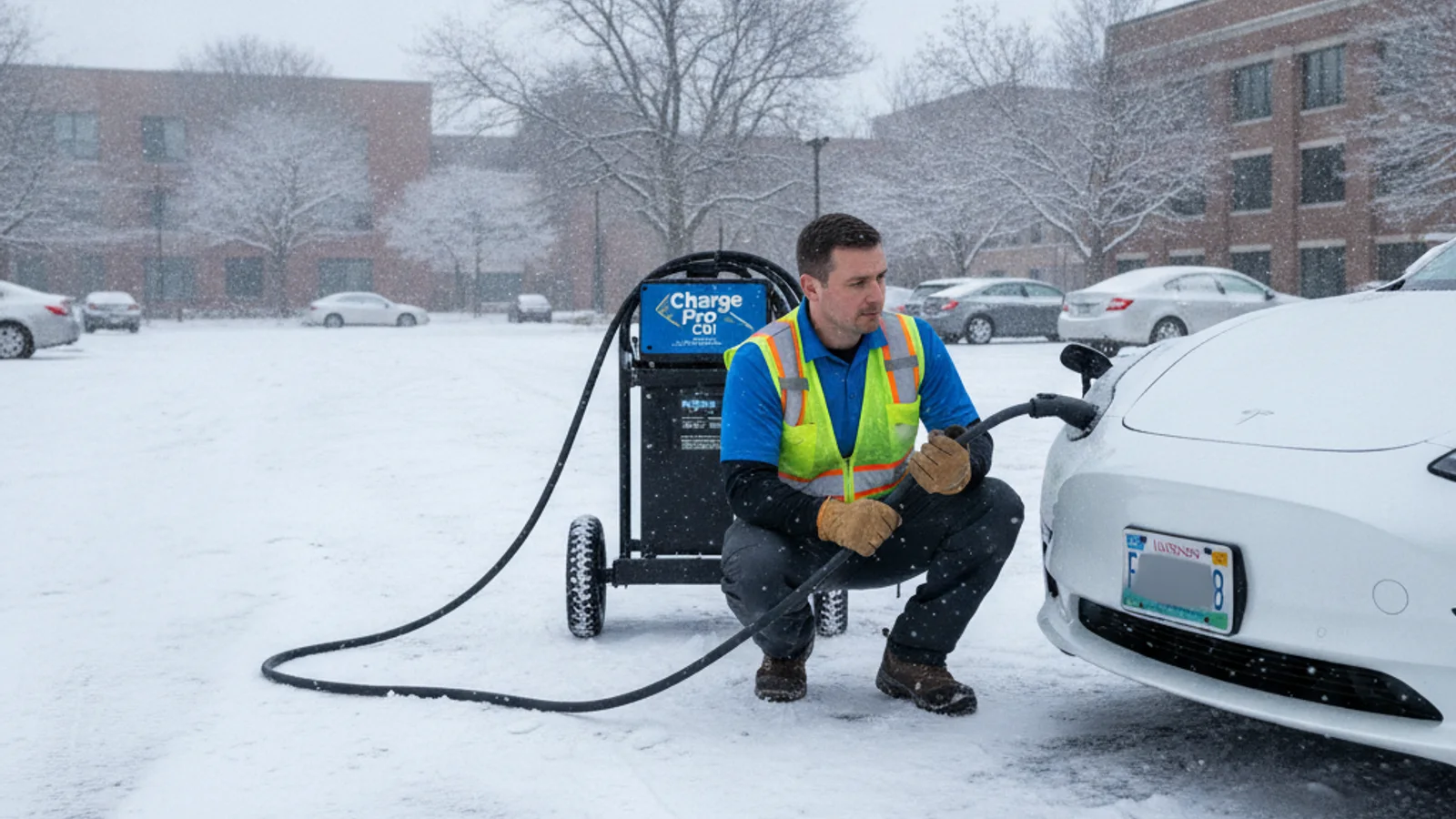
A mobile operator brings a 240V Level 2 source to the bumper. Teslas get a native NACS plug on that lead. Other EVs use a CCS or J1772 adapter. A 15 to 30 minute connection adds roughly 10 to 20 miles. That’s charging time, not an arrival time.
A boost, a jump, or a service center
If the dash still talks and range is near zero, you need pack energy. Stay with the car if it’s safe to do so. Don’t sit in a travel lane on the Edens. A local operator can add enough range to reach a compatible charger. They can also say the car needs transport. That call is theirs on scene, not ours on the phone.
Mobile EV charging is the request when the pack is the problem. Evanston roadside help covers how that call works in this city.
If the car is dark and silent, ask for a 12V jump first. Operators can jump or replace a dead 12V on site. Tesla and other major EV brands are in that mix. The operator quotes you before work starts, then bills you.
If the 12V dies again the next cold morning, a jump wasn’t a repair. Repeated no-starts in street parking point to a weak 12V. Replacement on site is something operators can do. A health score on the high-voltage pack still belongs at a service center.
If the car charges, drives, and wakes normally, you’re past roadside care. Long-term battery answers belong at a dealer or authorized shop. Roadside operators get you moving, and they don’t certify pack health. Warranty questions belong with the maker, not with a boost truck.
No verified Evanston-specific degradation rate turned up in this research. No verified dollar figure for a 12V replacement turned up either. Confirm the operator’s quote before you agree to the work. They set the price, and we don’t.
Charge Pro CHI is a referral line. We match you with independent local mobile rescue operators. We don’t own trucks or hold a trade license. The pros we connect you with are licensed and insured.
When to call
If the pack is empty, or the car won’t wake, that’s a roadside moment. Call (858) 925-5546 and we’ll connect you with a local EV rescue operator.