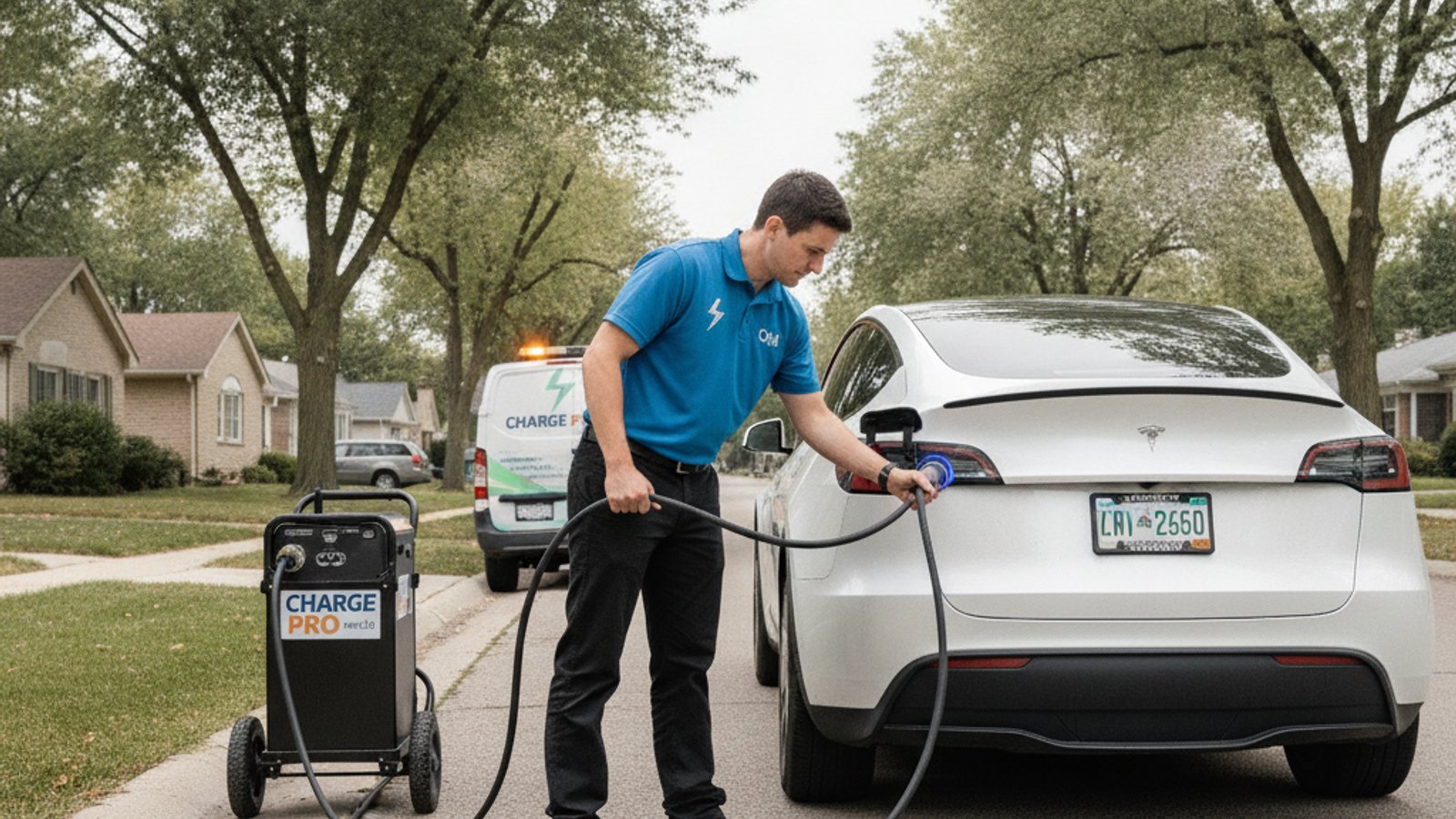
When your EV stalls in Highland Park, you need help at the car. EV roadside assistance here is a charger or a 12V jump. Charge Pro CHI doesn’t roll a branded fleet. We connect you with independent local operators. Those operators bring a 240V Level 2 source to the vehicle. They quote you before they start, and they bill you directly.
Lake wind is hard on range and on the 12V
Highland Park is a Lake County city of about 12.2 square miles. ACS 2019-2023 counted 30,229 people here. The 2024 Census estimate is 30,794. That footprint looks small on a map. The lake climate isn’t small for an EV.
East of town, the land drops toward Lake Michigan. The bluffs and beaches sit in that wind. In winter the wind is severe. Cabin heat plus a headwind pulls the pack down faster than a garage day. The same cold hits the 12V battery that wakes the computers. A car can look fine at Ravinia at 6 p.m. It can refuse to unlock at 10.
This isn’t a Loop garage stall. It isn’t an inland office-park stall either. Grade, wind, and long parking do the damage on this lake edge. Most owners here charge at home. Calls still cluster on dwell and the drive home. That’s the local pattern in the research for this page.
Ravinia after a long program
Ravinia Festival is the signature Highland Park dwell. You park for a summer concert. You leave the car for hours. You walk back after dark. Two failures show up in that lot.
The first is a pack that’s lower than you remembered. Cabin climate on the drive in uses energy. If accessories stayed on while you sat, that uses more. Then you still have to climb away from the venue. East Highland Park has real grade toward the bluffs. Uphill uses pack energy. Regenerative braking only pays you back on the way down.
The second is a car that won’t wake. The high-voltage pack may still hold a usable charge. The 12V is the gatekeeper. Locks and screens need it. The contactors that close the big battery need it too. Heat during the show is hard on a weak 12V. A cool lake breeze after dark finishes that cycle. Keep tapping the app and you can flatten it.
Ravinia is also a neighborhood, not only a venue. Streets around the park fill on event nights. Give the operator a lot name or a cross street. Saying you’re near Ravinia is too vague when the blocks are full.
The beaches and bluffs create the same pair of problems on a summer day. You park long, run climate, and climb out. For a shoreline stall, see stalled along the Highland Park lakefront.
East side streets versus west side highways
Sheridan Road is the lake road. Wind is strongest there. Winter slush hits charge-port doors. A frozen latch isn’t an empty pack. It can still block a boost until the door moves. Don’t force the inlet. Tell the operator if it won’t open.
Downtown Highland Park sits on the Metra Union Pacific North line. Green Bay Road runs that spine. A stall by the station is a tight-block problem. Roll into a legal space if the car can still creep. Don’t sit in the travel lane waiting for a quote.
West Highland Park faces the highways. US-41 is Skokie Highway here, with the Edens spur in the mix. I-94, the Tri-State, sits to the west. Clavey Road and Half Day Road, Illinois 22, cut across toward those roads. A commute stall on Half Day is often a winter-range story. The display still remembers July. January lake wind doesn’t.
If you’re still moving on US-41 or I-94, take the next safe exit. West Highland Park streets are a better wait than a live wall. The operator has to work next to the car. A live shoulder can be too dangerous to work. They may ask you to wait somewhere quieter. That isn’t a product. It’s a work-site call.
Deerfield sits west of the bluffs. Northbrook sits southwest toward the Tri-State. Highwood is the small lake neighbor to the south. Lake Forest is the next lake city north. The wind doesn’t honor the city limit. Your pin should be the stall, not your mailing address.
Empty pack or dead 12V: pick the right rescue
Out-of-charge recovery is for a traction pack that’s actually empty. The car drove until it couldn’t. You need energy in the high-voltage battery. A mobile operator connects 240V Level 2 at the car. Tesla inlets take a native NACS plug. Other EVs take a CCS or J1772 adapter. That pairing covers Tesla and every major EV brand the network handles.
A 12V failure looks ruder. The car may be dark. Handles may not work. You may see a low-voltage warning while the pack estimate still looks healthy. That’s the small battery, not a high-power DC problem. A Supercharger is Tesla’s high-power DC network. It doesn’t wake a dead 12V. You need a jump or an on-site replacement. That’s the Tesla 12V battery jump path. Other EVs use a 12V the same way. The architecture is shared even when the badge isn’t.
Lake wind makes the 12V the local twist. Cold slows the chemistry. Short trips on Sheridan don’t recharge it much. A long Ravinia sit lets accessories nibble it down. If the dash is dead, start there. If the car drives and the miles are gone, you need a boost.
Non-Tesla EV rescue uses the same on-site model. The inlet is just different. Don’t assume a Tesla-only truck. Say the make when you call so the quote includes the right adapter.
What Charge Pro CHI is, and what the operator brings
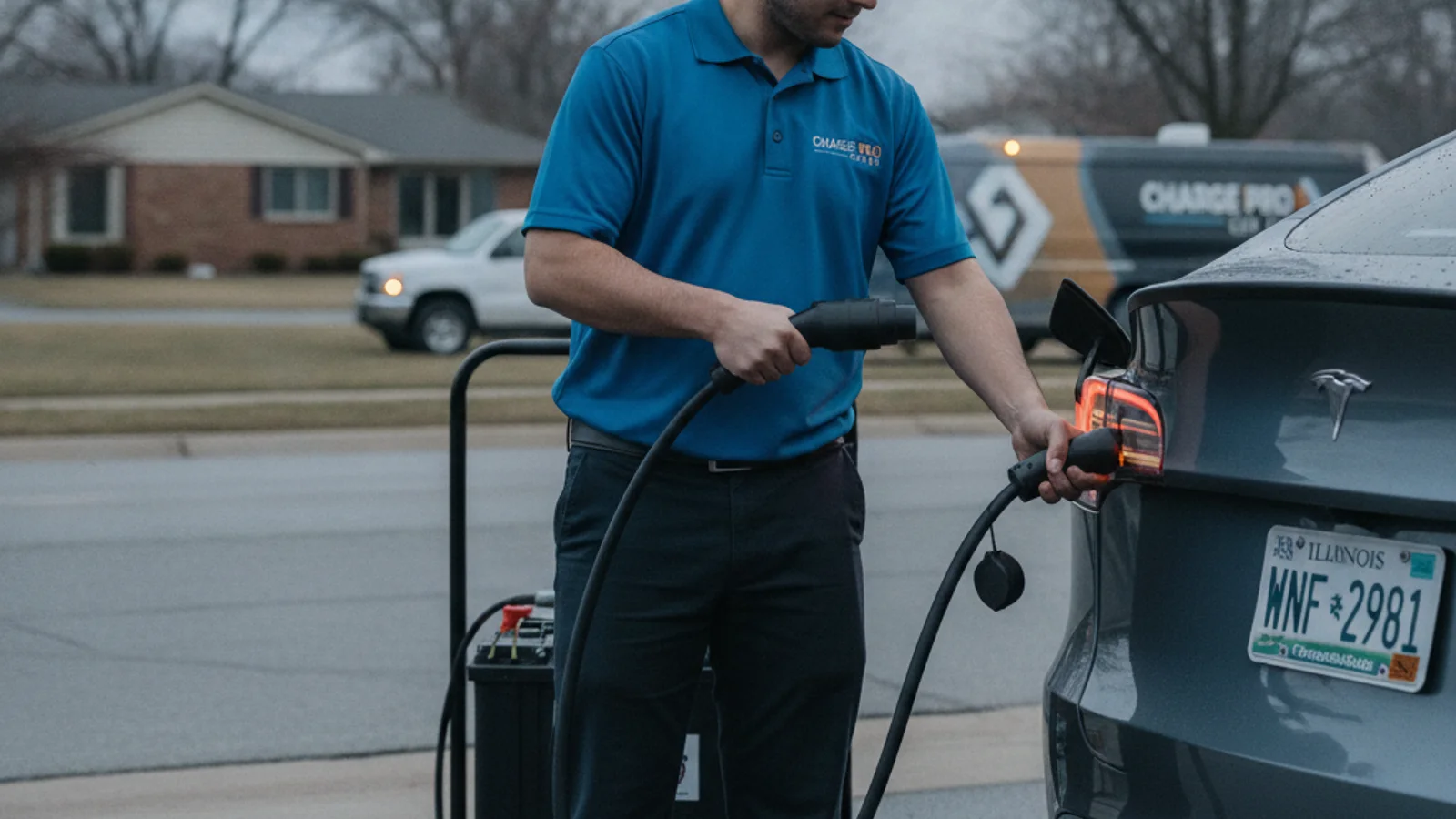
Charge Pro CHI is a referral line for Chicagoland. It doesn’t hold a trade license for the work. It doesn’t own trucks, a yard, or charging gear. It doesn’t employ technicians. It doesn’t set prices. It doesn’t publish business hours or arrival times. It matches stranded drivers with independent operators. The pros in that network are licensed and insured. They quote before they start. They bill you.
What they bring is a 240V Level 2 source. Typical on-car charging adds about 10 to 20 miles of range. That takes about 15 to 30 minutes of charging. Those minutes are charging time. They aren’t a clock for when someone shows up. Nobody on this line can promise that clock. The operator tells you what they can do when they call you back.
You don’t need a full pack on Sheridan. You need enough miles to reach your own plug. A public plug you already know you can make also works. This page doesn’t name public charging sites. The research packet didn’t verify them. If you already have a working destination, say so. If you don’t, stay put for mobile EV charging.
A Level 1 household outlet is 120V, and it’s slow on the roadside. Level 2 at 240V is the recovery tool. It still isn’t a Supercharger. Don’t expect a DC fill on the shoulder. Expect driving miles, then a real plug.
EV roadside assistance is the umbrella for both jobs. One is a boost for the pack. The other is 12V help when the car won’t wake.
ComEd, older houses, and the plug you aren’t standing next to
Commonwealth Edison, ComEd, is the electric utility in Highland Park. Most local EV miles start overnight on a home circuit. This page couldn’t confirm a current ComEd EV rate. It also couldn’t confirm a time-of-use window or a rebate. Those gaps are from the sources used here. ComEd sets those numbers. Check your bill, or ask ComEd, before you plan around a figure.
ACS 2019-2023 says 60.6% of Highland Park housing was built before 1980. That’s a housing-age fact. It isn’t a panel inspection. Some older garages already have a wall box. This page won’t guess yours. The point is simpler. A home plug only helps in the driveway. It doesn’t help in a Ravinia lot.
ZIP codes 60035 and 60040 cover Highland Park. 60015 overlaps the area too. Tell the operator the street. A ZIP alone is a big circle. Downtown, Ravinia, east Highland Park, and west Highland Park are different waits. East is wind and grade. West is US-41 and I-94. Downtown is Metra and Green Bay. Use the named area.
The 12V still has to wake the car
Every EV still carries a low-voltage battery. It isn’t the pack that moves the wheels. It runs computers, locks, and the relays that connect the pack. When that 12V is flat, the car can still hold plenty of traction energy. It can still refuse to wake. Owners often read that as an empty pack. It isn’t.
Lake Michigan wind makes that failure more common on the east side. Cold air, short Sheridan hops, and a long sit at Ravinia are a bad mix. The 12V doesn’t like deep discharge. It also doesn’t like being asked to close contactors after hours in the cold. A jump can get you home. If the same no-start returns the next morning, the 12V is done.
A replacement on site is a quoted job. It isn’t a surprise you have to guess. The operator sees the battery. You hear the quote from them. Charge Pro CHI doesn’t set that price, and this page doesn’t invent one.
Downtown Highland Park and the Metra sit
A lot of local days aren’t concert days. You drive to the Metra Union Pacific North station. The car sits on Green Bay or a downtown block until the evening train. That’s another long dwell. Winter makes it a 12V story. Summer heat with climate left on can be a pack story. Either way, you’re not in your garage.
Give a named downtown landmark if you have one. The station area is easier to find than a vague Green Bay pin. If the car can still roll, take a legal space. Don’t block a bus lane or a Metra curb to wait.
What to do in the first minutes
If the car can still roll, get out of the travel lane. Turn the hazards on. On I-94 or US-41, stay in the vehicle unless you’re in immediate danger. In a Ravinia lot or a downtown space, you have more room. Still treat the car as disabled. Don’t keep creeping on a near-empty pack to chase a plug you haven’t confirmed.
Then name the failure. If the car powers up and shows a range you can’t use, that’s the pack. If it stays dark or fails to unlock, that’s the small battery. A 12V message points the same way. Photograph the screen. You’ll repeat it on the call.
Have the make, the model, and a pin that a stranger can find. Native NACS versus CCS or J1772 is the adapter question. The operator quotes before a cable goes on. If you decline, they don’t start.
Don’t jump the 12V with a random gas-car kit. You need the EV procedure first. Clamp order matters. The 12V in an EV isn’t a lawn-mower battery. Operators who do this work treat it as an EV 12V.
See EV charging in Highland Park for a city overview. Use it for local context. It isn’t a live availability board.
A boost compared with a tow
A tow moves a silent car. It doesn’t put miles in the pack. Many EVs need a flatbed so the drive units don’t spin. That’s the right call when the car isn’t safe to charge in place. It’s also the right call when the real problem is mechanical. It’s a slow answer to a simple empty pack.
A mobile Level 2 boost is recovery in place. You leave under your own power. You may still drive to a DC charger or home after. The boost isn’t a full fill. It’s 10 to 20 miles in a typical session. That charging window is about 15 to 30 minutes on the car.
If the 12V is the failure, a shop tow may be extra tonight. A jump can close the contactors again. If it dies again tomorrow morning, that’s a replacement conversation. Lake wind will keep killing a weak 12V. One jump isn’t a repair.
Charge Pro CHI doesn’t pick the path for you. The operator sees the car. You hear the quote. You choose.
When a gas-car playbook isn’t the right first step
A gasoline stall often ends with a tow to fuel. An EV has no can of electrons to pour in. The leftover playbook is a flatbed. That can be the right tool. It often isn’t the first tool you want in a Ravinia lot.
A local mobile operator is built for the EV failure. Pack empty: Level 2 at the inlet. 12V dead: jump or replace on site. Tesla or not: NACS, CCS, or J1772. You still get a quote first. You still pay the operator. Charge Pro CHI doesn’t bill the job. We only make the match.
If another truck is already rolling, say so. Don’t stack a boost and a tow into the same stall. The operator needs room to work. A second truck in a tight downtown block helps nobody.
Keep a buffer on lake days
Check range in the driveway, not in the concert aisle. Winter cabin heat isn’t free. A lake-effect wind day isn’t a garage day. If the car sat through a long program, treat the 12V as the first suspect. If you’ve been driving Sheridan with heat on, treat the pack estimate as optimistic.
Plug in when you get home. ComEd delivers the electrons. This page won’t invent an off-peak clock. Set a reminder that matches your actual night. A missed plug plus a Half Day commute is a classic local stall.
Keep slush out of the charge port. Lake streets throw that mix all winter. A frozen door can look like a charging failure. It isn’t. It’s a latch. Clear it before anyone plugs in.
On US-41, don’t roll on a near-empty guess. Take an exit while the car still steers. A quiet west Highland Park side street beats the Tri-State as a pin.
Short hops on Green Bay Road can hide a 12V that’s already tired. The car starts. The screens work. Then a longer Sheridan run plus heat knocks it over. Odd electrical warnings are a 12V hint. Don’t wait for a Ravinia night to learn that.
Frequently asked questions
What EVs can an operator help in Highland Park?
Operators in the Charge Pro CHI network handle Tesla. They also handle every major EV brand they’re set up for. They bring a native NACS plug for Tesla. They bring a CCS or J1772 adapter for other EVs. Say the make and model when you call so the quote matches the inlet.
How much range does a mobile boost add?
A typical on-car session adds about 10 to 20 miles. That takes about 15 to 30 minutes of charging. Those minutes are charging time, not a promise of when someone arrives. The goal is enough miles to reach home or a plug you can actually use. It isn’t a full pack on the street.
What if the car won’t wake, but the pack wasn’t empty?
Treat that as a 12V problem until proven otherwise. Lake wind and winter cold are hard on that battery. An operator can jump it, or replace it on site if that’s the quoted job. Don’t keep pinging the app. You may finish off a weak 12V.
When you’re ready to call
Highland Park stalls cluster around Ravinia dwells, lakefront grade, and winter wind. They also happen on US-41 and I-94. That’s when the buffer was a summer number. Charge Pro CHI will match you with a local operator. Call (858) 925-5546 when you want that match. The operator quotes before any cable goes on the car.