A Cicero search for EV charger installation hits electrician ads first. The housing stock is the part those ads skip. Nine in ten homes here were built before 1980. Plenty of them are two-flats and rentals. A 240V wall box often isn’t a weekend project. It can stall on the panel, the owner, or ComEd. You still have to drive in the meantime. This guide explains what a Cicero install really involves. It also covers the mobile 240V path. That’s how drivers recover when the house can’t take a charger.
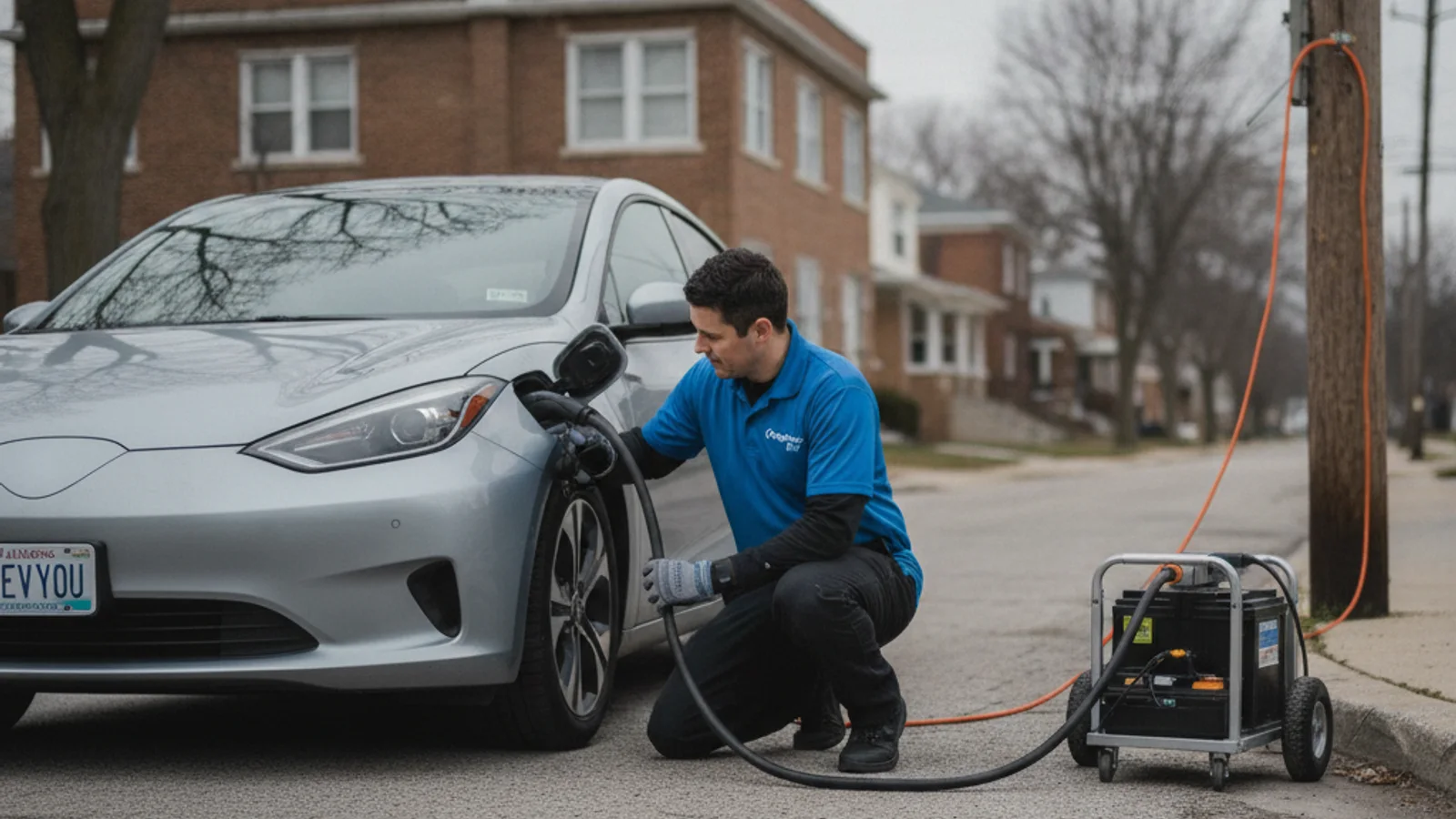
Cicero housing is why the install is hard
Cicero is a Cook County city on 5.865 square miles. The ACS 2019-2023 population is 83,223. The 2024 estimate is 82,090. The town sits in ZIP 60804. Hispanic or Latino residents are 88.8% of Cicero. That shows up in the buildings, not just the census table.
Census table B25034 is the one that matters for a charger. 90.2% of Cicero housing predates 1980. Berwyn, next door, sits at 90.0%. Oak Park is 78.6%, and Chicago citywide is 68.6%. Naperville, out in DuPage County, is only 11.7%. Glenview is 40.3%, and Northbrook is 39.1%. Schaumburg is 15.9%. Cicero isn’t those towns.
Pre-1980 houses weren’t built for a Level 2 wall charger. They were built for lights, a stove, and a window AC. A dryer circuit, if it exists, may already be the only 240V run. Adding another one means asking whether the panel has room. On a two-flat, it also means asking whose panel it is.
Downtown Cicero, the Hawthorne area, north Cicero, and south Cicero don’t share one floor plan. They share a building era from before 1980. That’s why ev charger installation in Cicero is a building question. It isn’t a shopping trip for a wall-box brand.
What a Level 2 charger actually asks of the house
Most people picture a box on a garage wall. The box is the last piece, and the circuit is the job. A Level 2 home charger needs 240 volts. That’s the same voltage a range or dryer uses. An electrician adds a dedicated breaker. Then they run new cable to the parking spot. Three things decide whether that’s even possible: panel capacity, wire distance, and who controls the building.
Charge Pro CHI doesn’t install chargers. We’re a referral line for stranded EV drivers. We match you with independent local mobile rescue operators. Those operators don’t pull permits or upgrade panels. If your building can take a charger, hire an electrician for that work. If it can’t, the operators we send still help. They put 240V into the car where it sits.
Panel room on a pre-1980 Cicero house
We couldn’t confirm typical panel sizes for Cicero from public records. Don’t copy a neighbor’s quote. Ask the electrician for a written load calculation. That math adds up what the house already uses. Then it checks whether a 240V charger still fits.
If the math is tight, electricians usually outline a few options. A load-management device can slow the charger when the house is already drawing hard. A panel upgrade can open room. It may involve ComEd if the service has to change. Sharing an existing 240V circuit works in some buildings and not others.
None of those paths has a verified Cicero price on this page. Quotes move house by house. A low number that never mentions the panel is a warning. Get two written quotes, and make both of them show the load calc.
Two-flats, renters, and who can say yes
Cicero’s grid is packed with two-flats and rented units. If you don’t own the building, you don’t add a 240V circuit alone. You need the owner before anyone opens a panel. You may share a basement panel. You may need access the other unit doesn’t want to give.
That’s a different install than a single-family garage in Glenview. Pre-1980 housing there is 40.3%. Northbrook’s share is 39.1%. Cicero’s conversation starts with who owns the wall. Berwyn’s housing age is almost identical, and the near-west pattern is close. For that neighbor’s context, see the Berwyn charging page. For this city, use the Cicero charging page.
A basement panel and a car out front can mean a long wire run. Some owners hear that and stop. That’s a building decision, not a defect in the EV.
Permits, ComEd, and the facts we couldn’t verify
A Cicero-specific permit rule for a home EV charger couldn’t be confirmed. The sources behind this page don’t publish one. Don’t assume the paperwork is optional. Ask the City of Cicero building department about a new 240V circuit. Ask whether a panel upgrade is a separate filing. Then have the electrician put that answer on the quote.
ComEd, Commonwealth Edison, is the utility in Cicero. We couldn’t confirm a current rebate amount. We couldn’t confirm an off-peak window you should count on. We couldn’t confirm a panel-upgrade credit that still applies. Those programs change. Check ComEd’s own EV pages before you budget around a credit. If a wall box does go in, ask how scheduling works. You want charging on whatever off-peak plan ComEd publishes now.
A service upgrade is a ComEd job as much as an electrical job. If the house needs heavier service, that clock is ComEd’s. The alley or pole work isn’t yours to schedule. Plan around it, and don’t use a figure we can’t publish.
The corridors where a delayed install becomes a stall
The charger question turns into a roadside question on a few streets. I-290, the Eisenhower, runs along the north edge. Cicero Avenue is Illinois Route 50 and cuts the city north to south. Cermak Road, Ogden Avenue, and Roosevelt Road carry the east-west trips. Those roads feed Chicago to the east and the near suburbs to the west.
Hawthorne Race Course sits on this grid. The Cicero Community Center is a landmark people actually use. The historic Hawthorne Works site still marks the old industrial edge. None of them puts a 240V circuit in your two-flat. They’re just where a low pack shows up after a shift or a weekend.
North Cicero and south Cicero don’t run the same errands. Downtown Cicero is tighter, with shorter blocks. The Hawthorne area mixes older industrial edges with residential blocks. On all of them, many cars sit without a dedicated home circuit. Renters and two-flat households often rely on charging they don’t control at home. That’s the housing pattern. It isn’t a claim about public plugs.
If the house can’t take the charger, a low pack is a roadside call. Our Cicero mobile rescue guide covers that stall. For the 240V choice itself, read home charging versus a mobile boost.
Questions to ask an electrician before you hire
Write the answers down, and don’t trust a box price alone.
- Will you run a load calculation, and can I see it?
- Does this panel have room, or are we talking about an upgrade?
- Who handles any city permit, and who meets an inspector?
- What amperage is the new circuit built for?
- How far is the wire from the panel to where I park?
- If I rent, what does the owner have to sign?
- Can the charger follow ComEd’s current off-peak schedule?
Someone who answers those in plain words is easier to trust. Charge Pro CHI isn’t that electrician. We don’t bid panel work. When the job is a new circuit, hire a residential electrician. When the car is empty tonight, that’s a different phone call.
How a mobile 240V boost fits when the house can’t take it
A regular 120V outlet, called Level 1, adds range slowly. On a Cicero Avenue or Eisenhower commute, that trickle may not keep up. Don’t treat it as a stand-in for a dedicated 240V circuit. If you want the Level 1 picture, we published a separate guide. Read what a Level 1 charger is, and when it isn’t enough.
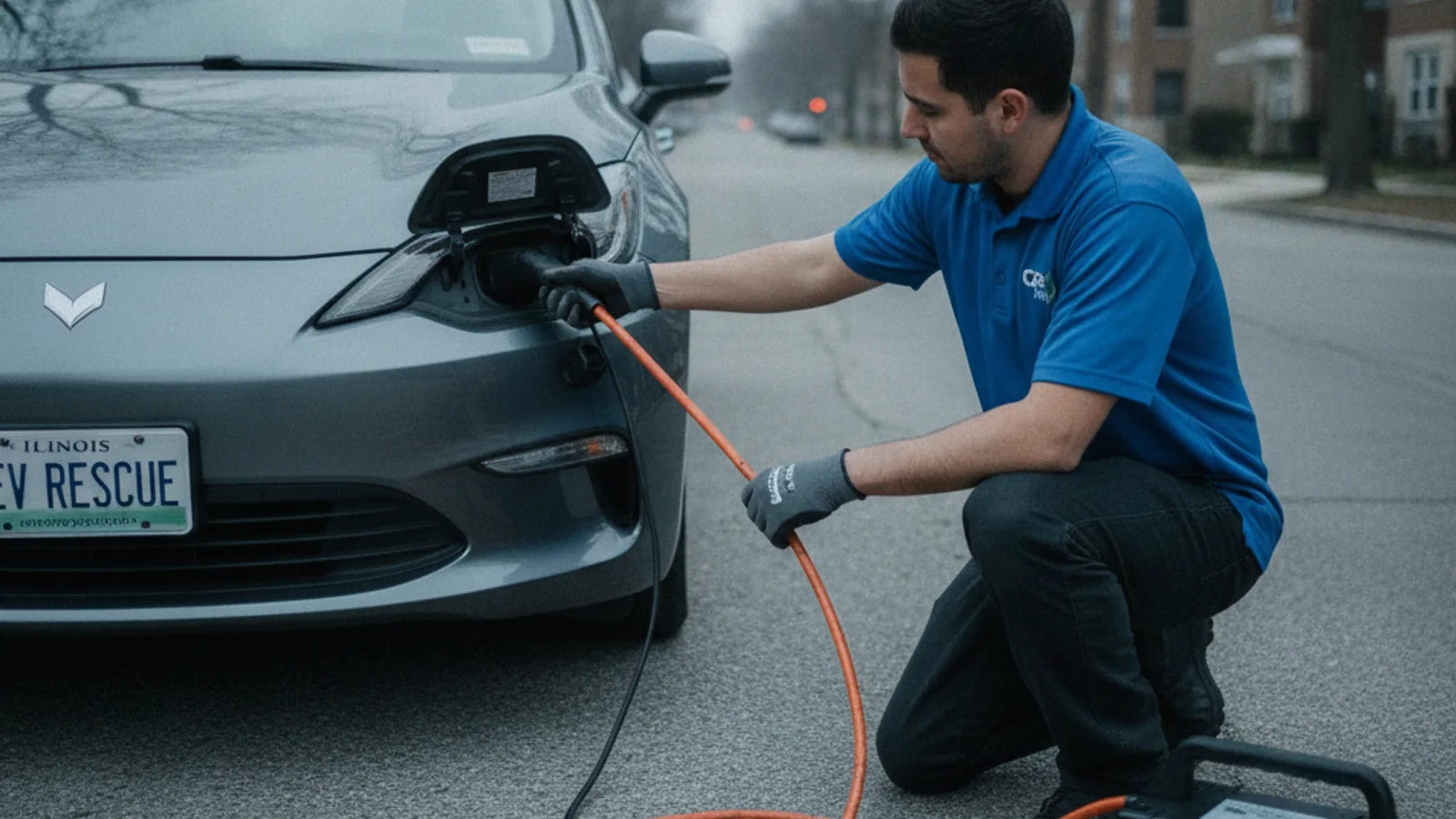
A mobile operator brings a 240V Level 2 source to the car. The vehicle carries a native NACS plug. For non-Tesla EVs, the operator uses a CCS or J1772 adapter. On-scene charging is typically 15 to 30 minutes. That window usually adds about 10 to 20 miles of range. That’s charging time. It isn’t an arrival time.
The operator quotes you before any work starts. The operator bills you directly. Charge Pro CHI doesn’t set that price. We don’t own the truck. We don’t employ the technician. We connect you with independent local mobile rescue operators across Chicagoland. That includes every part of Cicero.
They handle Tesla and every major EV brand. If the car won’t wake up, the 12V battery is often the real fault. Operators can jump or replace a dead 12V on site. That’s a different job from filling the high-voltage pack. Say which problem you have so you don’t buy the wrong service. Keep the cabin off while you wait if you still have a little range. Heat and AC spend miles you may need.
A weeknight in Cicero when the wall box never arrived
You come off the Eisenhower or Cicero Avenue with a low pack. The two-flat doesn’t have a dedicated 240V receptacle. The owner hasn’t signed off on a panel talk. ComEd hasn’t been asked about a service change. Tomorrow’s still a workday. You may not have the range left to make another charging stop tonight. That’s the moment a mobile 240V visit is the recovery. It isn’t a substitute forever. It’s how you keep the car in service while the building stays the building.
Why a Naperville or Schaumburg quote doesn’t travel
Electricians price the building in front of them. A post-1980 Naperville house isn’t a Cicero two-flat. Only 11.7% of Naperville housing predates 1980. Schaumburg’s pre-1980 share is 15.9%, so much of the stock is newer than Cicero’s. Copying that quote into ZIP 60804 doesn’t help. Bring photos of your panel. Bring the year of the building if you have it. Bring the owner’s name if you rent.
Cicero next to Berwyn, Oak Park, and Chicago
Berwyn shares the pre-1980 profile. Oak Park’s housing is also old, at 78.6% before 1980. Stickney sits on the south edge. Chicago is immediately east of town. A charger quote on one side of the line isn’t portable. It isn’t a quote on the other side. The buildings change in a few blocks.
North Shore towns often start with spare panel room. Cicero starts with who owns the place and how old the panel is. Western suburbs with new subdivisions aren’t useful comps. Use Naperville’s 11.7% pre-1980 share only as a contrast. It shows Chicagoland isn’t one housing market. You work in Chicago and come home on the Eisenhower. The last miles are still Cicero miles. A wall box that never gets installed doesn’t care which city you crossed. Recovery is still 240V at the building. Or it’s 240V from an operator at the curb.
When a wall box is in and it still fails
Some Cicero owners do get a circuit. Then a breaker trips, a GFCI faults, or the charger throws an error overnight. You wake up to a car that didn’t take power. That’s a mobility problem first. The electrician can return on their clock. You may need to leave on yours.
A mobile 240V boost doesn’t repair the wall box. It puts enough range in the pack to get you moving. Then you sort the wiring on your own time. If the car itself won’t start, check the 12V first. Dim lights, a silent dash, or doors that won’t latch are 12V clues. They aren’t pack clues. Don’t keep retrying a dead wall box until you’ve used the last mile. Get the car moving with a mobile charge, then call the electrician.
Frequently asked questions
Can a typical Cicero house take a Level 2 charger?
Sometimes. 90.2% of housing here was built before 1980. Many buildings need extra electrical work, owner approval, or both. A load calculation is the only honest answer for your address. We couldn’t verify a citywide yes or no.
What if my landlord won’t allow a wall charger?
Then you’re charging away from home until that changes. When you run short, Charge Pro CHI can connect you with an independent operator. That operator brings 240V to the curb, quotes first, and bills you directly.
How do I keep driving while I wait on an electrician?
A 120V outlet is slow. Public charging still works if you can reach a site you already use. The operators we send bring Level 2 to the car. They typically add 10 to 20 miles in 15 to 30 minutes of charging.
If the house can’t take the charger, you still have a path
Cicero’s housing era is the story. It isn’t a missing map pin. Get the load calc. Ask the City of Cicero about permits. Confirm any ComEd program on ComEd’s own pages. If the building can’t take the circuit, stop waiting on that wall box.
When you need range at the curb, call Charge Pro CHI at (858) 925-5546. We’ll connect you with a local operator who quotes the job before they start. The mobile EV charging service page explains what that visit looks like.