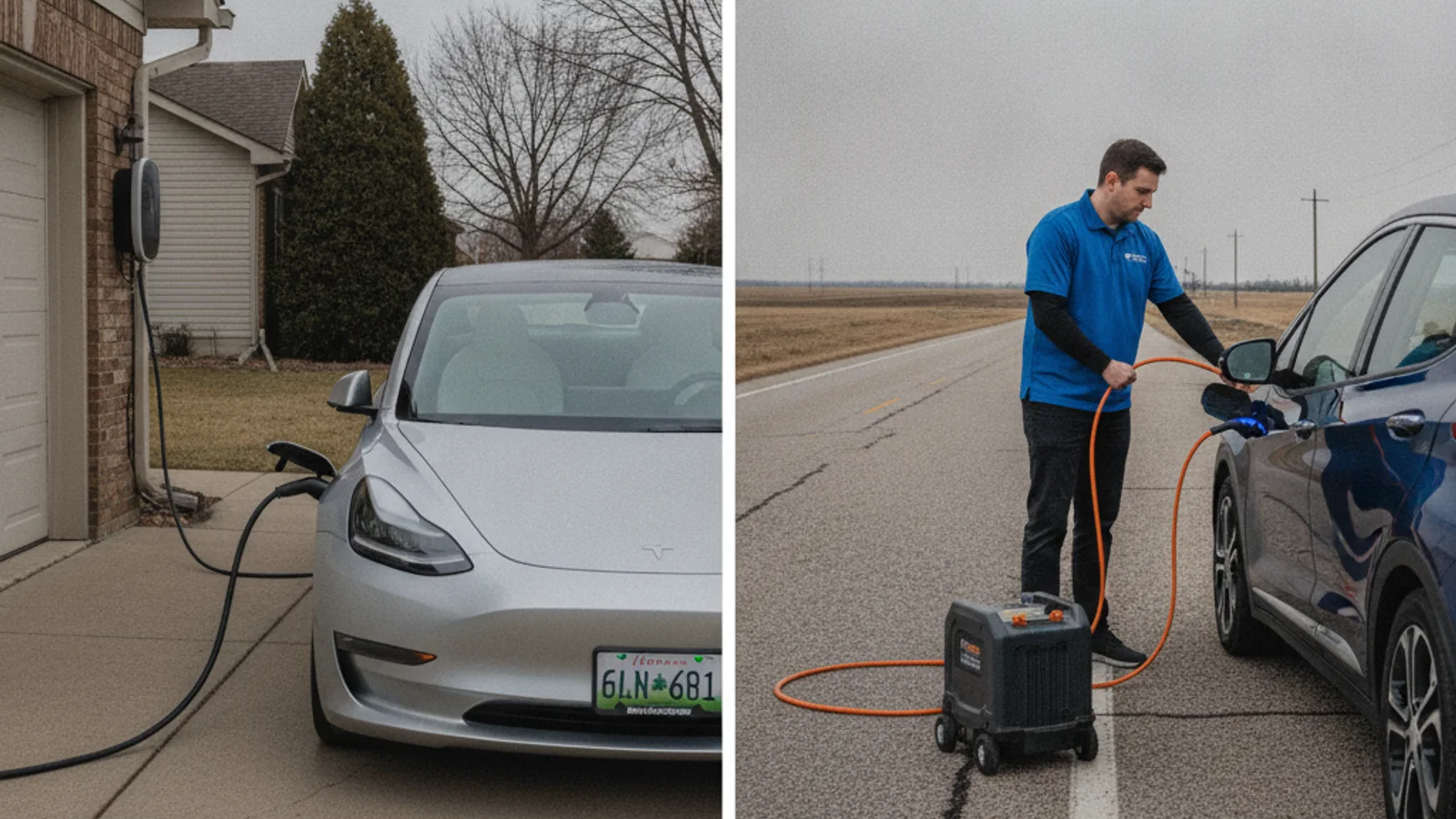
A 240 volt EV charging station is the Level 2 box at home. It fills the pack on a circuit you control. It stays on the building and doesn’t travel with the car. Chicago curb parking and a stall on the Dan Ryan share that limit. When that wall box isn’t available, a mobile Level 2 boost is the backup.
What a 240 volt EV charging station is
At a house, 240 volts usually means Level 2 charging. The U.S. Department of Energy treats residential Level 2 as 240-volt service. Some commercial sites run 208 volts on commercial service instead. Voltage alone doesn’t set how fast the pack fills. Circuit size, station output, and the car’s onboard charger all matter.
Level 1 is the 120-volt outlet already in most rooms. It works for a trickle, but it’s slow. Our Level 1 charger note explains when that outlet isn’t enough. A 240 volt EV charging station is the home step up. It only exists if the property can feed it.
DOE guidance puts Level 2 near 25 miles of range per charging hour. Treat that as charging performance, not a promise. Pack size, weather, and the vehicle’s charge rate all change it. That figure isn’t a roadside arrival claim for any operator. It isn’t a guarantee for every EV on every night.
Charge Pro CHI doesn’t hang wall boxes or run new circuits. We don’t pull wire through a garage. We connect stranded drivers with independent local operators. Those operators bring a 240-volt Level 2 source to the car. They quote before they start and bill you directly.
Home charging only exists where the house can support it
A home station needs a parking space you control. It also needs a circuit that can carry the load. That’s a property fact, not a product fact. The station can’t invent a garage, a driveway, or spare panel capacity.
Chicago’s housing stock is old by a wide margin. Census ACS 2019-2023 figures put 68.6% of Chicago units in buildings from before 1980. Cicero sits at 90.2%, and Berwyn is 90.0%. Oak Park is 78.6%, and Evanston is 71.2%. Skokie is 72.0%, and Wilmette is 74.3%. Evergreen Park is 87.7%, and Park Ridge is 67.1%. Older panels and shared two-flats make a dedicated 240-volt circuit a real electrical project. Curb parking on those blocks is another limit. The wall box has nowhere to live on the street.
Newer suburbs start from a different housing mix. Naperville’s pre-1980 share is 11.7%, and Gurnee is 9.5%. Plainfield is 6.7%, and Huntley is 3.8%. A two-car garage off a cul-de-sac isn’t a Cicero street stall. Schaumburg’s housing is newer too, at 15.9% pre-1980. Office-park parking and a home garage feel like two different EV lives there. See our Cicero home charging note for that housing limit.
A licensed electrician has to read the panel and the household load. They also judge the proposed station against everything else on that service. Charge Pro CHI doesn’t do that panel walkthrough. We don’t file electrical permits or inspect your panel. Those rules sit with the local building department. Confirm the process for your address before anyone opens a wall. If the house can’t take a 240 volt EV charging station, you hire an electrician. That call isn’t a rescue call for a stranded car.
Chicago street parking is the other hard line. A wall box can’t sit on the curb. Overnight charging on the block isn’t a Glenview garage or a Wheaton driveway. Highland Park and Northbrook have more attached garages than a typical North Side two-flat. The station still stays at the address, and the car doesn’t. Street parking means you don’t have home 240 volts at the bumper.
A mobile Level 2 boost is a different tool
A mobile boost brings 240-volt Level 2 power to the EV. The car stays where it already sits on the street. Independent operators we connect you with typically add 10 to 20 miles of range. That usually takes 15 to 30 minutes of charging at the car. It isn’t a clock on when a truck appears.
Tesla drivers usually get a native NACS plug. Other brands need a CCS or J1772 adapter. The operator matches the connector on your car. Don’t choose an adapter because it looks close. The owner’s manual for that make, model, and year is the rule.
The job is enough range to reach a charger you can use. Sometimes that boost is enough to get home. It also isn’t a replacement for a home 240 volt EV charging station. Our stranded charging-levels guide maps Level 1, Level 2, and DC fast charging.
A no-start isn’t always an empty pack. The 12-volt battery runs computers, contactors, and door latches. If that battery is dead, the car can look fully dead. Range can still sit on the traction pack. Operators can jump or replace a 12-volt battery on site when that’s the failure. A 240-volt boost won’t wake a car that can’t close its contactors.
A fixed outlet can’t follow you onto the road
A 240-volt receptacle only helps if the EV can reach it. The car also has to sit safely and use matching equipment. A dryer plug in a friend’s garage isn’t a charging plan. The owner, the circuit, and the car all have to agree. A familiar-looking outlet on a loading dock isn’t yours to use.
That home station does nothing if you’re already on the Kennedy. The same limit holds on Lower Wacker, the Eisenhower, I-55, and the Tri-State. The Jane Addams and the Bishop Ford don’t carry your garage circuit either. The box is still on the house you left. Public charging only helps if you have the range to get there. The stall also has to be free, and the connector has to match. We don’t guess the distance to the next site. Use the car’s map and the network app for live status.
A wall box that failed in the driveway is still a home problem. The breaker, the station, or the car may need diagnosis while you’re parked. Our Aurora home-charger note covers that split. Stay with the electrical problem if the car is already home and safe. If you’re away from home and can’t reach a charger, use out-of-charge recovery.
Immediate hazards come first, before any charging plan. Smoke, fire, a collision, or traffic that can hit you is an emergency. Charging advice waits until you’re clear of that danger. Once you’re out of the lane, an operator can judge a boost or a tow.
Boost or tow, decided at the car
A mobile charge can fit when the pack is empty. The car has to accept power at that location. Someone also has to work at the stop. Access, slope, traffic, and the connector all get a look before the operator commits. A tight Chicago alley is a different work site than a Naperville driveway.
Our mobile charging truck note shows the equipment side. The mobile EV charging page is how Chicagoland drivers get the referral. Charge Pro CHI makes the introduction, not the repair. The matched operator does the physical work on site. They explain the option and set terms with you.
A tow can be the better path when the car refuses power. A fault on the screen can point the same way. A stop that can’t support a 240-volt session can too. The operator can say whether the EV should go to a charger or a shop. You can also name an address you pick. Confirm that destination’s connector, and confirm it’s actually available. An app pin isn’t a hold on a stall.
Before you accept, ask what equipment they’ll use. Ask what range they expect to add on this stop. Ask what you’ll pay before they start. Charge Pro CHI doesn’t set operator prices. We don’t warrant the work they perform. No single metro figure exists, because the provider and the stop set the quote. Get those details from the person who’ll do the job.
Details that help the operator help you
Start with the exact make, model, and year. Read every warning message the screen is showing. Note remaining range and the port type on the car. Say whether the car can shift, steer, or take a charge. Give a precise pin so the operator can find the car. Name the Chicago block or the Naperville garage. Name the Joliet lot or the Schaumburg office park. Name the shoulder if you’re on the Jane Addams.
Say if this looks like an empty pack or a 12-volt no-start. The operator quotes before starting, and you pay that operator. You don’t pay Charge Pro CHI for the work. We connect drivers across Chicagoland, including Waukegan, Evanston, Elgin, Aurora, and Joliet. Coverage is the metro, and the operator still has to reach your pin.
When to call
Call when the EV can’t reach a usable charger. You need an operator to judge a 240-volt boost or a tow. Charge Pro CHI matches stranded drivers with licensed, independent local rescue operators. Call (858) 925-5546 and we’ll connect you with a local EV rescue operator.