Ice can glue a Mustang Mach-E charge port shut after an overnight plug-in. A weak 12-volt battery can do the same thing. So can a public charger that never closed the session. That’s a real Chicagoland winter stall, not a rare glitch. The latch is electric, and cold starves it. Ford hid a manual pull strap in the frunk for this. Use that before you yank the CCS handle.
Winter is what turns a sticky latch into a stall
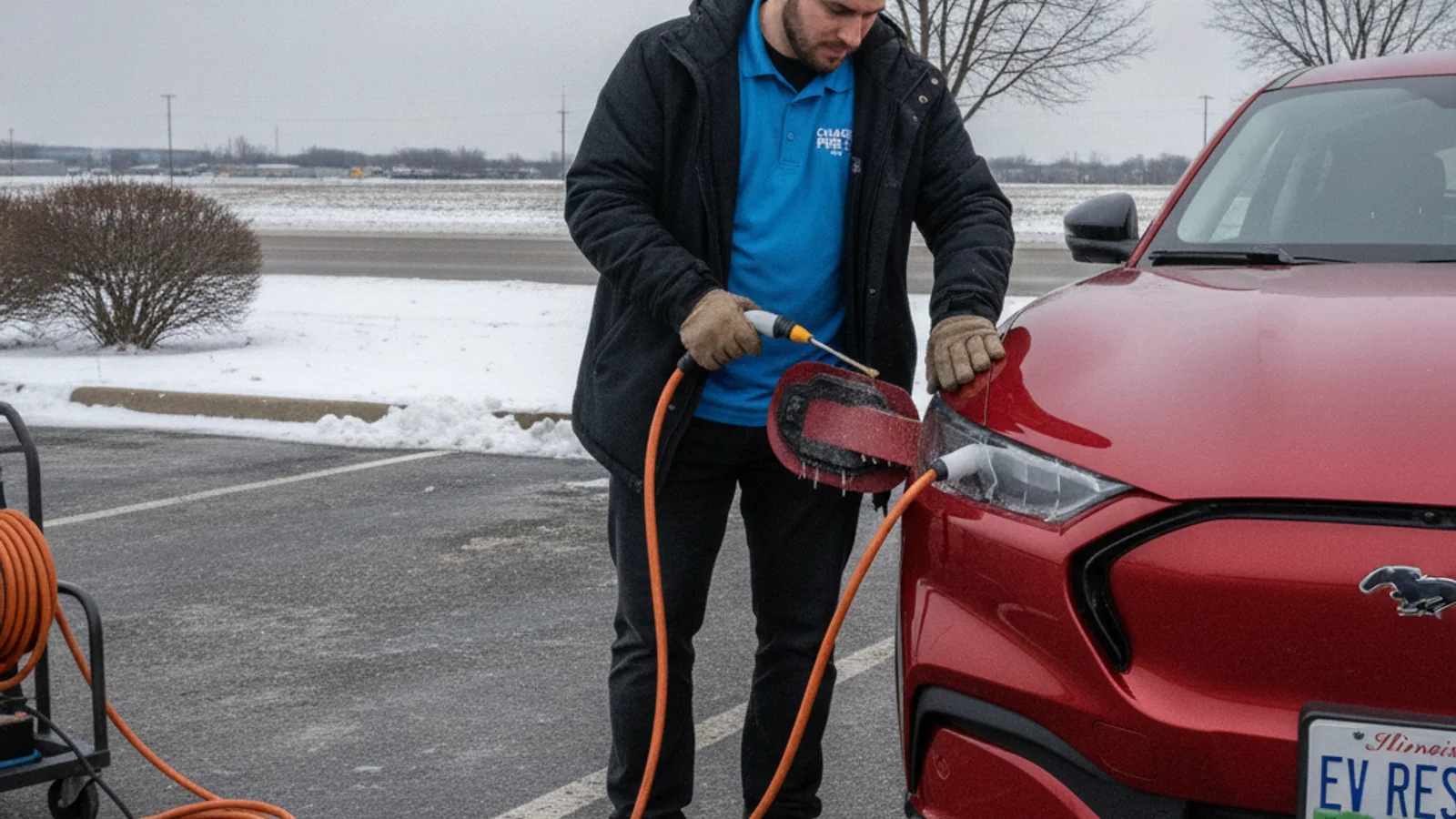
This metro’s freeze-thaw cycle is the trigger. Road slush and melt run into the charge door overnight. Then temps drop again before morning, and ice takes the door. A thin skin of ice can also hold the CCS handle. The electronic latch can fail at the same time if the 12V is down.
That mix shows up in Cook, Lake, DuPage, Kane, Will, and McHenry counties. It doesn’t look the same on every block.
Chicago’s housing is old: about 68.6% of city homes predate 1980. Oak Park sits at 78.6% pre-1980, and Evanston is 71.2%. Skokie is 72.0% and Wilmette is 74.3%. Cicero is 90.2% pre-1980, and Berwyn is 90.0%. On those blocks, many Mach-Es charge at the curb. They’re not sitting in a warm garage.
The port faces weather all night. Ice builds where a closed garage would’ve kept it dry. Oak Park EV charging follows that older Cook County pattern.
Newer suburbs read differently. Naperville’s pre-1980 share is 11.7%, and Plainfield is 6.7%. Huntley is 3.8% and Gurnee is 9.5%. More of those cars wake up indoors. They still ice up after a public DC fast charge. A Schaumburg office lot can leave the same locked handle. So can a Joliet work stall at the end of a shift.
The car didn’t fail in a special way. Winter did what winter does here.
Two stucks that feel the same from the sidewalk
Owners treat every seized port as one problem, but the cause isn’t always ice.
The first is ice on the motorized charge door. The door won’t swing, and FordPass may still show it closed. You never even see the CCS inlet. Let cabin heat run, then try the door command again. Don’t pour boiling water on the port. Don’t pry the door with a tool. You can crack the door or the inlet.
The second is a locked CCS connector. The door’s already open, but the handle won’t come out. The car thinks it’s still charging, or the station does. Or the latch solenoid never got enough 12V to let go.
A third case sits on the station side. The Mach-E has ended the session, and the public unit hasn’t. The handle stays clamped until that network releases it.
For the shared steps across brands, start with how to unlatch an EV charging cable that’s stuck in the port. The Mach-E frunk strap is the Ford-specific piece.
Water left in the inlet is a separate winter hazard. Water in your EV charge port explains why you shouldn’t plug into a wet inlet.
What to try at the car first
Start with the session, not the handle.
Open FordPass and confirm the charge has actually stopped. On a public unit, end the session in that network’s app or on the screen. Walking away at a full pack doesn’t always close the station’s lock.
Press the release on the CCS handle once. Pull straight back with steady pressure. If it doesn’t move, stop. Forcing a locked connector can bend pins or crack the housing. That turns a morning delay into a dealer visit. A parts price for a Mach-E port assembly couldn’t be confirmed for this page. Ask a Ford dealer for a current quote if the inlet’s already damaged.
If the door itself is iced, wait for a little cabin heat. Try the door command again. Don’t hammer the door or chip at the latch with a key.
If the car’s dark or the door motor never tries, treat it as a 12V problem.
The latch runs on the 12-volt battery
The Mach-E charge door motor and the connector latch both draw from the 12V system. The high-voltage pack can still show a healthy charge. The small battery can still be too weak to fire the solenoid.
Cold makes a weak 12V worse. A battery that felt fine in October can sag after a night at the curb. Evergreen Park’s housing is 87.7% pre-1980, so cars there often sit outside. Homewood and Chicago Heights follow a similar older-stock pattern.
Symptoms can mimic a frozen door even when ice is thin. The charge port light may blink, or FordPass may show an error. The door may ignore a command. The connector may stay locked after you ended the session cleanly.
Don’t assume the pack is empty. Check the 12V path first. What to do when your Mustang Mach-E won’t start covers the no-start version of the same battery.
If the 12V is dead, the frunk may not open from the app. You’ll need a jump at the under-hood auxiliary point first. The positive post sits behind a small cover near the driver-side strut tower. Ground to a clean body bolt. If you’re not comfortable with that, stop. A mobile operator can jump the 12V on site.
Software hangs happen after a public DC fast charge that didn’t close cleanly. A restart of the car can clear some of those. It won’t help if the 12V can’t hold voltage.
The frunk strap is the override Ford built in
Ford put a mechanical release in the front trunk. It bypasses the solenoid. That’s the move when the latch has power problems.
Open the frunk from FordPass, or use the hood release in the cabin. If the 12V is dead, jump it first as above.
Look toward the driver’s side of the frunk floor, near the back wall. You want a bright orange loop, yellow on some years. It looks like a heavy zip-tie handle. A cable runs from that loop to the charge port latch.
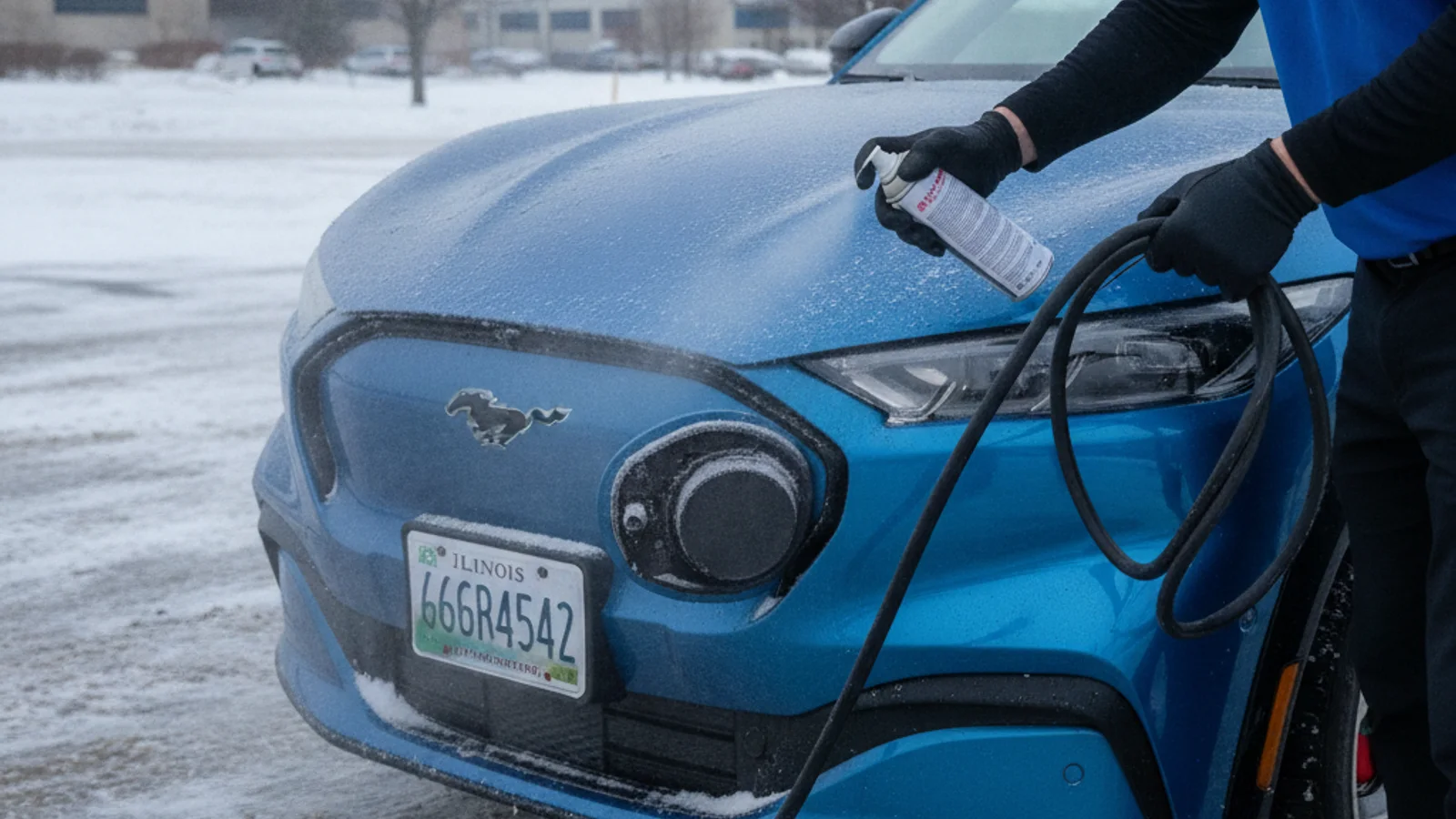
Pull once, firm and steady. Don’t yank. You should hear a soft click at the port. Go back to the handle, press the CCS release, and draw the connector out.
That strap is a workaround. It doesn’t repair a weak 12V. It doesn’t fix a station that’s still holding the lock. If the stall repeats the next cold night, the 12V or the software hang is still there.
When the strap moves and the handle doesn’t
Pay attention to how the strap feels.
Firm resistance usually means the cable is intact. You overrode an electrical latch. If the connector still won’t move after a solid click, the station may be holding the handle. Go back to the unit’s app, screen, or the support number printed on the cabinet. Give them the station ID on the label. Ask them to release the connector remotely. How long that takes couldn’t be confirmed here. It varies by network and hour.
Almost no resistance on the strap is a worse sign. The cable may be slack or unhooked. The hook inside the port may be bent. You won’t fix that on the street. Don’t keep pulling until something snaps.
Don’t wait for a station to reboot as your plan. It might release, and it might not. A January stall in a Schaumburg office lot isn’t the time to gamble on a reboot. Neither is a Waukegan public unit after dark.
Street parking in old Cook County, garages farther out
This search spikes after the first hard freeze because so many Mach-Es sit outside. Cicero, Berwyn, Oak Park, and Evanston still mean overnight cords at the curb. Slush hits the port, and morning ice locks it.
Naperville, Wheaton, and Downers Grove put more cars in garages. The bind there often starts at a DC fast charger after a commute. Joliet, Bolingbrook, and Elgin add long work-lot sessions that never closed. Crystal Lake and McHenry see the same winter latch stalls farther north.
A garage stall still ices if you plug in wet. A public CCS unit can hold the handle in any suburb.
If you’re already empty after the stall, freeing the port and adding range are different jobs. A mobile EV charging boost is the range call. Free the connector first, then see whether the pack actually needs energy.
When you should stop DIY and call
Most frozen Mach-E ports free with heat, a closed session, or the frunk strap. Some don’t.
Stop if the 12V is dead and you can’t open the frunk. Stop if the strap is missing, broken, or limp. Stop if the CCS housing looks cracked. Stop if you’re on a public unit and the network won’t release the handle.
Charge Pro CHI is a referral line. It doesn’t own trucks or employ technicians. It matches you with independent local mobile rescue operators. Those operators can jump or replace a dead 12V on site. They can bring a 240V Level 2 source to a Mach-E with a CCS adapter. That typically adds 10 to 20 miles of range in 15 to 30 minutes of charging. That’s charging time, not an arrival time. The operator quotes you before starting and bills you directly.
A 12V jump can restore latch power so the door and solenoid work again. A mobile boost doesn’t unlock a public station’s connector. It also doesn’t replace a bent latch inside the port. If the inlet is mechanically damaged, you still need a Ford service visit after you’re unstuck.
Non-Tesla EV rescue is the service path for Mach-E owners in that spot. Non-Tesla EV rescue in Chicagoland explains how the match works when you’re not in a Tesla.
Call (858) 925-5546 when you’ve tried the strap and the handle still won’t come out. An operator will quote the work before anything starts.