Your Mustang Mach-E sat at the curb through a cold Chicagoland night. In the morning the screens stay dark, and the fob does nothing. That stall is usually the small 12V battery, not an empty drive pack.
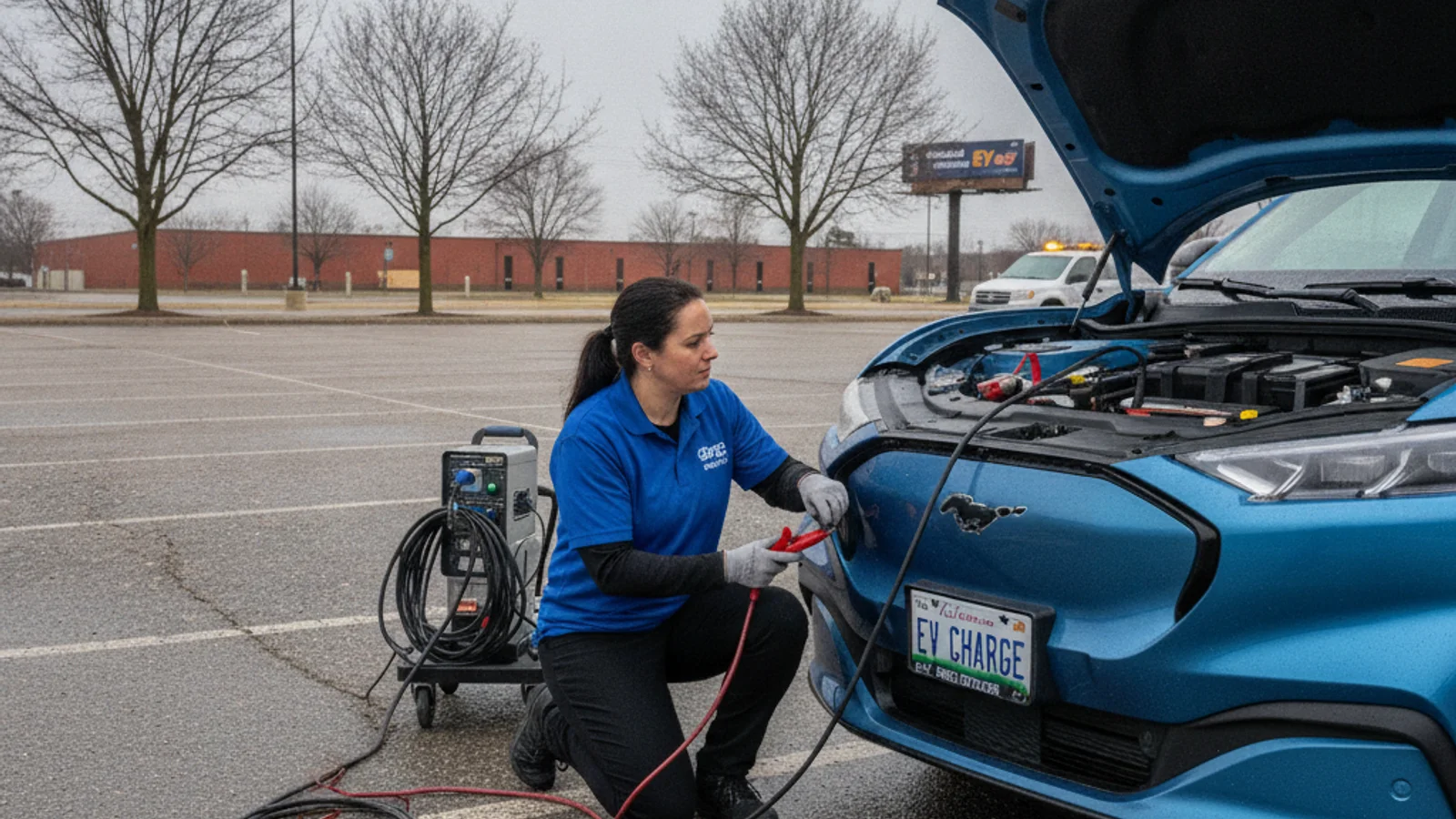
Cold nights and street parking hit the 12V first
A Mach-E still needs a regular 12-volt battery to wake up. That battery runs the computers, locks, lights, and the contactors that tie in the high-voltage pack. When the 12V is flat, the car won’t boot. The pack can still hold a full charge.
Street parking is common on older Cook County blocks. Chicago’s ACS 2019-2023 count puts 68.6% of housing in buildings from before 1980. The city’s 2024 population estimate is 2,721,308. Oak Park sits at 78.6% pre-1980 housing. Cicero is 90.2%, and Berwyn is 90.0%. Evanston is 71.2%, Skokie is 72.0%, and Evergreen Park is 87.7%. A Mach-E left on these streets overnight still feeds the alarm and the key receivers. Cold nights raise that drain on a curb. By morning the 12V can be too weak to close the contactors.
Newer suburbs show a different housing mix. Naperville’s pre-1980 share is 11.7%. Gurnee’s is 9.5%, and Plainfield’s is 6.7%. The same 12V can still fail there after a week of short winter trips. It just spends fewer nights sitting on a curb.
Highland Park in Lake County is 60.6% pre-1980. Waukegan is 54.0%. DuPage towns run younger than inner Cook. The 12V still dies after short winter trips in those towns. The curb in older Cook County just makes it fail first.
Ford truck owners see the same 12V stall. If you also drive a Lightning, start with the Ford F-150 Lightning won’t start checks.
A dark cabin isn’t the same as an empty pack
A no-start feels like a range problem. On a Mach-E, those are two different failures.
A dead 12V looks quiet, with black screens and a fob that may not unlock. You might hear a click, or see a brief flicker, then nothing. The charge port may ignore a plug, because the car can’t wake to start a session.
A low high-voltage pack behaves the other way. The car often still boots, and you can read the display. You just can’t go into drive, or power is limited. The cluster talks about low charge or restricted power.
What happens when an EV 12-volt battery dies in the cold walks through that split in more detail.
Don’t assume you need a tow. Don’t assume you need a pack charge either. Sort the two batteries first.
Messages that point at the 12V
When the cluster still has power, the wording matters.
“System Off to Save Battery” and a shutdown countdown usually mean the 12V is fading. The car is shedding loads to stay alive.
“Key Fob Not Detected” can be the coin cell in the fob. It can also be a weak 12V that can’t power the receivers. Swap the fob battery if you’ve got a spare. Then try the fob from a few spots around the car.
A fully blank screen is the classic dead 12V. There isn’t enough voltage left to draw a warning.
“Stop Safely Now” is a different class of fault. That one usually points at the high-voltage side or another critical system. Don’t treat it like a simple jump. Get the car somewhere safe, then call.
“Service Vehicle Soon” is a general flag. It may not block a start today. It still needs a shop if it stays on after the 12V recovers.
Snap a photo of the exact wording. That helps the operator you call later.
Checks before you open the frunk
Try the other key if you’ve got one. A single dead fob looks like a dead car.
Watch the door locks and the interior lights. If nothing responds, the 12V is the lead suspect.
If the car still shows a range number, the pack probably isn’t empty. If it boots and then refuses to roll, treat it as a pack or drive-system issue.
Think about how the car sat overnight. A Mach-E left awake on the street will flatten the 12V faster than one that slept. Accessory mode on a Cicero or Berwyn curb will do that. The same thing happens on an Oak Park or Chicago side street.
Short hops around Evanston, Skokie, and Chicago don’t give the 12V a long recharge window. The DC-DC converter only tops up the 12V once the car is fully awake. A string of short trips in the cold leaves it behind.
If the charge door is iced shut, that’s a different problem. Free the door first, because a jump won’t open a frozen latch.
Where Ford put the 12V
Ford put the Mach-E’s 12V up front, in the frunk. It isn’t in the rear cargo well.
Open the frunk with the fob or the interior release. On the passenger side you’ll see a plastic cover. Clips or fasteners hold that cover down. Lift it and you’ll see a small conventional 12V battery.
Ford also gives you jump posts that are easier to reach than the battery clamps. Look for a positive post under a red cap. The negative is usually a bare metal ground bolt or bracket nearby. Use those posts if you jump.
A multimeter tells you more than a guess. Set it to DC volts, then touch red to the positive terminal and black to the negative. A healthy rest voltage sits near 12.6 volts. A reading under 12 volts, and especially down around 11.5, means the battery is discharged or failing.
A low reading isn’t always a ruined battery. It may take a jump, then hold for a while. If it goes flat again after a day, plan on a replacement. If it dies again the next morning, read what to do when an EV 12V dies after a jump.
Jump the 12V only
You’re not jumping the high-voltage battery. You’re only waking the 12V system.
You need jumper cables and a running 12V source, or a portable jump pack. Keep both vehicles off until the clamps are set.
On the Mach-E, red goes to the positive jump post. Black goes to the marked ground point.
On the donor car or pack, red goes to positive. Black goes to negative or a clean ground.
If you’re using another car, let it idle while some charge can move. Then try to power the Mach-E. If the screens come up, the 12V took the charge.
Pull the cables off in reverse. Negative off the donor first, then positive off the donor. Then negative off the Mach-E, then positive.
Keep the Mach-E awake after it starts. Drive it, or plug it in. The car’s DC-DC converter can refill the 12V from the pack once the contactors are closed. If you shut it down in the same street spot, it may be dead again by morning.
Follow the owner’s manual if it disagrees with any of this. Ford’s diagram for your model year wins.
For a winter-focused walkthrough, use how to jump start an electric car in winter.
When a jump still leaves you stuck
Some no-starts aren’t 12V.
If the car wakes, shows a low pack, and won’t go into drive, you need energy in the high-voltage battery. A jump pack won’t fill that pack. A mobile EV charge from an operator can add range on site. The pros we send bring a 240V Level 2 source. They use a CCS or J1772 adapter on a non-Tesla like the Mach-E. Charging time is typically 15 to 30 minutes for about 10 to 20 miles of range. That’s time on the plug, never a promise of when someone arrives.
If you can’t tell which battery failed, say that when you call. The operator quotes you before any work starts, and bills you directly.
A tow is the last move, not the first. A Mach-E that won’t wake often needs a 12V jump, not a haul. If you do need a tow, confirm flatbed handling for an EV with whoever hooks the car. We don’t publish tow prices, and we don’t set them.
Charge, jump, or tow is the decision most owners actually face.
What to tell the operator
Say that it’s a Mustang Mach-E that won’t start. Say whether the screens are black or the car woke and then refused to roll. Say whether you’re on a street, in a lot, or in a driveway. Mention the last message you saw.
If the doors won’t unlock, say that too. The operator can plan for a 12V jump at the front posts.
Charge Pro CHI is a referral line. We don’t own trucks, and we don’t do the work. We match stranded EV drivers with independent local mobile rescue operators.
The operators we connect you with are licensed and insured. They handle Tesla and every major EV brand, including Ford. They can jump or replace a dead 12V on site. They can also bring that Level 2 boost if the pack is the problem.
That help covers Chicago and the rest of Chicagoland. It includes Oak Park, Cicero, Berwyn, Evanston, Skokie, Evergreen Park, Naperville, Gurnee, Plainfield, and the other cities we serve.
If you’d rather not open the frunk in the cold, skip the DIY. Call (858) 925-5546 and we’ll connect you with a local operator. Ask for a quote before they start.
For Mach-E owners outside the Tesla network, non-Tesla EV rescue is the service page to read next.