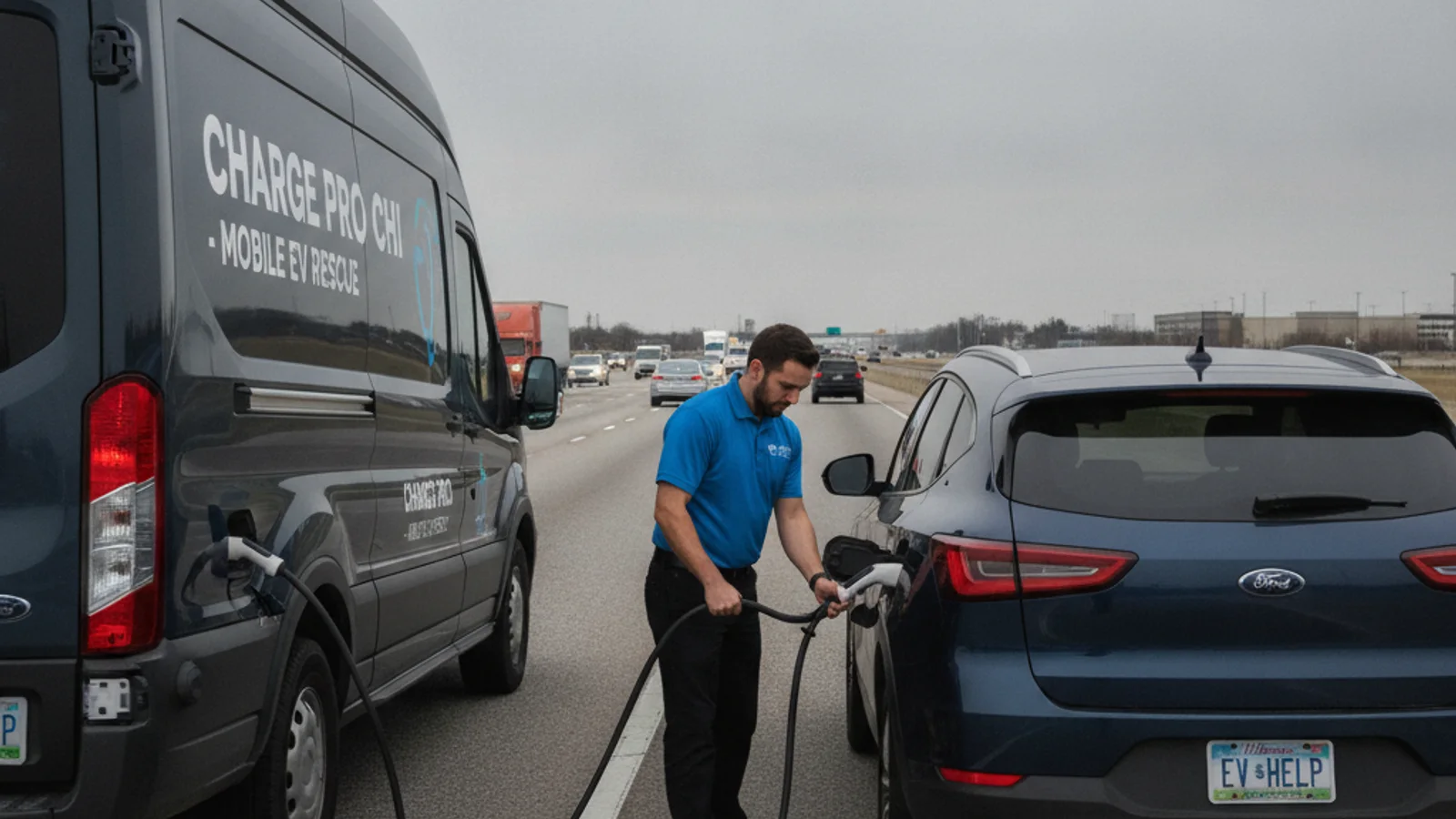
If your EV pack hits empty on I-55, get off the live lane first. Pull as far right as the pavement lets you. Turn the hazards on while you’re still slowing down. Stay with the car while you make the next call. Then get a local operator on the phone for a 240V boost. Charge Pro CHI is a referral line, not a fleet owner. We match stranded drivers with independent operators across Chicagoland. They quote before they plug in, and they bill you directly.
I-55 is a logistics belt, not just a commute
I-55 through this metro does two jobs at once. In Chicago it’s the Stevenson Expressway, where household EVs mix into the downtown commute. Southwest of the city it feeds Will County warehouse and distribution trips. Personal cars and fleet vans share the shoulder when a pack hits zero.
Chicago’s 2024 population estimate is 2,721,308, per Census Bureau figures. ACS 2019-2023 figures put Hispanic or Latino residents at 29.6% of the city. 68.6% of housing predates 1980, which shapes overnight charging at home. It doesn’t prove anything about a plug on the Stevenson itself. Confirm any station in the app you already use.
Cicero sits in the same Cook County band of older housing. The city’s 2024 Census estimate is 82,090 people. Hispanic or Latino residents are 88.8% of Cicero. Pre-1980 housing is 90.2% of the stock. Street parking and older garages are normal there. A thin morning pack plus I-55 traffic is a hard mix. We still won’t guess a mileage to the next charger. That figure isn’t in the research behind this page.
The housing story flips as you head into Will County. Bolingbrook’s 2024 Census estimate is 74,756 people. Only 12.3% of Bolingbrook homes predate 1980. Plainfield’s 2024 Census estimate is 48,881 people. Pre-1980 housing in Plainfield is only 6.7%. Newer garages can hide a wall unit at home. They still don’t block a stall after a long shift.
Joliet is the large Will County city on this belt. The 2024 Census estimate is 151,837 people. Hispanic or Latino residents are 34.7% of Joliet. Romeoville’s 2024 Census estimate is 41,177 people. Hispanic or Latino residents are 35.7% of Romeoville. Those cities mix school-run commutes with industrial work. Fleet EVs finish routes here, and commuter EVs start them.
We didn’t find a verifiable I-55 truck count in the census files. We also didn’t find a published EV fleet count for this corridor. Don’t treat a round number on a blog as official. The local fact we can stand on is the city mix. Chicago and Cicero sit on the Cook County end. Bolingbrook, Romeoville, Plainfield, and Joliet sit on the Will County end.
Why a pack dies here even when the morning looked fine
Creep in Chicago traffic still uses energy from the pack. The motor isn’t off because you’re moving at walking speed. Heat or AC keeps drawing from the same battery. A buffer that looked fine in a quiet suburb can vanish here. A stop-and-go Stevenson crawl is where that buffer goes.
That’s an energy story, not a map of plugs. This page doesn’t list I-55 charging sites. We didn’t verify a named, freeway-ready station in the research packet. If your map shows a live plug you can reach, use it. If it doesn’t, don’t invent a backup distance in your head.
Fleet runs fail in a different way on this belt. The van sits at a dock while accessories still sip power. The driver leaves late with less pack than the route assumed. Then I-55 traffic holds them in place. They don’t need a scolding about planning. They need range to clear the shoulder and get off the road.
Watch the 12V battery too, not just the main pack. An EV can show miles and still refuse to ready. The 12V closes the contactors that wake the high-voltage system. Cold, age, and short trips are hard on 12V batteries. If the screens went dark, say that when you call. Operators in this network can jump or replace a 12V on site. They also handle Tesla and every major EV brand.
Shoulder first, diagnostics second
You’re on a high-speed road with people behind you. The empty pack can wait one extra minute. Get every tire as far right as you can. Don’t assume a wide, comfortable shoulder at your mile. We couldn’t confirm shoulder width at each I-55 location. Use the edge you can see from the driver’s seat. That might be a guardrail, a painted line, or a gravel strip.
Hit the hazards early, not after you’ve fully stopped. Drivers behind you need that flash while you’re still slowing. Once you’re stopped, stay out of the travel lane. If you step out, use the passenger door only. The driver’s door dumps you into live traffic. Stay behind the right rear corner of the car. Don’t walk down the shoulder looking for a better pull-off.
Call 911 if you’re in a lane or on a blind curve. Call 911 if anyone is hurt or out of the car in traffic. Give your direction, the last exit, and a mile marker. We didn’t confirm a specific patrol-district name for I-55. 911 routes the call to whoever covers that mile. Repeat your location rather than guessing an agency.
Stay with the vehicle unless a responder tells you otherwise. Walking toward lights in the distance is how people get hit. If you stay inside, lock the doors and leave the hazards on.
What the operator actually does on the shoulder
Charge Pro CHI doesn’t hold a trade license for this work. We don’t own trucks, yards, or a parts warehouse. Independent operators do the charging and the 12V jobs. They bring a 240V Level 2 source to your charge port. Teslas get a native NACS plug from those operators. Other EVs get a CCS or J1772 adapter on the same visit.
Typical charging time is 15 to 30 minutes. That’s time on the cable, never an arrival clock. In that window the car typically gains about 10 to 20 miles. That’s a bridge off the shoulder, not a full pack. The operator quotes before they start, then bills you. We don’t set that number or publish business hours. We don’t quote an arrival time for any I-55 mile. For the hardware walkthrough, see how a mobile EV charging truck works.
If you’re not in a Tesla, that’s still a normal call. Tell the operator the make so the adapter is ready. Non-Tesla EV rescue is the path for CCS and J1772 cars. Hyundai, Kia, Ford, Chevy, Rivian, and BMW are in that set.
If the car is fully silent, don’t assume the pack is empty. A 12V failure looks like a brick from the outside. A pack at 1% looks like a brick too. Your last warning screen is the clue you should repeat. Out-of-charge recovery is for the empty-pack case. A 12V job is a different on-site fix. The operator sorts that after they see the car. You shouldn’t poke around under orange high-voltage covers.
Commuter empty versus fleet empty
A Chicago commute stall often started the night before. The car slept in older housing in Chicago or Cicero. Overnight charging was a household outlet, a shared lot, or nothing. Morning range looked acceptable on the driveway display. The Stevenson afternoon used more than that display promised.
A Will County stall often started at work, not at home. Joliet, Bolingbrook, Romeoville, and Plainfield collect those depot days. The van’s problem was buffer and traffic, not a theory about plugs. The van was low on buffer and then stuck in traffic. The driver still needs enough range to leave the shoulder.
Don’t bounce across lanes chasing an exit you haven’t confirmed. Surface streets with an empty pack are not a rescue. They’re a second stall with less room to work. If you’re at zero, the shoulder you’re on is the work site. Mobile EV charging is built for that stop.
A tow is a different quote from a boost. Many EVs need a flatbed and a specific tow mode. Wrong wheels-down towing can damage the drive unit. We don’t have a verified I-55 tow price, so we won’t print one. Get the tower’s quote and the operator’s quote as separate numbers. Compare them before you commit to either path. The hidden costs of towing a dead EV covers why that comparison matters.
What to tell the person who picks up
Lead with place, not with how the day went. Say I-55 southbound, right shoulder, last exit you passed. A mile marker is better if you can read one. A GPS pin from your phone works if signs aren’t in view.
Then give the vehicle: year, make, model, and color. Say if it’s a fleet van or a personal car. Upfits and charge-port locks show up on work EVs. The operator wants that before they park behind you.
Then give the battery story in plain words. Give the last percent you saw on the display. Say whether it was a low-pack warning or a low-voltage warning. Tell them if the car shut down while moving. Tell them if it failed to ready after a stop. Odd doors or dark screens are 12V language.
Give the scene in one short set of facts. Narrow pavement, weather spray, a curve, or a clipped lane. 911 gets the safety version of that picture. The operator gets the staging version of the same picture.
Charge Pro CHI serves Chicagoland, including this I-55 belt. Chicago, Cicero, Bolingbrook, Romeoville, Plainfield, and Joliet are in that area. We make the match, and they do the work on site.
Don’t make the stall worse
Keep every person out of the travel lanes. Don’t stand at the rear bumper watching for headlights. Don’t open the hood to inspect a battery unless you’re asked. High-voltage hardware isn’t a gas-car jump-start scene.
Don’t let a passerby clamp onto unknown points. The 12V has specific posts or jump points. The orange-cabled pack isn’t a jump target. Wrong clamps cost you time and can damage the car.
Don’t spend a last sliver of range chasing an unconfirmed pin. Charging apps lag, and pins go stale without warning. We won’t estimate how far a station is from your mile. Open the charging app you already use. If you can’t complete a session from where you sit, stay put.
If you still have a sliver of range, a wider legal shoulder can make sense. Rolling toward an unverified plaza is how people block an intersection. Treat zero as a stop, not as a maybe.
After the cable comes off
When the operator adds that 10 to 20 miles, pick one destination. Choose home, a workplace plug you’ve used, or a live app session. Don’t burn the new range on a tour of maybe-open stalls.
Frequently asked questions
What should I do first if my EV dies on I-55?
Pull fully onto the right shoulder and turn on the hazards. Use the passenger door if you get out. Call 911 if you’re in a lane or can’t be seen. Then get a local operator for a 240V boost or a 12V check. Charge Pro CHI matches you with that operator.
Can an operator charge my EV on the I-55 shoulder?
Independent operators can bring 240V to a car on the I-55 shoulder. They use Level 2 power with NACS, CCS, or J1772 adapters. Typical charging time is 15 to 30 minutes on the cable. Added range is typically 10 to 20 miles. The operator quotes before they start and bills you directly.
Do you serve I-55 through Joliet and the southwest suburbs?
Charge Pro CHI serves Chicagoland, including Chicago, Cicero, Bolingbrook, Romeoville, Plainfield, and Joliet. We don’t publish an arrival time for any mile of I-55. The operator you talk to quotes the work.
If you’re stranded on I-55 with an empty pack, call (858) 925-5546. That’s the number for a match with a local operator.