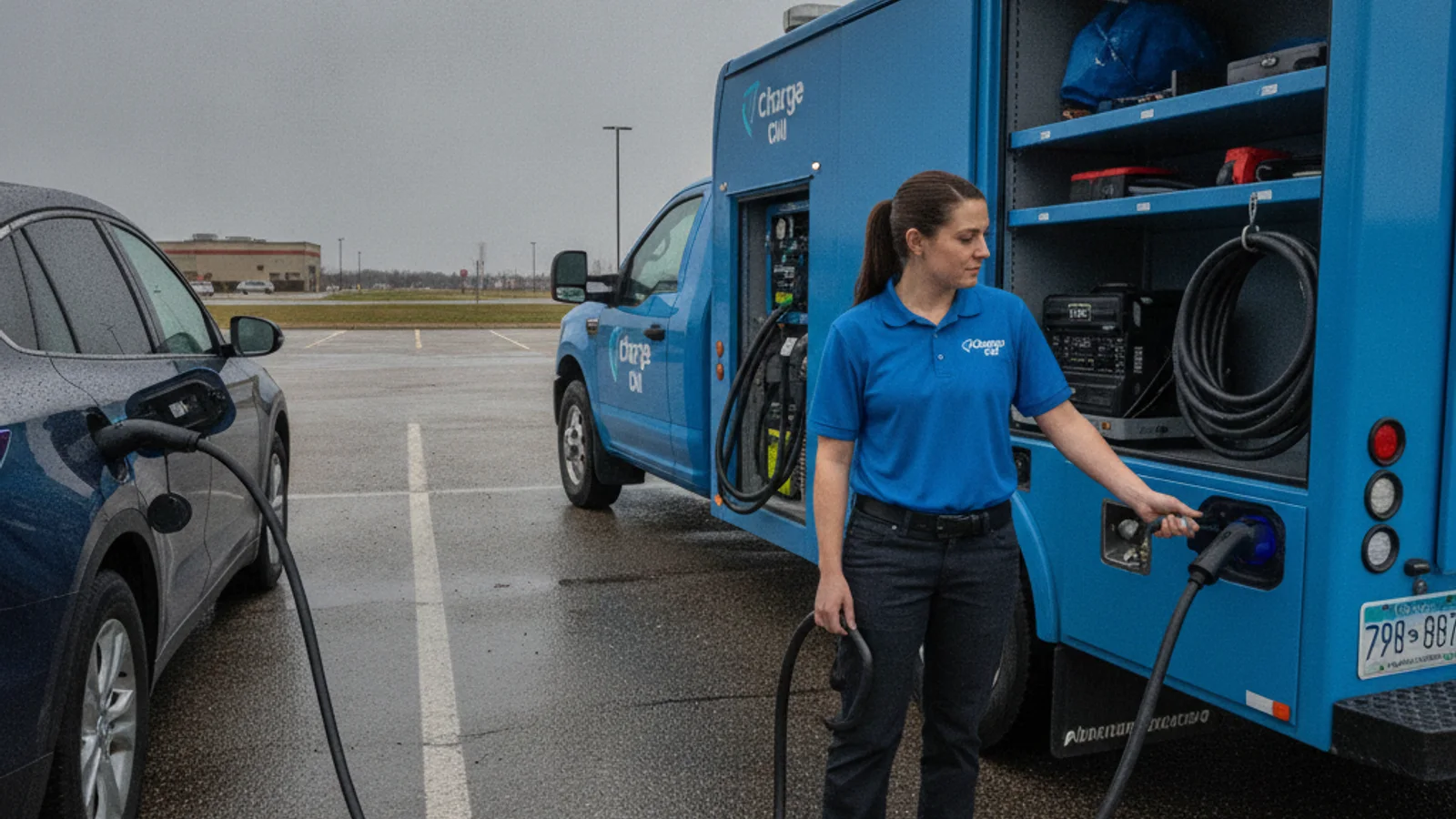
An EV charging truck brings a 240-volt Level 2 source to a stranded EV. Charge Pro CHI is a referral line in Chicagoland. We match you with an independent operator. That operator brings the 240V gear, quotes you before starting, and bills you directly.
People search this when the percentage is already ugly. They want to know what shows up and what it adds. This page answers it for Cook, Lake, DuPage, Kane, Will, and McHenry. The housing, the roads, and the counties are specific to this metro.
What an EV charging truck actually carries
The truck’s a mobile power source. It isn’t a Supercharger stall, and it isn’t a flatbed. You stay with your car. The operator connects a 240V Level 2 cable and feeds the high-voltage pack.
Tesla drivers usually get a native NACS plug. Other brands use a CCS or J1772 adapter. The operators we connect you with handle Tesla and every major EV brand. The job’s a short boost. Typical charging time is 15 to 30 minutes. Typical added range is 10 to 20 miles. That’s charging time, not a clock on when someone arrives. We don’t publish arrival windows.
If you want the level-by-level version, read EV charging levels, explained for stranded Chicagoland drivers. Level 2 on the shoulder is a rescue tool. It isn’t the same as a public DC stall you drive to.
This metro’s housing mix is why the call happens
Chicago’s 2024 population estimate is 2,721,308. Plenty of those trips stack on the Kennedy, the Dan Ryan, and the Eisenhower. When the pack hits zero there, you can’t always roll to your planned site.
Home charging isn’t uniform either. ACS data shows 68.6% of Chicago housing predates 1980. Cicero is 90.2% pre-1980. Berwyn is 90.0%. Oak Park is 78.6%. Evanston is 71.2%. Wilmette is 74.3%. Older two-flats, bungalows, and tight lots shape overnight plugging. Those figures describe housing age, not the public charging map. We didn’t verify charger counts by town, so we won’t publish them.
Newer suburbs look different. Naperville’s pre-1980 share is 11.7%. Schaumburg’s is 15.9%. Orland Park’s is 11.8%. Gurnee’s is 9.5%. Plainfield’s is 6.7%. Huntley’s is 3.8%. Attached garages show up more in that stock. A stall there often follows a long park at work or a mall. Bolingbrook, Tinley Park, and Hoffman Estates sit in that later-built pattern too.
Lake County isn’t one place. Waukegan’s 2024 estimate is 88,570. Highland Park’s is 30,794. Libertyville’s is 20,643. Gurnee’s is 30,546. Will County adds Joliet at 151,837, plus long I-80 and I-55 runs. Kane County adds Aurora at 180,710 and Elgin at 114,701. Same referral match. Different pavement.
Battery bank or generator: ask the operator
Not every rig makes power the same way. Two designs exist. This page can’t certify which independent operator uses which one. That wasn’t in the verified notes. Ask on the quote call.
A battery bank on the vehicle
Some trucks store energy in a pack that’s separate from the drivetrain battery. The operator arrives with that energy already on board. They convert it to the 240V your car will take. The stall doesn’t need a grid hookup.
A generator on the vehicle
Some trucks make the electricity on site. A generator feeds the charging hardware. That can mean more noise. It can also mean the rig isn’t waiting on a prior charge of its own bank.
Charge Pro CHI doesn’t choose the design. We don’t own the trucks, the cables, or a warehouse of parts. Mobile EV charging here means a match with a local pro. The pro quotes the work. You pay that pro.
For a walk-through of the gear that often rides along, see what’s on a mobile EV rescue van.
How many miles a session is for
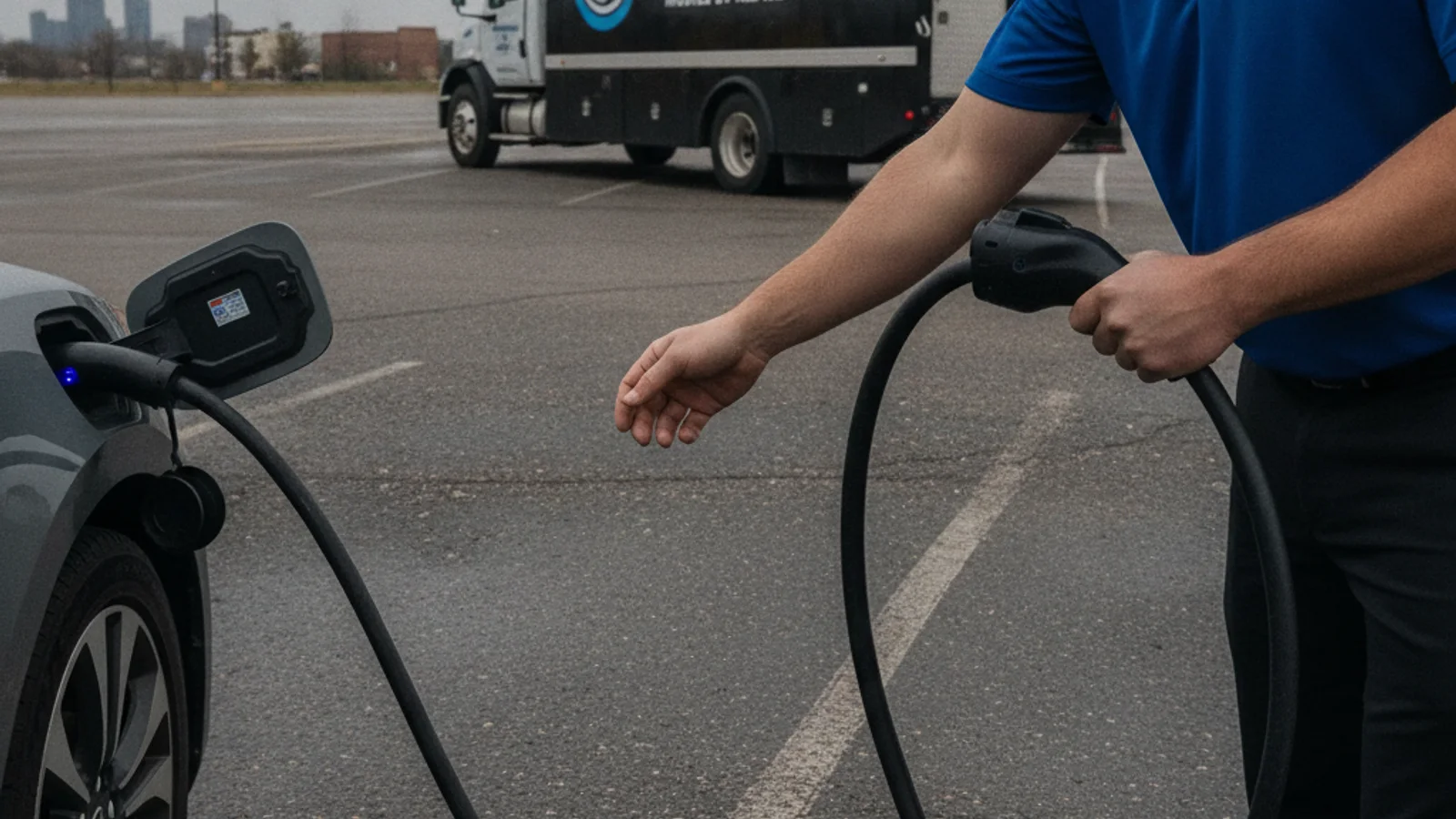
Owners always ask how far the boost will take them. The verified range for this network is 10 to 20 miles. That’s after 15 to 30 minutes of charging. That’s enough to get off a shoulder and onto your next plan. It isn’t a fill-up.
We don’t have a verified miles-per-kWh table on this page. That includes Model 3, Mach-E, Ioniq 5, and Rivian. Efficiency changes with heat, speed, and cabin load. Your cluster’s the number that matters. A compact car usually stretches a kilowatt-hour farther than a heavy pickup. That’s physics, not a local statistic.
Ten to twenty miles on the Jane Addams gets you moving again. Same on the Reagan Tollway or Randall Road. Same on I-55 or the Bishop Ford. We won’t estimate how far any named charger sits from those shoulders. That figure wasn’t confirmed. If you already know the site you wanted, tell the operator. The boost is meant to reach a plan you can name.
Out-of-charge jobs are the out of charge recovery match. Rescue is range. Repair is a bay.
NACS, CCS, and J1772 on the same call
Connector mix is real. The operator should show up ready for it.
NACS started as Tesla’s inlet. It’s now the North American Charging Standard on many new models. Native NACS on the truck covers those cars without extra adapters.
CCS combined extra DC pins with the older J1772 AC inlet. Plenty of Hyundai, Kia, VW, BMW, and Chevy EVs still present that way. A 240V rescue still uses the AC path. That’s why a CCS or J1772 adapter is part of the kit for non-Tesla cars.
You don’t need to study pins while hazards are flashing. Say the brand. Say the year if you know it. The operator confirms the plug before the billed session starts.
When the car is dead but the pack isn’t
A charging truck solves an empty traction pack. A lot of no-start calls are the 12-volt battery.
The 12V runs computers, lights, locks, and the contactors that connect the big pack. When it’s down, the car can ignore a healthy high-voltage battery. Operators we connect you with can jump or replace that 12V on site. That’s a different hookup than the 240V cable on the charge port.
If buttons are dead and the app can’t find the car, think 12V first. If the display still boots and the range reads zero, think pack. A Tesla 12V battery jump is the match for the first case. Keep the two jobs straight when you call.
How the match works in Chicagoland
This isn’t an app maze. You call. You leave the facts.
Say you’re in Chicago, Skokie, Naperville, or a Will County ramp. Give a cross-street, a lot name, or a map pin. Lower Wacker needs the lower-level detail. A Schaumburg office park needs the building name if you have it. An Oak Lawn shoulder needs the direction of travel.
We connect you with an independent local operator. The pros we connect you with are licensed and insured. Charge Pro CHI isn’t the licensee. We hold no license, own no fleet, and employ no technicians. We set no prices.
The operator quotes you before starting. You can take the quote or pass. If you take it, they bill you directly. That’s the whole commercial relationship.
Once connected, charging typically runs 15 to 30 minutes. That’s for the 10 to 20 mile bump. Stay clear of live lanes. Follow what the operator asks on scene. We don’t script their setup. That’s their job.
The metro hub is EV charging in Chicago. Use it when you want city pages, not a truck explainer.
North Shore, northwest lots, and the south suburbs
Evanston, Wilmette, Glenview, Northbrook, and Highland Park sit on the inner and outer North Shore. Older housing shares are high in Evanston and Wilmette. Glenview’s pre-1980 share is 40.3%. Northbrook’s is 39.1%. Lakefront streets and side lots are tighter than a DuPage driveway. The truck still needs room to park legally. You still need to say exactly where you sat down.
Northwest Cook is a different texture. Arlington Heights, Palatine, Des Plaines, and Mount Prospect mix homes and arterials. Elk Grove Village and Hoffman Estates add office and industrial parks. Elk Grove Village work stalls often happen after a shift. Des Plaines and Park Ridge sit closer in. Northwest Cook also feeds the Tri-State. The referral’s the same.
West, DuPage towns like Wheaton, Downers Grove, Elmhurst, Lombard, and Glen Ellyn feed the Eisenhower. Kane adds St. Charles, Geneva, and Batavia. McHenry adds Crystal Lake, McHenry, Algonquin, and Huntley. Far south includes Chicago Heights, Calumet City, Evergreen Park, and Homewood. Their street grid isn’t Naperville’s newer tracts.
None of that changes the hardware. It changes how you describe the pin. A charging truck is only useful if the operator can find the bumper.
What to do when you’re the person on zero
Hazards on if you’re on a live road. Stay in the car when traffic is close. Don’t stand on the Kennedy wall. Don’t walk the Dan Ryan.
Call with make, model, and whether the car is at zero or just dark. Mention Tesla or not. Mention if the charge port will open. If you’re in a garage, say if the attendant can let a van in.
A tow’s a separate decision. If a wheel is damaged or the car must go to a shop, say so. If you only need miles, ask for the 240V boost. Don’t mix the quotes.
We serve every city in this Chicagoland footprint. When you want the match, call (858) 925-5546. You’ll get an operator who quotes first and bills you directly.