The range number hits zero on the Bishop Ford and the car goes quiet. You’re still in Cook County, close to Oak Lawn. The next move has to be safe, not fast.
Drivers type that search from the shoulder, not from a desk. They need a plan for I-94 and for I-294. That’s the Tri-State that sits next to Oak Lawn.
Two freeways sit on Oak Lawn’s edge
The Bishop Ford is the south-side stretch of I-94. Oak Lawn sits near that corridor, and near the Tri-State too. People stall on the way out of Chicago. Others stall on the drive home. Many cut over toward Cicero Avenue, 95th Street, Southwest Highway, or Pulaski Road.
Oak Lawn is a real city in this part of Cook County. The Census ACS count is 57,098. This is hospital traffic and 95th Street retail. Metra SouthWest Service parking is part of that mix.
The housing stock is what sets EV days apart. Census figures show 58.4% of homes were built before 1980. Older houses and apartments often have no 240-volt circuit in the garage. Many owners charge at work, in a lot, or on a slow household outlet. When the pack is already thin, a Bishop Ford crawl can finish the last miles. A Tri-State merge can do the same.
Charge Pro CHI doesn’t own trucks and doesn’t do the work. We match stranded drivers with an independent local operator. That person quotes you before they start. They bill you directly.
Empty pack versus a silent 12V
Not every dead EV is the same failure.
An empty traction pack is a range problem. The car used the high-voltage battery until nothing useful was left. Screens may still wake. You just can’t roll far, or at all.
A dead 12-volt battery is a start problem. The big pack can still hold a charge. The small battery that runs computers, locks, and contactors has dropped out. The car looks bricked. You may not get in. You may not open the charge port.
Hospital parking makes the 12-volt case common in Oak Lawn. Advocate Christ Medical Center is a major hospital and a Level I trauma center. Visitors and staff leave cars for a long shift. A weak 12-volt can die while the car sits. You walk back to a silent cabin, not a low-range warning. Metra lots see the same long sit.
On the Bishop Ford, the empty-pack case is the one people dread. You counted the miles at home. Traffic stacked up. Heat or cold kept the climate system on. The estimate didn’t survive the last stretch.
If the car still answers and shows zero miles, treat it as a pack problem. If it won’t wake, treat the 12-volt first. A local operator can jump or replace a 12-volt on site. They can also bring a 240-volt Level 2 source for a true empty pack.
Start with out-of-charge recovery for the empty-pack path. For the wider menu, use EV roadside assistance.
What to do while the car still rolls
Don’t wait for a dead stop in a live lane. The moment the car warns you, pick a plan.
If you still have a little range, ease right and take the next safe exit. 95th Street and Cicero Avenue are calmer places to wait. If you can’t make an exit, take the right shoulder as soon as you can.
Turn the hazards on before you finish the move. Keep your seatbelt fastened. Stay in the car unless you’re in immediate danger. A freeway shoulder is a bad place to stand.
If any part of the car sits in a travel lane, call 911 first. Say you’re in an EV on the Bishop Ford or the Tri-State. Give your direction of travel. Let them handle traffic. Then you can ask for a charge.
Have three facts ready for the next call. Give your direction of travel. Name the last exit or cross street you saw. Add your make and model.
Don’t weave across lanes hunting a prettier shoulder. Don’t leave the car to look for a plug on foot.
If you made it into a lot, stay with the car. A 95th Street stall and a hospital garage are easier work sites.
What a mobile 240-volt boost actually does
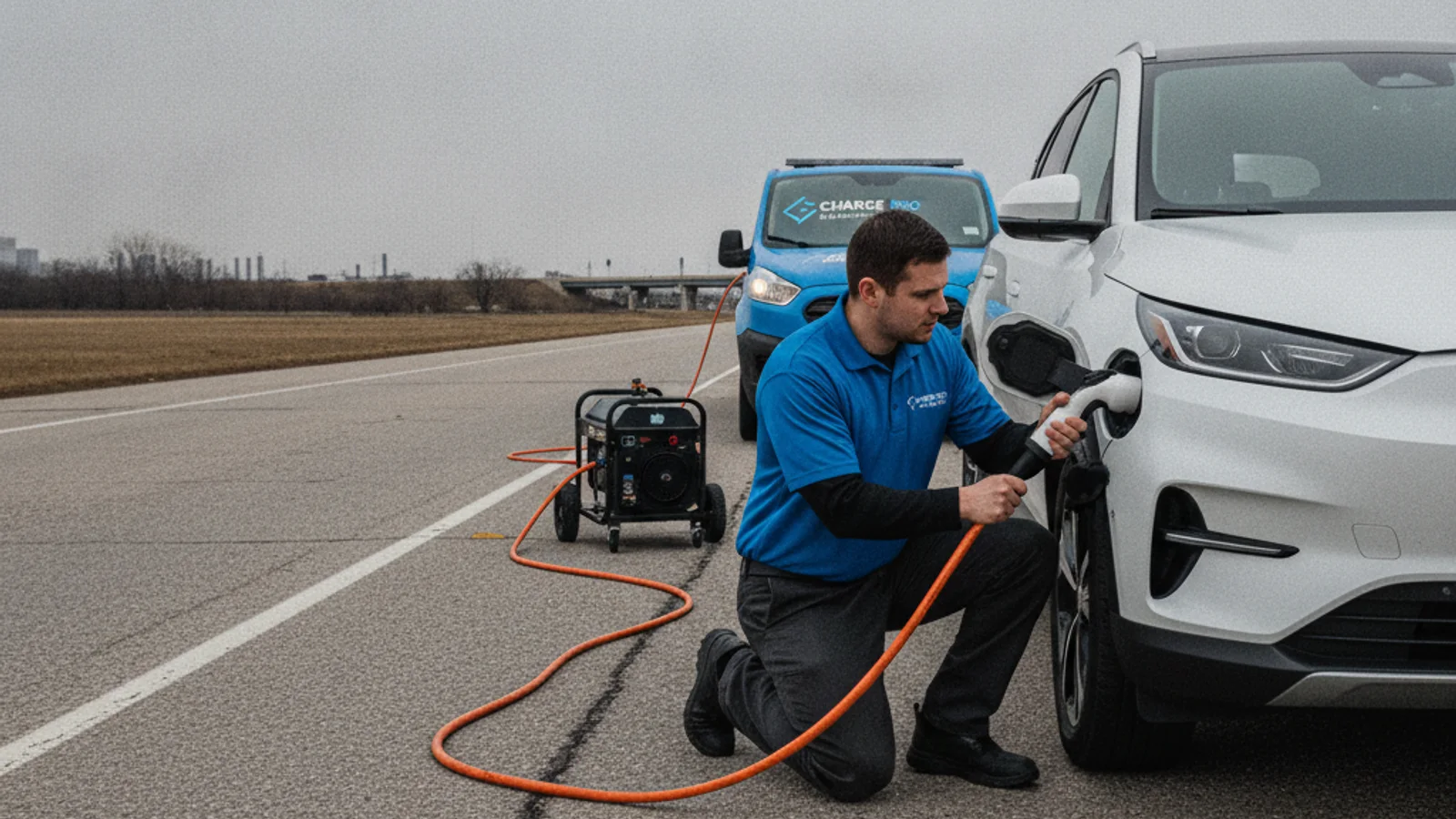
A mobile boost isn’t a Supercharger on wheels. It’s a Level 2 AC top-up, brought to your bumper.
The operator shows up with a 240-volt source. Tesla owners get a native NACS plug. Other EVs use a CCS or J1772 adapter. The point is enough range to leave the shoulder. You finish charging somewhere you choose.
Typical charging time is 15 to 30 minutes. That window usually adds about 10 to 20 miles. Those figures are charging time, not an arrival promise. Charge Pro CHI doesn’t publish arrival times.
Ten to twenty miles is often enough to get off I-94. It can get you onto a local street in Oak Lawn. It can cover a short hop toward Evergreen Park, Burbank, Chicago Ridge, or Hometown. It isn’t a full recharge.
The service page for that visit is mobile EV charging.
A tow is a different job. Some empty EVs need a flatbed because the car won’t go into the right mode. Some have a fault that isn’t range at all. If a tow is the safer call, a good operator will say so. We don’t publish fees here. Ask the operator, and ask the tow company, before you agree.
After you leave the Bishop Ford
Once you have enough range to roll, keep the next stop simple. Don’t jump back onto a packed interstate just to save a few minutes. Oak Lawn’s 95th Street corridor is dense retail. The hospital district around Advocate Christ is another place people already park for hours.
ComEd is the electric utility in Oak Lawn. That matters at home, not on the shoulder. If you later want a wall connector, you’ll deal with ComEd and a licensed electrician.
If your stall was on I-294, use the same order. Get to a shoulder or an exit. Stay in the car. Book a boost if you can’t finish the trip on what’s left. We wrote a separate guide for that road: low on charge on the Tri-State.
For help once you’re in town, start with EV charging in Oak Lawn. Then read mobile EV rescue when you stall in Oak Lawn.
Why so many Oak Lawn owners leave home already low
This is the local piece, not a generic range lecture. Nearly six in ten Oak Lawn homes predate 1980. Panels from that era were sized for lights, a stove, and a window air conditioner. They weren’t sized for a dedicated car circuit.
Apartments and two-flats add another limit. You may not control the panel. You may not have a reserved garage stall. You may share a lot with no assigned outlet.
So a lot of Oak Lawn drivers start the day with a partial charge. They top up at work, at a store, or on a commute into Chicago. That pattern holds until the last stop runs long. A visit at Advocate Christ can eat an afternoon. A slow crawl on 95th Street can spend the buffer. A packed merge onto I-294 can do the same.
Nearby towns share pieces of that story. Evergreen Park’s housing is even older. Census figures put 87.7% of its homes before 1980. Many drivers here can’t count on a full pack every morning.
If that’s your house, plan the return trip with a reserve. If the reserve is gone, use a mobile boost instead of a tow.
Pulaski Road and Southwest Highway are the other Oak Lawn arteries after a freeway exit. Stay on those last miles. Don’t climb back onto I-94.
Tesla, and every other badge on this road
Operators in the network handle Tesla and every major EV brand. A Model 3 or Model Y on the Bishop Ford uses a native NACS plug. A Chevy, Hyundai, Kia, Ford, Rivian, or Volkswagen uses the adapter on the truck.
Tesla’s own roadside channel is a separate path. Confirm what they’ll send before you wait on it. A local operator’s job is the 240-volt boost or the 12-volt jump.
Non-Tesla owners should say the brand on the first call. The operator needs the right adapter in hand.
Frequently asked questions
Can a mobile operator charge me on the Bishop Ford shoulder
A Level 2 boost can happen on a freeway shoulder. That only works when it’s safe to park behind you. The operator sets up, plugs in, and adds range on site. Charge Pro CHI doesn’t promise a clock time. Ask the operator on the call. If you’re in a live lane, start with 911.
How do I tell a dead pack from a dead 12V
A dead pack usually leaves some screen life and a zero-mile reading. A dead 12-volt often kills the whole car, including locks and the charge port. Hospital lots around Advocate Christ see that 12-volt version after a long dwell. Operators can jump or replace that battery on site. They can also feed the big pack if that’s what’s empty.
What if I can’t plug in at home in Oak Lawn
That’s common in pre-1980 houses and in apartments. ComEd is the utility. A wall connector still needs a panel that can take the load. If you can’t charge at home, keep a bigger reserve on freeway days. If you still hit zero, use a mobile 240-volt boost. That’s how you leave the Bishop Ford or I-294.
If you’re on the Bishop Ford near Oak Lawn, call (858) 925-5546. The same line fits a Tri-State stall beside this part of Cook County. We’ll tell you if a local operator is the right fit. The operator quotes you before any cable goes in. If a tow is smarter, you’ll hear that too.