You’re low on charge on the Tri-State and the work zone took the shoulder. That isn’t a charger-map problem anymore. It’s a live-lane problem. Stay with the car. Call for a mobile boost instead of spending the last miles on a guess. Charge Pro CHI is a referral line for Chicagoland, Illinois. It matches stranded EV drivers with independent local operators. Those operators bring a 240V Level 2 source to the car. They quote you before they start, and they bill you directly.
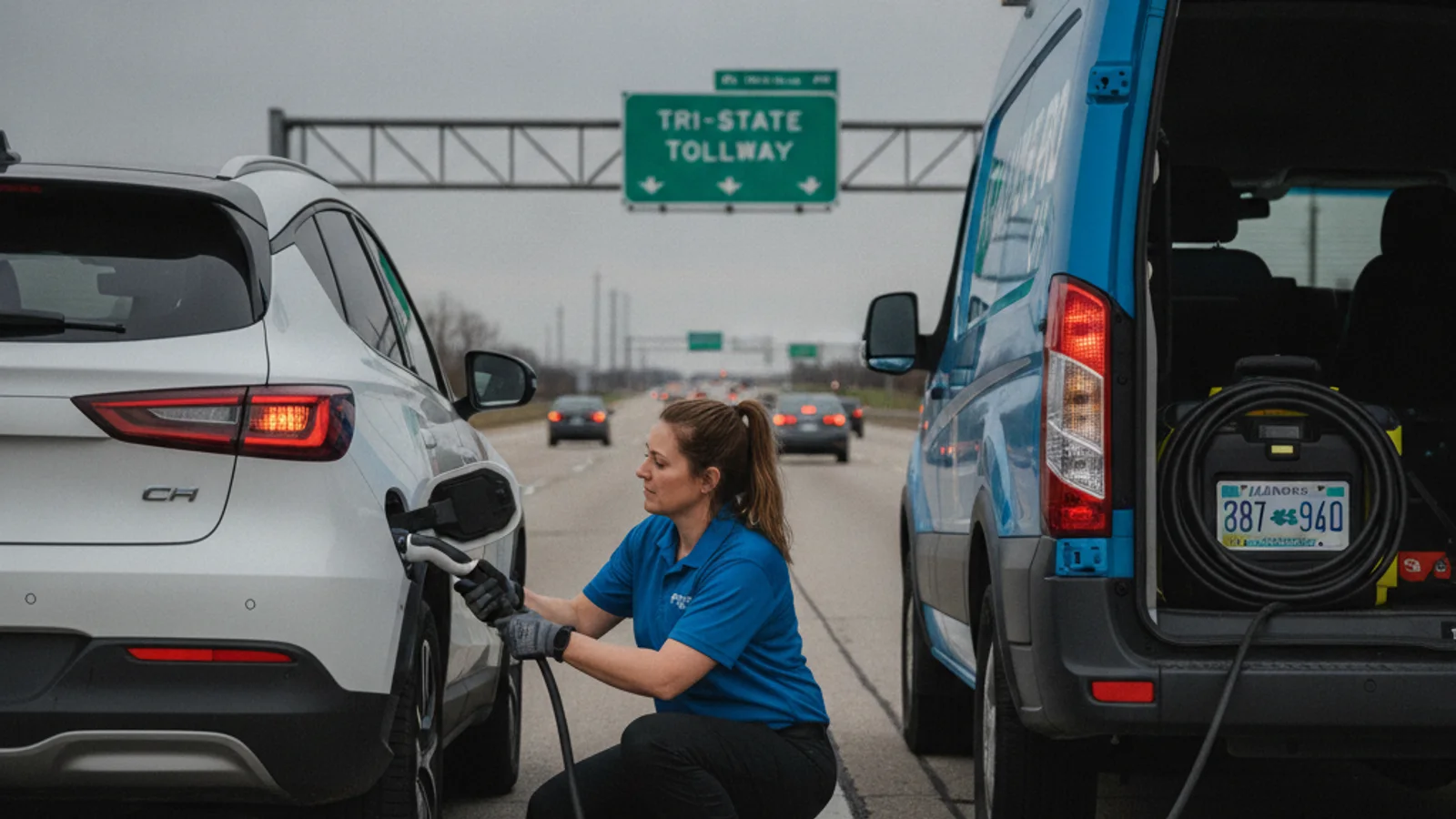
When barrels replace the breakdown lane
The search behind this page is ev roadside tri-state. People type it when the belt has already closed the place they meant to sit. A gas car can idle on a remnant of shoulder. An EV that hits a true empty pack can’t roll. If the high-voltage battery is spent, you’re a stationary object in a travel lane. You stay there until someone moves electrons or a flatbed takes the car.
Climate load here is not a small footnote. Summer air conditioning on a slow belt pulls from a thin pack. Cabin heat in a Cook County winter does the same. Range that looked fine at the ramp can collapse inside a crawl. That’s pack physics. It isn’t a local tariff, and this page will not invent one.
If the car can still move, use those miles on purpose. Ease as far right as the cones allow. Then stop. Don’t spend the rest hunting an interchange you haven’t confirmed in your own app. Once you’re stopped, the useful call is a mobile EV charge or a 12V wake-up.
Charge Pro CHI doesn’t do that work itself. It doesn’t own trucks, a yard, or charging gear. It doesn’t employ technicians. The operator who takes the job decides if your pin is workable.
The north leg isn’t the west swing, and south Cook isn’t either
The towns on this belt are not interchangeable.
Northbrook had a 2024 population estimate of 34,546. Hispanic or Latino share is 5.3%. Only 39.1% of housing predates 1980. Glenview sits next to it in Cook County. It’s 47,634 people. Hispanic or Latino share is 8.9%. Pre-1980 housing is 40.3%. Those North Shore towns put newer housing on the north Tri-State. A lot of EVs use that leg for city jobs and school runs. The stall you remember from a Northbrook off-ramp is not the stall inside barrels two miles back.
Des Plaines is a different Cook County band. The 2024 estimate is 58,832 people. Hispanic or Latino share is 23.2%. Pre-1980 housing is 58.8%. Park Ridge sits close by. It shows 38,445 people. Hispanic or Latino share is 6.0%. Some 67.1% of homes were built before 1980. Older housing doesn’t tell you how a given block plugs in at night. It does mark stock that predates a wall box. More commutes on this stretch start with less buffer.
West into DuPage, Elmhurst is 46,108 people in the 2024 estimate. Hispanic or Latino share is 10.1%. Pre-1980 housing is 56.6%. That west swing is peak-hour DuPage traffic, not a North Shore school run.
South into Cook, Oak Lawn is 56,531 people in the 2024 estimate. Hispanic or Latino share is 23.7%. Pre-1980 housing is 58.4%. Evergreen Park sits nearby. The 2024 estimate is 19,301 people. Hispanic or Latino share is 18.5%. Pre-1980 housing is 87.7%. Chicago sits inside the ring. The 2024 estimate is 2,721,308 people. Hispanic or Latino share is 29.6%. Pre-1980 housing is 68.6%. The Tri-State is the belt those trips share. It isn’t one suburb with the city name swapped.
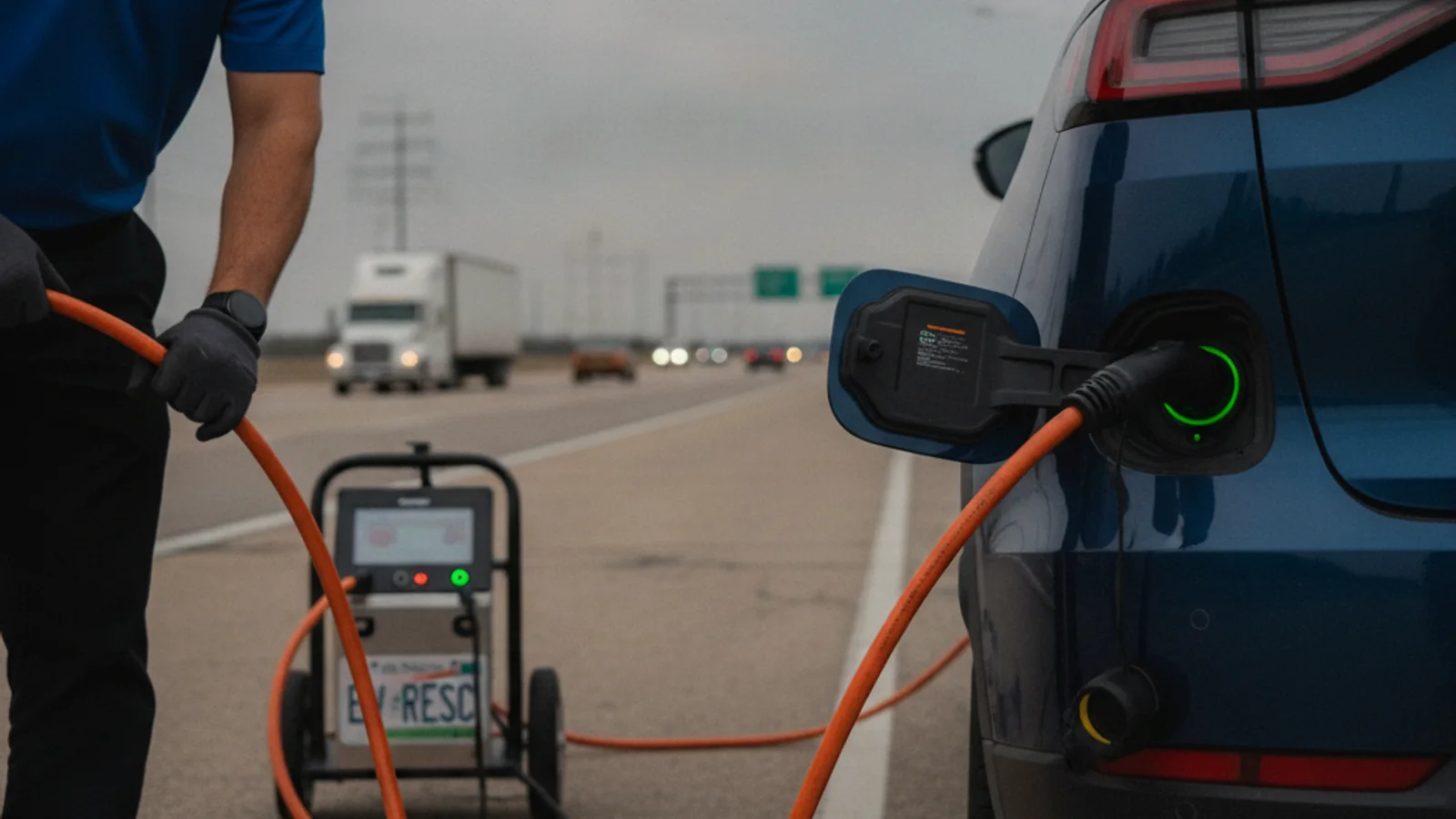
This page could not confirm current construction
The notes behind this article are Census ACS tables and 2024 population estimates. They don’t list lane closures, overnight shoulder takedowns, or active contracts on the Tri-State. No verifiable project name, mile marker list, or finish date turned up in that material.
That gap is the honest version. A guessed work zone helps no one. If the right lane is cones, the shoulder is gone. That stays true even if you sat there last month. Boards over the roadway are the authority in that minute. Cook County and DuPage County housing files don’t carry live tollway work. This page will not invent a map they didn’t publish.
Check the signs in front of you before you assume you can wait. Then call from the pin you’re actually on.
Empty pack, dead 12V, or a car that just won’t wake
Two failures put you in the same pose. They are not the same job.
If the traction pack is empty, the car may still show lights, then refuse to go. That’s out-of-charge recovery. The operator brings 240V Level 2 to the car. Teslas take a native NACS plug. Non-Tesla EVs use a CCS or J1772 adapter. Typical charging adds about 10 to 20 miles of range in 15 to 30 minutes of charging. That window is time on the plug. It’s not an arrival clock. Charge Pro CHI doesn’t promise when someone shows up.
If the 12V is dead, the car can look fully bricked. No unlock. Dark screen. Charge port stuck shut. The high-voltage pack may still have energy. Operators jump or replace that 12V on site for Tesla and every major EV brand. A flatbed for a 12V no-start is often the long way around.
If you can’t tell which battery failed, describe what you see. Dark dash. No handle click. Range already at zero. Don’t guess a diagnosis on a noisy shoulder.
What moves the quote, because no price belongs here
Charge Pro CHI doesn’t set rates and doesn’t take the repair. The matched operator quotes you before they start and bills you directly.
What changes that quote is the job. Distance to your pin matters. So does time of day, and how stacked the belt is. So does how much range you need to leave the work zone under your own power. So does whether they are boosting the pack, jumping the 12V, or both. There’s no figure on this page to compare against. Ask for the quote. Take that quote, not a guess from a blog.
A boost is not a fill-up. Ten to twenty miles is often enough to leave the barrels. You can then exit toward Northbrook, Elmhurst, or Oak Lawn. Finish charging on your own plan. Confirm the stall you want in your app once you’re moving. This page doesn’t name charging sites. It will not guess how far the next one is.
If the vans can’t sit where you are, say so. A mobile charge versus a tow is a decision at your pin. It isn’t a rule for the whole tollway. The operator should tell you which they can actually do.
What to tell them so they can find you
Lead with direction. Northbound and southbound are split by a wall. An operator can’t infer it from “I’m on the Tri-State.”
Then the last exit you passed, or the next name on the overhead. Northbrook, Des Plaines, Elmhurst, and Oak Lawn point to different approaches.
Read a mile marker if one is in view. If it isn’t, drop a pin and read the coordinates off the phone. “Near the barrels” is not a location.
Give make, model, and plug type if you know it. Say what the dash shows. A Tesla with a few miles left is one setup. A dark truck that won’t unlatch the port is another.
Say whether you’re against barrels in a live lane or on a scrap of leftover shoulder. That decides whether EV roadside assistance can work the spot. It also decides whether the car has to be dragged first.
If you still have range, and you’re reading this in a driveway, start earlier. Read what to do before you stall. Don’t roll into a posted work zone with a thin pack. Don’t save the last miles for a hunt you can’t complete.
When to pick up the phone
Call when the pack won’t get you off the Tri-State. Call when a 12V failure has killed the car in a work zone. Call when you still have a sliver of range. Don’t spend it guessing at the next sign.
The network serves Chicagoland. That includes Chicago. It includes the North Shore towns on the north leg. It includes DuPage stops like Elmhurst. It includes south Cook stops like Oak Lawn. That’s service area. It isn’t a claim that a truck is already in your mirror.
Call (858) 925-5546. The operator quotes the job before they start.