A Tesla that sat overnight by a Waukegan two-flat can refuse to wake. Wind off the lakefront and harbor strips heat from the pack. Much of the housing downtown and in south Waukegan predates 1980. Street parking is the norm. A dedicated wall box usually isn’t. You open the app and see a 12V alert. Or the range left won’t cover US-41 south. Tesla roadside assistance in Waukegan then splits into three paths. Tesla’s own program is one. AAA is another if you keep the club. A local operator is the third. That operator can jump the 12V or roll a 240-volt boost to the car.
Why Waukegan Tesla stalls start on rental streets
Waukegan is the largest working-class city in Lake County. The ACS 2019-2023 count is 88,919 residents. The 2024 estimate is 88,570. Hispanic or Latino residents are 57.0 percent of that mix. Census data also shows 54.0 percent of housing was built before 1980. That stock is apartments, two-flats, and older singles. Overnight curb parking is how a lot of cars live. Home charging isn’t part of that lease. ComEd is the utility. The landlord and the panel still decide whether a circuit ever gets added. Confirm that with the building before you count on a plug.
Gurnee sits next door with a different housing story. Only 9.5 percent of Gurnee’s stock predates 1980. Garages and dedicated circuits show up more often there. Waukegan calls more often look like a car that sat in the open. That might be a Genesee Theatre night, a lot by the harbor, or a stall after the US-41 commute south. Lake wind keeps both range and the 12V under stress most of the year. Cabin heat and a car that never sees a garage add draw. That’s local, not a copied suburb script.
West Waukegan feeds I-94, the Tri-State Tollway. Downtown and the lakefront feed Grand Avenue and the harbor lots. Green Bay Road and Belvidere Road cut across town. Skokie Highway is the south commute. A low pack after that run is a range problem. A dark car after a night on a side street is usually the 12V. Mixing those two up sends the wrong truck. For how rescue is mapped on the city page, use the Waukegan EV charging page.
Empty pack or a silent 12V
Teslas carry a high-voltage pack and a small 12V battery. The 12V wakes the computers, latches, and screens. When the 12V is down, the car can look fully dead. That can happen with miles still in the pack. Doors may not release the way you expect. The phone app may fail to connect.
When the pack is empty, the car may still talk to you. You’ll see a range warning or a turtle icon. You might have rolled to a stop on I-94. You might sit in a downtown lot after an evening out. The 12V can still be healthy. What you need then is energy into the pack, not a jump.
A Supercharger is Tesla’s DC fast network. It’s the right fill if you can reach one under your own power. It doesn’t help a car that can’t wake. It also doesn’t help a car already at zero with no way to creep. Don’t guess a pin-to-plug distance from this page. Open the Tesla app and read what it shows for your location right now.
If the car is silent, treat it as a 12V job first. If it’s awake and empty, treat it as a range job. That split decides the first number you call. The operators we connect you with can handle a Tesla 12V battery jump where the car sits. They can also add a short Level 2 boost when the pack is the problem.
Tesla’s own roadside, as the app describes it
Tesla roadside assistance lives in the Tesla app. Coverage is often included for a limited window after delivery. After that window, Tesla may still send help. You confirm what’s included before anyone rolls. Current terms sit in the app and on Tesla’s site. This page won’t invent a mileage cap, a year count, or a price. If the app doesn’t list it for your VIN, treat it as unconfirmed.
What Tesla usually sends is a contractor, a 12V jump, or a tow. For a flat, they often move the car. They may not repair it in the lane. For an empty pack, Tesla’s program has historically leaned toward a tow. That tow is usually toward a Supercharger or a service stop. It isn’t a long charge on Grand Avenue. Confirm the current policy in the app. Don’t assume a Tesla-branded truck will fill the pack at the curb.
A tow is the right tool when the car can’t roll. It’s also right when the 12V won’t hold. It’s a slow tool when you only need enough range to move. Teslas need a flatbed. If Tesla dispatches a wrecker, ask what equipment is coming.
Tesla’s line is national. The dispatcher may sit far from Lake County. They may not know the harbor lots or Waukegan National Airport. They may not know how US-41 stacks up at peak. For a longer readout of the OEM path, see what Tesla roadside assistance covers here.
AAA, when you already carry the card
AAA is a general auto club. Plenty of Lake County drivers keep it for tires, lockouts, and gas cars. A Tesla can sit on that same membership. The contractor who arrives is often a standard truck. Some of those trucks can jump a 12V, and some can’t. We couldn’t verify a Waukegan-specific AAA EV playbook. Ask the dispatcher whether the unit can jump a Tesla 12V. Ask whether it can tow an EV on a flatbed. If they can’t say yes, the club may still hunt a tow. You may still need a second call for a charge.
AAA doesn’t typically bring a 240-volt Level 2 source to the bumper. A jump can wake a car that still has pack miles. It won’t fill an empty pack. If you used the club recently, ask what service remains on the membership. AAA sets those limits.
The same three-way choice shows up in the city as well. Read AAA or a local Tesla rescue in Chicago for that split. Housing and lake wind are what change the Waukegan version.
A local operator, and what actually arrives
Charge Pro CHI is a referral line. It matches stranded Tesla drivers with independent local mobile rescue operators. It doesn’t hold a trade license. It owns no trucks. It employs no technicians. It sets no prices. The operator quotes you before any cable goes on the car.
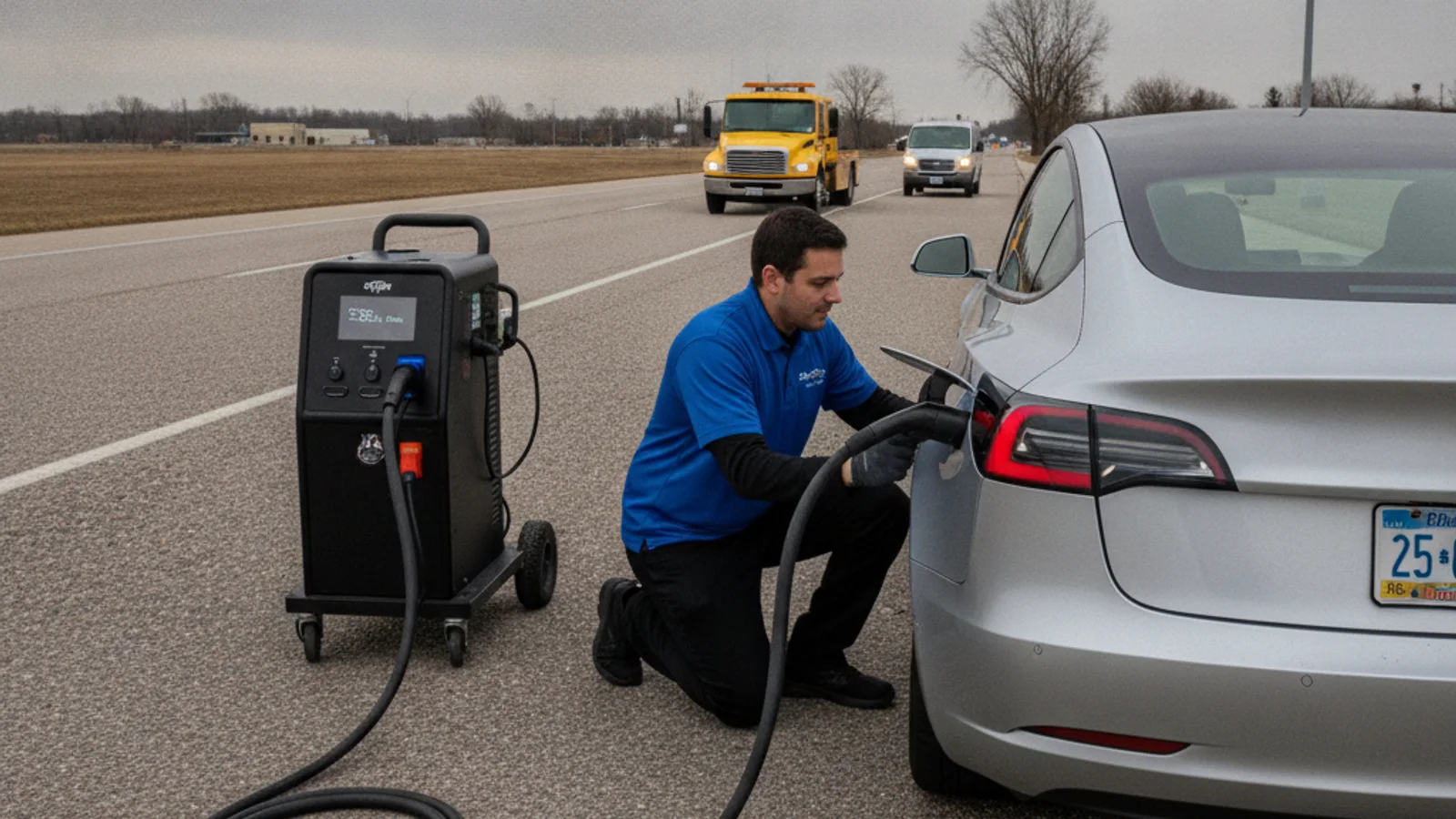
What those operators bring is specific. They roll a 240-volt Level 2 source to the Tesla. The plug is native NACS. They typically add 10 to 20 miles of range. That charge usually takes 15 to 30 minutes at the bumper. That window is charging time. It isn’t a promise about when the truck appears. If the 12V is dead, they can jump it or replace it on site. They handle Tesla and the other major EV brands.
That on-site boost is the point of Tesla roadside rescue when the pack is low. The car still has to take a charge. It’s also the point of mobile EV charging when you’d rather drive to a Supercharger than sit on a flatbed. If the high-voltage pack has a real fault, you still need Tesla service. A boost can’t invent a healthy pack.
Operators work the streets you already use. They cover downtown curb spots, harbor lots, and Waukegan National Airport. They also cover west Waukegan near the Tri-State and south Waukegan along Green Bay Road. They still have to reach you through real traffic. Nobody here can promise a clock. They can quote the job, then work on the car where it sits. North Chicago, Zion, and Beach Park sit on the same lake strip. A Waukegan commute can stall there too.
What moves the quote
Charge Pro CHI doesn’t publish a rate. Tesla’s out-of-window terms live in Tesla’s own materials. AAA’s remaining allowance lives on your membership. A made-up number goes stale the next time an operator updates a quote.
What moves a local quote is plainer. Distance to the car matters. A stall on I-94 is a different reach than a downtown side street. Time of day matters because the Tri-State and US-41 clog. Weather off the lake matters. Wind, ice, and a tight shoulder change how long the stop takes. How much range you need matters. A short boost is a different job than a long fill. A 12V jump is a different job than a pack boost. Some stops need both.
Ask for the quote before the operator starts. If that quote doesn’t work, you can still call Tesla or AAA. Charge Pro CHI has no membership to join. You book the operator for that stop, or you don’t.
Illinois towing and storage rules sit with the city and with state law. A verified figure for Waukegan private-property tows didn’t turn up in the research for this page. If a lot wants to move the car, ask which yard they use. Call that yard for the current rate before you pay.
I-94, US-41, and the lots that sit in the wind
The Tri-State Tollway is the west edge of many Waukegan trips. A Tesla that goes quiet on I-94 is a shoulder problem first. Stay in the car if traffic is close. Then decide 12V versus pack. Don’t walk the lanes. Tesla’s app still works for some 12V failures, but not all. If the phone can’t see the car, treat it as a 12V wake-up.
US-41, Skokie Highway, is the south commute. Range falls faster in lake wind than the car’s summer estimate. Preconditioning and cabin heat spend pack. An older apartment with no overnight plug leaves you starting the day already thin. That’s the rental-housing pattern. It isn’t a claim about the Supercharger map. If the car is awake, check the app for a charger you can actually reach. If it isn’t awake, skip the charger hunt and deal with the 12V.
Grand Avenue, Belvidere Road, and Green Bay Road are the in-town cuts. Downtown Waukegan and the lakefront stack evening parking around the Genesee Theatre and the harbor. Long dwell in the wind is hard on the 12V. A car that sat through a show can look dead even when the pack is fine. West Waukegan lots near the airport have the same dwell pattern. Jump first if the car is silent. Boost later if the pack is actually low.
How to choose a path while you’re still in the seat
Start with the car, not the brand. Dark screens and a silent app point to the 12V. An awake car with a zero points to the pack. A flat tire is a third problem. Tesla and AAA both tend to tow a Tesla on a flat. A local operator’s main tools are the 12V jump and the Level 2 boost.
If Tesla’s app still shows included roadside, open that request. Read what they’ll send. Ask whether they’re jumping, towing, or charging. If they’re only towing, and you need a short range bump, you can still call a local operator. If AAA can jump the 12V and that’s the whole problem, the club may be enough. If you need energy in the pack, the club is usually the wrong toolkit.
A local operator is the match when the car can take a charge where it sits. It’s also the match when the 12V needs a jump or a replacement at the curb. Compare that path with the 2026 owner rundown in Tesla, AAA, or a local mobile rescue. Then pick based on the car in front of you, not on a slogan.
Keep people out of the travel lanes. On I-94 that matters more than any script. On a downtown side street, watch for traffic and ice. Tell the dispatcher the nearest cross street. Grand and Green Bay, a harbor lot, or the airport all read differently on a map.
If you want a local operator
Charge Pro CHI connects Waukegan Tesla drivers with independent operators. Those operators quote before they start. They don’t work for Tesla, and they don’t work for AAA. Call (858) 925-5546 and we’ll match you with a local operator. Have the model, the 12V-versus-pack read, and your pin ready. The quote comes from the operator. The work happens at the car.