Uber roadside isn’t a 240V truck. A driver stuck on the Dan Ryan with an empty EV pack still needs a local mobile boost, not an Uber dispatch. The Uber program sends a gas-car tow or a 12V jump. Neither one fills a pack on the shoulder.
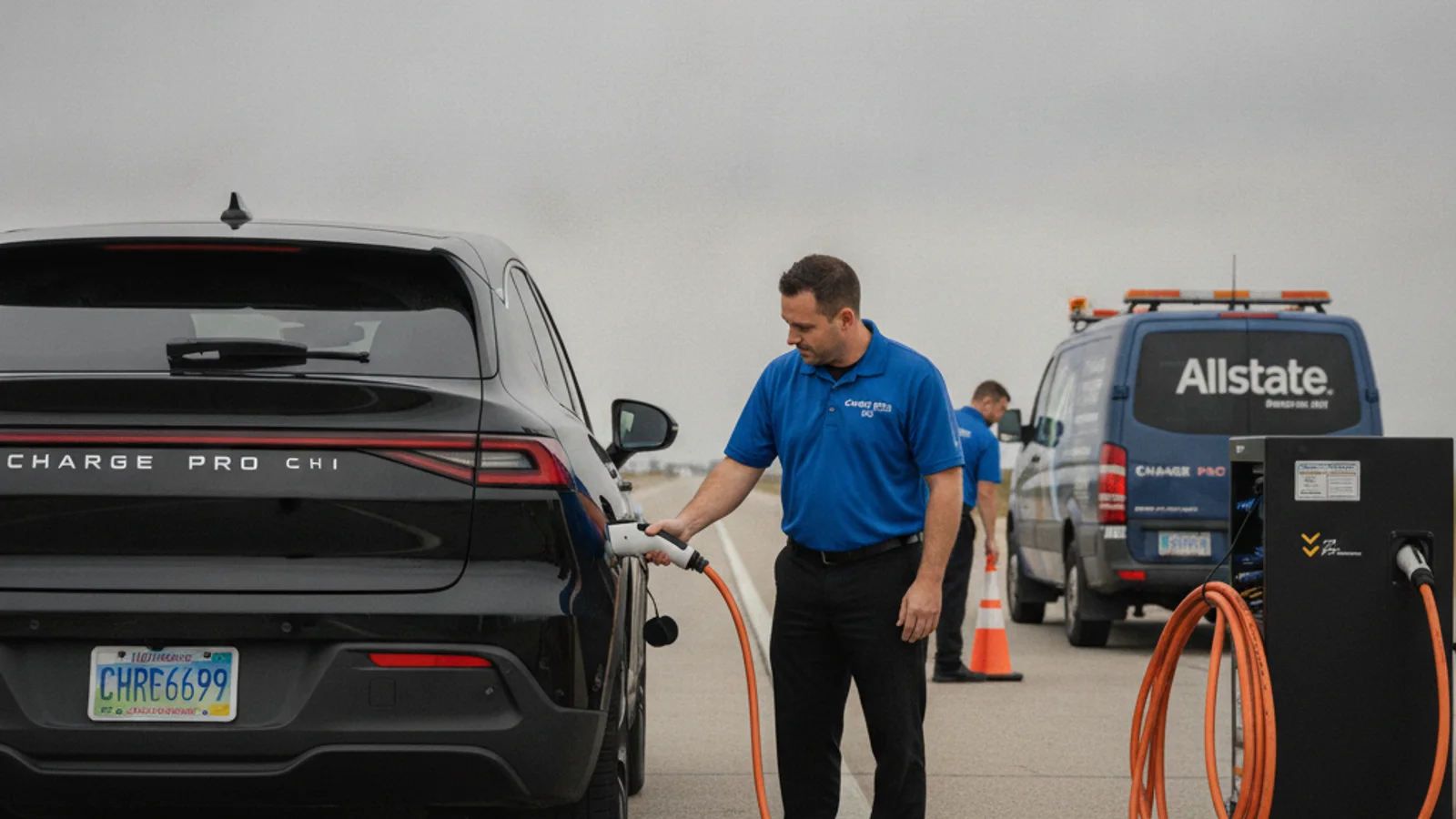
What Uber roadside actually covers
Uber partners with a national roadside dispatch network. When a driver hits the help button in the app, the dispatcher sends a tow truck or a 12V jump contractor. Coverage depends on the tier. Some Uber Pro drivers get a flat number of service calls per year. Others pay per call. The contract is with the dispatch network, not with Uber directly.
What the network does for an EV is the same as for a gas car. A 12V jump wakes a flat battery. A flatbed tows a dead car. A tire swap fits a spare. None of those trucks bring a mobile Level 2 charger. The model assumes the car can reach a charger after the service call.
Why that doesn’t help an empty pack here
An EV that hits zero on the road can’t reach a charger under its own power. A flatbed tows the car to a charger, but the driver is still stranded without a ride. The original goal was to keep driving, not to relocate the car.
A Chicagoland Uber driver’s day is miles. I-90 from Schaumburg to O’Hare, I-55 from Bolingbrook to the Loop, the Edens back north at night. Heat runs in winter. The cabin heat pulls 5 to 10 percent of pack over a long shift in January. The driver who starts a Saturday at 80 percent can finish it under 20 percent. A missed turn onto a charging station ends the shift on the shoulder.
What Uber roadside does for a 12V fault
A 12V fault is the part Uber’s network can actually help with. A dead 12V in a Model 3 looks like a bricked car. Doors stay locked, the screen is dark, and the app shows nothing. A jump wakes the modules. The driver can drive to a charger and reset.
The dispatch sends a contractor who brings a portable jump pack. The contractor opens the bumper cover on a Model 3 or Y, clips red first, then black to ground. They wait. The screen wakes. The contractor pulls black first, then red. The driver takes it from there.
What Uber roadside does not do
It does not bring a Level 2 source. It does not bring a CCS or NACS adapter for a boost. It does not send a mobile charger to a curb. The contractor can tow the car. The contractor cannot refill the pack on site.
A driver on the Tri-State with 4 percent and a cold pack needs a 240V boost, not a tow. The operator we connect you with brings the right truck. They use a NACS plug for Tesla, a CCS for most other EVs, and J1772 adapters where needed. They typically add 10 to 20 miles in 15 to 30 minutes of charging. That is charging time, never an arrival promise.
When Uber’s network still makes sense
If the car won’t move under its own power and there’s no charging station at the destination, a flatbed is the right call. A wheel stuck in a Rosemont pothole. A sidewall tire that won’t hold air. A 12V so dead it won’t take a jump. The contractor tows to a Tesla-rated shop or a tire shop. The driver pays the miles.
Uber’s network also works for a flat at the airport. O’Hare economy lots run a long walk from the terminal. A flat on a week-long parker is a tow, not a boost. The driver needs to get to a counter, not charge in the lot.
How Charge Pro CHI fits
Charge Pro CHI is a referral line. We match Uber drivers with independent local mobile rescue operators. The operator brings a 240V Level 2 truck for an empty pack. They quote before starting and bill the driver directly. Charge Pro does not set the price.
If the Uber dispatch is going to take too long, call us. The operator we connect can often get there faster for a Level 2 boost. For a tow, Uber’s network is often the right path. We don’t dispatch for Uber, and we don’t replace their coverage. We fill the gap their network leaves.
What to have ready when you call
Have your location, model, and what the car is doing ready. Black screen or alive screen. Pack at zero or 12V dead. Frozen port or open port. Boost or tow. The operator can quote faster when they know what’s needed before they roll.
For the wider driver checklist, see our EV roadside assistance guide. The same checks apply whether the car is a personal Model Y or an Uber-driven one. The miss is usually the same.
When to call Charge Pro CHI
If your EV is on the road with an empty pack and Uber’s network can’t bring a charger, call. Driveway, street, garage, or shoulder, the operators we match do this work. Call (858) 925-5546 and we’ll match you with a local operator.