Roadside assistance for EV drivers in Chicagoland is not a gas-can errand. Winter range loss and older housing without a wall box are the stall pattern here. You want a mobile 240-volt boost or a 12-volt jump. A generic tow is the backup, not the opening move.
Two problems get mixed up at the curb
An electric car that won’t roll is not one failure. It’s usually an empty pack or a dead 12-volt. They look similar from the sidewalk at night. The dash can be dark in both cases. Locks and handles may not act the way they should. That’s why roadside assistance for EV starts with a diagnosis.
The high-voltage pack is what moves the wheels. The 12-volt battery is what wakes the computers. It closes the contactors on the big pack. It also runs the lights, locks, and accessories. If the 12-volt is flat, the traction pack can still hold energy. The car just won’t use any of it. The operators we connect you with can jump that small battery. They can replace it on site when a jump won’t hold.
An empty high-voltage pack is the other story. Cabin heat on a Cook County commute burns range fast. A slow overnight trickle may not replace what you used. You can still hit zero before you get home. Then the fix is electricity delivered at the car. It’s not a fuel can or a push.
Older housing is a charging plan, not scenery
Chicagoland is not one housing market with a charger in every garage. Census ACS 2019-2023 figures make the split obvious. In Cicero, 90.2 percent of housing was built before 1980. Berwyn sits at 90.0 percent in the same table. Evergreen Park is 87.7 percent pre-1980 stock. Oak Park comes in at 78.6 percent. Chicago itself is 68.6 percent pre-1980. The city’s 2024 Census estimate is 2,721,308 people.
A pre-1980 two-flat wasn’t designed around a 240-volt EV circuit. Some owners still add a wall circuit later. Many can’t, because parking sits on the street. Cicero home charging is that bind by name. That bind isn’t only a Cicero story. Chicago Heights is 74.3 percent pre-1980. Large stretches of Chicago share the same era of stock.
Start the day from a 120-volt outlet and you leave with a partial pack. Street parking overnight in January takes more energy. The parked car sits cold all night long. The pack sits cold right along with it. You don’t get the quiet top-off a wall box would have given you.
The North Shore isn’t exempt just because the towns read as wealthy. Wilmette still shows 74.3 percent pre-1980 housing. Evanston is 71.2 percent in the ACS file. Skokie is 72.0 percent pre-1980 as well. Park Ridge lands at 67.1 percent pre-1980. Highland Park, in Lake County, is 60.6 percent. Brick houses from mid-century can still lack a 240-volt outlet. Income doesn’t install that circuit on its own.
Newer rings look different in the same Census file. Naperville’s pre-1980 share is 11.7 percent. Its 2024 population estimate sits at 153,124. Plainfield is only 6.7 percent pre-1980. Huntley is 3.8 percent pre-1980 housing. Gurnee, in Lake County, is 9.5 percent. Bolingbrook is 12.3 percent pre-1980 stock. Schaumburg is 15.9 percent in that column. Younger housing is an easier place to picture a 240-volt install. That isn’t a count of wall boxes on those streets. The Census Bureau doesn’t publish charger counts here. It only tells you the housing is younger. Winter still cuts range on the way to work. A stall in those towns is more often a cold pack. It’s less often a building that could never take a circuit.
Winter eats range and the 12-volt too
Chicagoland cold isn’t a footnote on the window sticker. Cabin heat in an EV is electric heat. Preconditioning draws from the same pack you drive on. Rolling resistance rises when the pavement is cold. Regen feels weaker on slick winter pavement. You don’t need a made-up percentage for that to matter. You feel it on a Kennedy crawl. You feel it on I-55 in stop-and-go. You feel it on the Tri-State when traffic dies.
Tesla owners already compare cold-day range here. The same physics hits a Mach-E, an Ioniq 5, a Lyriq, and a Rivian. The car’s map looks optimistic if you ignore heat.
The 12-volt fails in the same weather for another reason. Short trips never let that small battery recover. Accessory loads stay high while you defrost the glass. A pack that never gets a long, warm rest is harder on the 12-volt. The car looks fully bricked from the outside. It may only need a careful 12-volt jump. Sort that out before you call for a flatbed. See the winter jump-start walkthrough. It covers the safety order. If you’re not sure, wait for an operator who treats EVs as EVs.
Charge ports stick in slush and road salt too. A frozen latch isn’t an empty pack. Forcing it is how people break the door. That’s a separate job from a range boost.
What the operators we send actually bring
Charge Pro CHI is a referral line for stranded drivers. We match you with independent local mobile rescue operators. We don’t own the trucks or the chargers. We don’t employ the technicians who show up. We don’t set the price for the job. The operator quotes you before any work starts. They bill you directly after that quote.
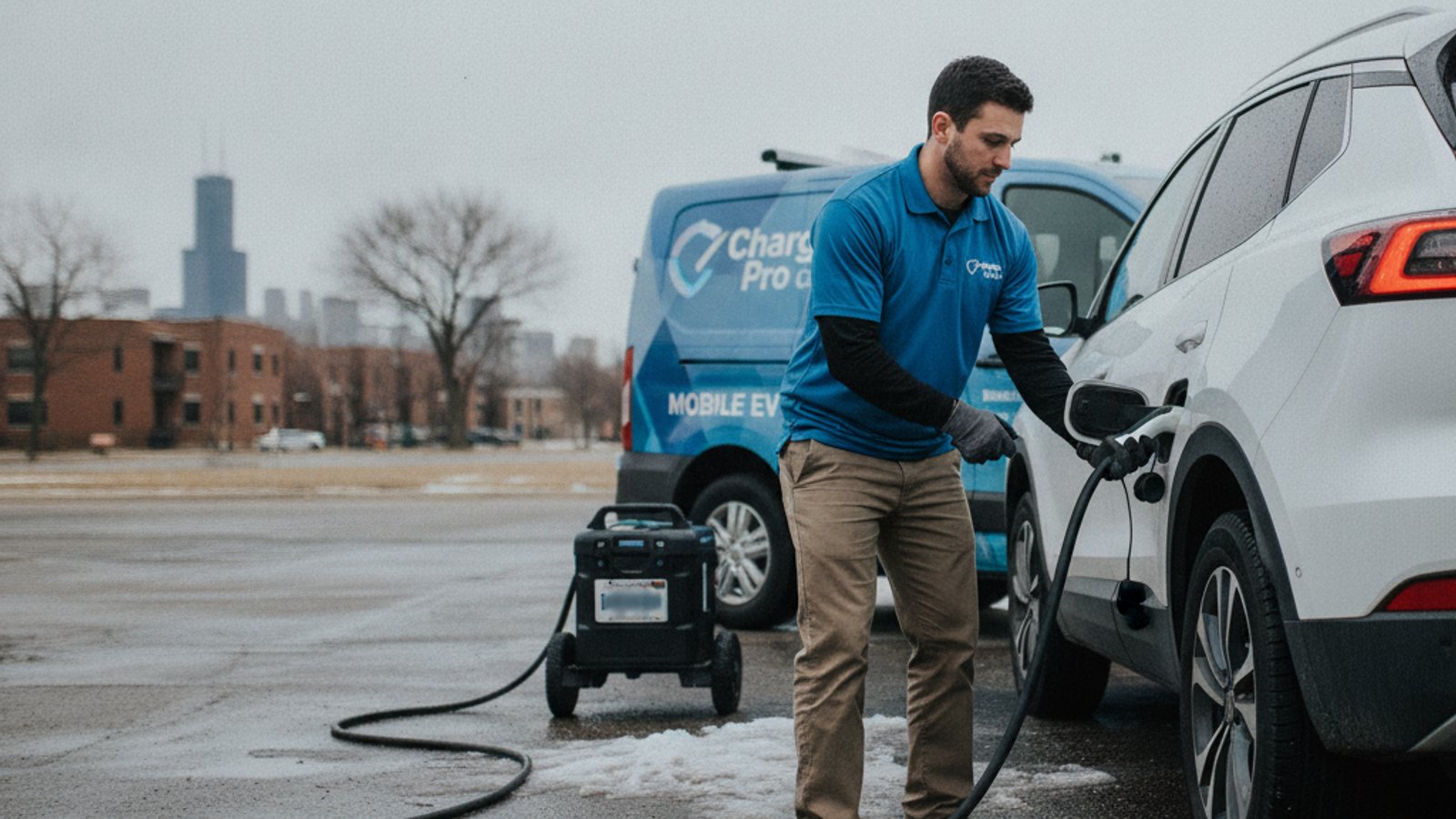
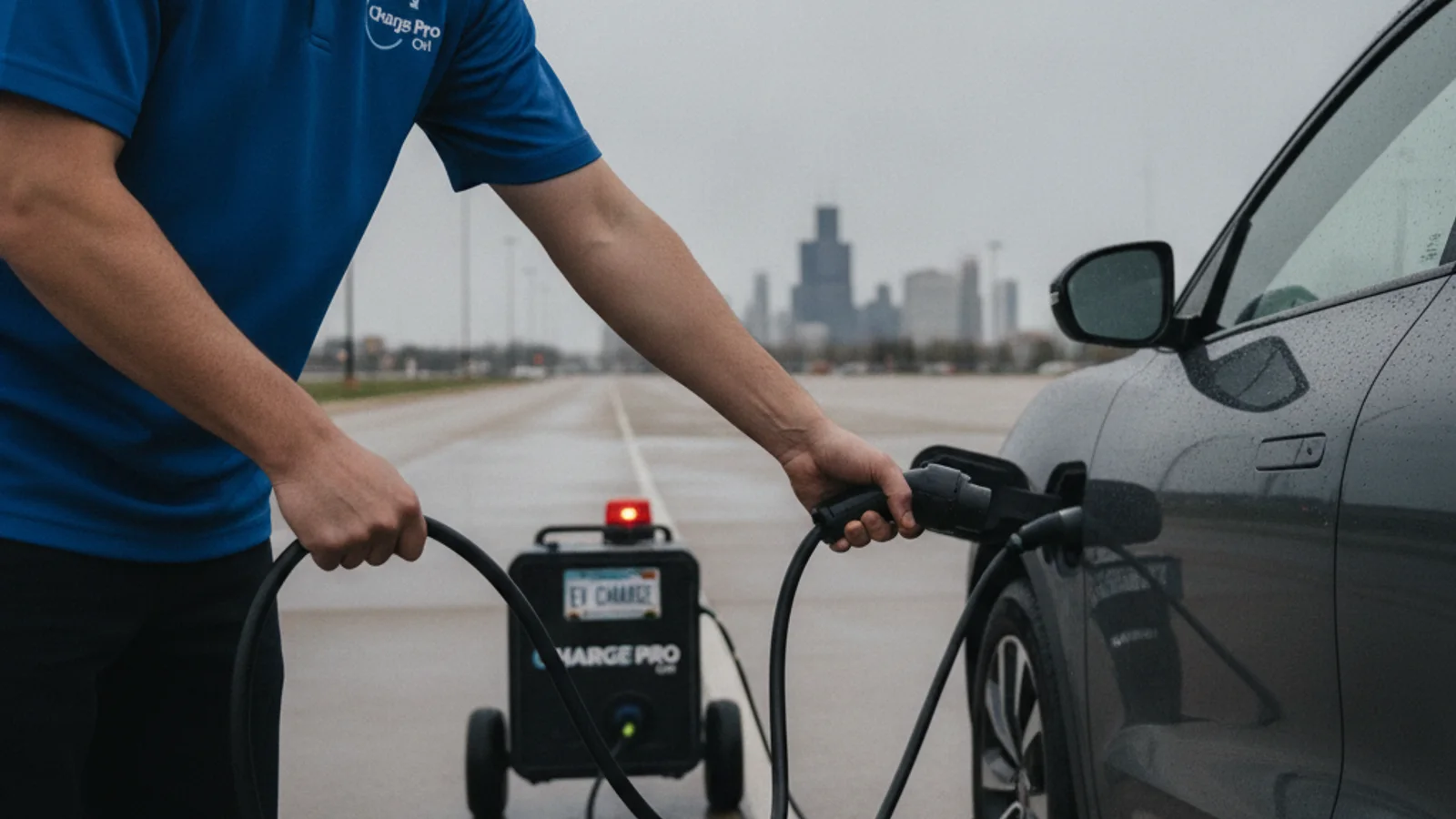
What those operators bring is what an EV stall actually needs. They roll up with a 240-volt Level 2 source. Teslas take a native NACS plug on that lead. Other brands use a CCS or J1772 adapter. Typical charging time on site is 15 to 30 minutes. That window is charging time at the car. It isn’t an arrival clock we can publish. In that span they’re usually adding about 10 to 20 miles of range. That’s often enough to reach a charger you already planned. It can also be enough to get home if home is close.
That visit is mobile EV charging, not a tow. Out-of-charge recovery covers the empty pack. For a Tesla that won’t wake, start with the 12-volt. A jump on site may be the whole call.
They handle Tesla and every major EV brand. The quote is for the work in front of you. No price list lives on our side of the phone. Confirm their quote before they plug in.
A traditional club call is built around gasoline, a jump, and a tow. Some of that still helps an electric car. A jump can save a 12-volt EV. A flatbed can move a car that can’t take a charge. What the club van often can’t do is put 240 volts into your port. If the pack is empty, towing to a charger is a longer day. Ask what they’ll actually do before you wait in the cold.
The metro is not one commute
The split is the city and inner Cook. Then the North Shore, the far west, and the south suburbs.
Chicago’s 2024 population estimate is 2,721,308. The housing stock is old on average here. Street parking is a normal night, not a rare one. A stall on Lower Wacker is a traffic problem and a battery problem. A stall on the Dan Ryan is the same mix. Stay in the car if you’re in a live lane. Keep the hazards on while you wait there. Keep the seatbelt on until help is beside you. NHTSA roadside guidance is the same on any American freeway. It’s posted at https://www.nhtsa.gov/.
North and northwest Cook still mix old roofs with newer subdivisions. Arlington Heights is 42.0 percent pre-1980 housing. Des Plaines is 58.8 percent pre-1980. Schaumburg’s housing is younger at 15.9 percent pre-1980. Office-park parking there is a long-dwell risk in January. The car can sit through a full workday in the cold. It may not be empty when you return. The 12-volt might still be the thing that failed.
Lake County isn’t one kind of town at all. Waukegan’s 2024 estimate is 88,570 people. Pre-1980 housing there is 54.0 percent. Gurnee is only 9.5 percent pre-1980. Highland Park is 60.6 percent pre-1980 housing. They share a county and not a housing era. Different garages change whether you left home on a full pack.
DuPage isn’t uniformly new construction either. Naperville’s 2024 estimate is 153,124 people. Its pre-1980 share is 11.7 percent. Elmhurst is 56.6 percent pre-1980 housing. A Naperville stall after a commute is often winter range. An Elmhurst brick block can still be the no-wall-box story.
Kane and Will carry the long west and southwest drives. Aurora’s 2024 estimate is 180,710 people. Elgin’s 2024 estimate is 114,701 people. Joliet’s 2024 estimate is 151,837 people. Those three already stacked a lot of miles before dinner. The stall risk on I-80 or I-55 is still cold and distance. No verified distance to a charger turned up in the research. Confirm a working plug on your map before you count on it.
McHenry is the far-north edge of the Chicagoland service area. Crystal Lake is 25.7 percent pre-1980 housing. Huntley is 3.8 percent, the lowest in this table. Newer houses don’t cancel a January commute. It changes whether you had a warm garage at dawn.
South Cook is its own housing picture in the ACS file. Oak Lawn is 58.4 percent pre-1980. Chicago Heights is 74.3 percent pre-1980. Orland Park is 11.8 percent pre-1980. If you live on the older blocks, don’t assume a wall box. Plan the day around a workplace plug or a public session. Plan around a partial pack if that’s what you have. When that plan fails, you want a boost at the car.
Charge Pro CHI serves Chicagoland, across these cities. That includes the Chicago charging hub and the wider metro. The operators we send are local independent pros. The pros we connect you with are licensed and insured. Charge Pro CHI itself holds no trade license. We don’t do hands-on work on your car.
If you’re already stopped
Get out of the live lane if you can still roll a few feet. If you can’t, stay in the vehicle. Don’t walk the Dan Ryan, the Eisenhower, or I-90 on foot.
Then name the failure before you dial. Check whether the car will wake at all. Check whether lights and screens come up. If everything is dead, think 12-volt first. If the car is on and the range hit zero, think pack. If a cable is stuck in the port, leave it. Don’t yank a frozen handle or latch.
Turn off cabin heat if you still have a sliver of high-voltage left. Save it for hazards and the systems that help someone find you. That’s conservation, not a repair of the pack.
Call the line that can send an EV operator. Don’t call only for a hook and a tow. Tell them the make and the model. Tell them whether the car will power up. Give the road, the direction, and the last exit you saw. Lower Wacker, a Schaumburg garage, and a Cicero side street are different jobs. Say which street you’re sitting on.
Charge Pro CHI will match you with an operator who quotes before they start. If the right call is a 12-volt jump, that’s the work. If the pack is empty, they bring Level 2 to the bumper. If the car can’t take a charge, you may need a flatbed. You also need a flatbed if it can’t be driven. Book that tow from a towing company. Charge Pro CHI doesn’t provide that tow. Don’t let someone drag an EV on its drive wheels.
Manufacturer roadside is a separate path from a local boost. Tesla posts the policy on its support site. Other brands bundle roadside for a period after purchase. Coverage and towing rules are their terms, not ours. Whether anyone will charge you on site is also their terms. Read the plan you actually bought with the car. Don’t assume a 240-volt boost is included. Many owners still need a local operator for the empty-pack case.
Habits that match this climate and this housing
Leave with more buffer than a July trip would need. Winter range is shorter here. You don’t need a fake percent to drive like it.
If your building can’t take a 240-volt circuit, treat home as a trickle. Treat it as nothing if even that outlet is missing. Top up at work when you can. Use a public session on purpose, not as a panic stop. Apps help you see a stall coming. They don’t put electrons in the pack by themselves.
Watch the 12-volt the way you watch washer fluid in January. Random accessory faults and a car that sleeps too hard are early signs. A jump that works once isn’t a new battery. If it dies again, replace it. Another January night on a weak 12-volt can leave you stuck in a lot.
Keep a tire inflator if your EV has no spare. Heavy cars chew shoulders in the cold. It’s still a stall if you’re on the Bishop Ford with a shredded tire.
Store one number that reaches EV operators, not only a club that sends gas. For Charge Pro CHI, that number is (858) 925-5546. It’s a match to a local operator. It isn’t a promised arrival window. We don’t publish hours. The operator on the other end quotes the job you have.
Frequently asked questions
What if my EV hits zero on a Chicagoland road?
Pull out of traffic if the car still moves. Then stay inside with hazards on. You’re not waiting for gasoline. You’re waiting for a 240-volt Level 2 source at the port. Operators we connect you with typically add 10 to 20 miles of range. That takes 15 to 30 minutes of charging. That’s charging time, not a clock on their drive to you. They quote before they plug in.
Is a dead EV always the big battery?
A failed 12-volt can freeze the car while the pack still holds range. Screens go dark and locks misbehave. The car won’t ready. A jump or an on-site 12-volt replacement is the usual path then. An empty high-voltage pack is the other diagnosis. It needs a boost, not jumper cables on the traction battery.
Does Charge Pro CHI charge the car itself?
Charge Pro CHI is a referral line, not the crew at the bumper. Independent operators do the work, own the equipment, and bill you. They bring native NACS for Tesla and CCS or J1772 adapters for other EVs. They jump or replace a dead 12-volt on site. We match you with that operator. We don’t perform the rescue.