The i7 sat through a freeze in Wilmette. Morning came, and the fob still unlocked the door. Nothing else woke up. The iDrive stayed black. The doors unlatched, then nothing else moved. You remembered range from the last charge. The car still refused to boot.
That’s a BMW i5 or i7 that won’t start after a cold sit here. It’s typically the 12V, not the drive pack. The small auxiliary battery wakes every computer, closes the contactors, and lets you shift. When that 12V sags too far, the car stays silent. A healthy high-voltage pack doesn’t change that.
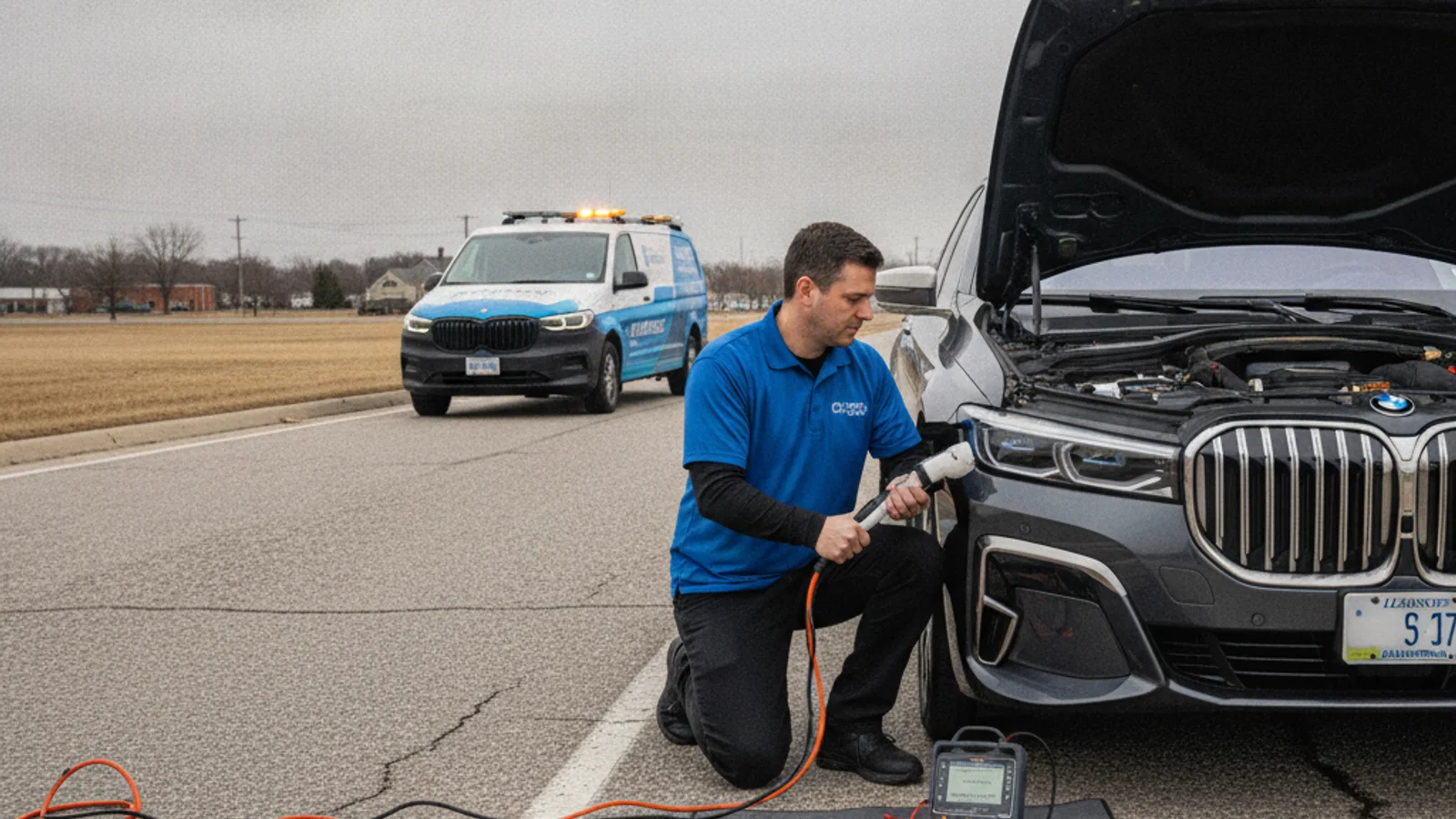
The i5 (G60) and the i7 (G70) share this layout. Treat them as one 12V problem with two body styles. If you’re in a dark cabin in Chicago, Northbrook, or Oak Park, run the checks below. Call a flatbed only after the 12V path fails.
What the no-start looks like on these cars
Owners often blame the pack first. The pack is the wrong suspect when the car is this quiet. A low drive battery still tries to talk to you. A dead 12V does not.
Watch for this cluster after an overnight sit:
- The screen never lights, and there’s no ready chime.
- The fob unlocks, then the power button does nothing.
- Handles go dead, and the doors will not pull themselves shut.
- Warning lamps flicker, then the car shuts itself down.
- It wakes for a second, then resets under load.
Two or more of those after a freeze is a 12V flag. Don’t start with a charger hunt. Don’t start with a dealer tow unless the jump fails.
The i7 works that small battery harder. Power doors, the rear theater screen, executive seats, the cellular modem, and the alarm all sip current while parked. The i5 carries a lighter version of the same standby load. Either car can flatten a tired AGM on a cold night. The i7 just gets there with less warning.
For how a 12V failure shuts an EV’s systems down, see what happens when an EV’s 12-volt battery dies in the cold.
The pack can be full and the car still won’t wake
These cars run two batteries. The high-voltage pack moves the wheels. The 12V boots the electronics that let that pack connect. If the 12V can’t hold voltage, the contactors never close. You get a silent car with unused range.
The phone app can omit what you need. As the 12V sags, passive entry drops first. Then interior lighting. Then the screen. Some remote functions fade before the car is fully dead. Standing close with the fob is a real test.
A 12V jump is what usually brings an i5 or i7 back. Dragging it to a DC fast charger does not. The car has to boot before it can take a charge. If the pack itself were empty, you’d still see some life. You’d get a warning, a percent, or a complaint. A dark cabin after a cold sit is the auxiliary battery until you prove otherwise.
Why a cold sit here takes out the 12V
Cold cuts what a 12V AGM can deliver. That’s chemistry, not a brand quirk. Park an i5 or i7 overnight in Chicagoland, and a weak battery can refuse to wake the computers. The car doesn’t need an empty pack. It needs a 12V that’s too tired to boot the rest of the car.
The pattern shows up on the North Shore and in the west suburbs, then in the city. Wilmette is in Cook County. Its 2024 population estimate is 27,443, and 74.3% of its housing was built before 1980. Northbrook is also Cook, with a 2024 estimate of 34,546 and a newer mix. Only 39.1% of Northbrook homes predate 1980. Highland Park sits in Lake County. Its 2024 estimate is 30,794, and 60.6% of housing is pre-1980.
Older blocks are common closer in. Oak Park’s pre-1980 share is 78.6%. Evanston’s is 71.2%. Chicago’s 2024 population estimate is 2,721,308, and 68.6% of its housing predates 1980. These i5 and i7 cars still spend nights on city streets and in older neighborhoods.
Newer tracts look different and still strand the same cars. Naperville in DuPage County has a 2024 estimate of 153,124, and only 11.7% of its housing is pre-1980. An i7 in a Naperville driveway still sits through the freeze. The 12V does not get a pass because the house is newer.
Long parking is the other local trigger. An i7 that sits for weeks keeps drawing standby current. Power-door hardware, the alarm, and the modem do not fully sleep. You come back to a dark cabin. The pack may still have range. The computers will not wake to use it.
What BMW’s replace-battery message actually means
The warning is about the 12V auxiliary battery. It is not the drive pack. The full wording usually reads like this: increased battery discharge when stationary, continued driving possible, replace battery.
Continued driving possible is true while the car is moving. The high-voltage system tops the 12V up as you drive. Park it, and that line becomes a countdown. A marginal AGM can look fine on the way home from Naperville or Libertyville. Then it can die on the pad by morning.
If you’ve already had one dark cabin, you’re past the heads-up. Replace the 12V. Another jump buys a commute, not a fix.
BMW’s other EVs throw a cousin of this warning. Our BMW i4 replace battery message guide covers that wording on the i4. The i5 and i7 follow the same idea. Trust the 12V less. Don’t assume the pack failed.
A new 12V on these cars also needs registration. That’s a VIN-specific step through ISTA or a compatible BMW tool. A shop that can talk to BMW’s system handles that step. Charge Pro CHI does not. We’re a referral line. We don’t hold a trade license. The operator we connect you with can jump or replace a dead 12V on site. Ask them on the quote whether they carry registration tools. That step is often a BMW shop job after you’re mobile.
No parts price for an i5 or i7 AGM turned up in a verifiable public source for this page. Ask the shop for the current part and registration quote before they order it.
The battery is in the trunk. The jump post is under the hood.
BMW hid the 12V. It isn’t under the hood on the i5 or the i7. The AGM sits in the rear luggage compartment, behind a trim panel.
That’s a problem on a dead car, because the trunk release is electronic. No 12V means no powered tailgate. Use the physical key blade inside the fob on the driver’s door. Then fold the rear seatback. Reach the battery from the cabin only if you truly need it.
You usually don’t. BMW put a jump terminal up front for this exact case.
The interior hood release is mechanical. It works with zero 12V power. Open the hood. Look for a red cover or red cap near the strut tower or the fuse box. That’s the positive jump post. For ground, use unpainted metal on the chassis: a bracket or a bolt.
Connect positive to positive first. Then clamp the negative to the i5 or i7 chassis ground. A portable jump pack is the clean method. A donor car works if that’s what you have. Let it sit two to three minutes before you try to wake the car. After the 12V comes back, give iDrive another 30 to 45 seconds to boot.
Don’t put clamps on the orange high-voltage cables. That’s a different system. For clamp order, winter gloves, and what not to touch, use the guide to jump starting an EV in winter.
Checks to run before you call a tow
Work them in order. Stop when the car wakes.
Get the fob within inches of the handle. Passive entry often fades before the 12V is fully dead. A tap from across the lot can fail. A press against the door can still work.
If the fob does nothing, pull the key blade and use the driver’s door lock. That gets you into the cabin with no electronics at all.
Pull the mechanical hood release. Find the red-capped positive post. Connect a jump pack if you carry one.
Wait those two to three minutes. Then press start and give the screen time. Mashing the button early looks like a failed jump when the computers are still coming up.
If you don’t have a pack, and the car is dark, call for a mobile operator. Charge Pro CHI matches stranded drivers with independent local pros. They handle BMW i5 and i7 cars, and every other major EV. Operators jump or replace a dead 12V on site. They quote you before they start, and they bill you directly. The pros we connect you with are licensed and insured.
If the car wakes and the pack is also low, that’s a second job. Operators can bring a 240V Level 2 source to the car. They’ll use a CCS or J1772 adapter for a BMW. That typically adds 10 to 20 miles of range in 15 to 30 minutes of charging. That’s charging time. It is not an arrival time.
Don’t keep driving a car that has died twice in a week. A 12V that can’t hold the i7’s standby load will drop you again. See what to do when an EV battery dies again after a jump before you treat a second no-start as bad luck.
When the jump is enough, and when it isn’t
A 12V that went flat from one cold sit will often take a charge and hold. A worn AGM will take a jump, get you home, then strand you after the next overnight. That’s the replacement line.
Roadside replacement and shop registration can be two visits. The operator may get you a working 12V on site. The car may still need ISTA registration at a BMW-capable shop. Ask both parties what they can actually do. Don’t assume one call covers both.
If it won’t wake even on a known-good jump pack, stop. You may have a poor ground, a fuse, or a deeper electrical fault. That’s past a simple 12V revive. A tow to a BMW-capable shop is the honest next step. Charge Pro CHI does not repair cars. We don’t own trucks, and we don’t run a service bay.
What a local operator brings on this call
The right path for an i5 or i7 is non-Tesla EV rescue. Pros in the network jump a dead 12V. They replace it on site when that’s the job. They can also boost a low pack with mobile Level 2 when the car can actually boot.
They set the price. Distance and time of day move the quote. So does whether you need a 12V jump, a replacement, or a range boost. Confirm the quote they give you before they start. This page does not publish a rate, because we don’t set one.
We don’t post an arrival window here, because we don’t have one to post. The operator tells you whether they can take the job. If they can’t, you try another option.
Service area is Chicagoland. That includes the city, the North Shore, Lake County towns like Highland Park, Gurnee, and Libertyville, and the west and southwest suburbs. A stall in Naperville, Elmhurst, Joliet, or Glenview is still inside the network.
If you’re sorting a jump from a pack boost, look at what failed. Dark screens and dead handles are 12V. A car that powers on and reports no range is the pack.
Frequently asked questions
Why won’t my BMW i5 start when the drive battery still has charge?
The pack isn’t what boots the car. The 12V auxiliary battery powers the computers and closes the contactors to that pack. If the 12V is flat, the i5 or i7 stays dark no matter how much range is left. A jump on the under-hood post is the usual revive. Then get the 12V tested if this has happened before.
Can I keep driving with the replace-battery message on?
For the rest of that trip, yes. The high-voltage system keeps the 12V up while you drive. The risk is the next park. A weak AGM can drain overnight and refuse to wake. Finish the drive. Then replace the 12V before another cold sit.
Where is the 12V in a BMW i7, and how do I jump it?
It’s in the rear luggage compartment behind a trim panel, not under the hood. For a revive, skip the trunk. Open the hood with the mechanical interior release. Use the red-capped positive jump post up front, then a chassis ground. Wait two to three minutes. Then wake the car and give iDrive half a minute.
If the i5 or i7 is still dark, call Charge Pro CHI at (858) 925-5546. We’ll connect you with a local operator who can jump the 12V and quote the work before it starts.