A garage jump woke the EV, then it died again. A battery dying after jump start usually means the 12V can’t hold a charge. Another jump from a neighbor’s cables isn’t the fix. Talk through an on-site replace with a local operator. Keep a clean record of what the car showed.
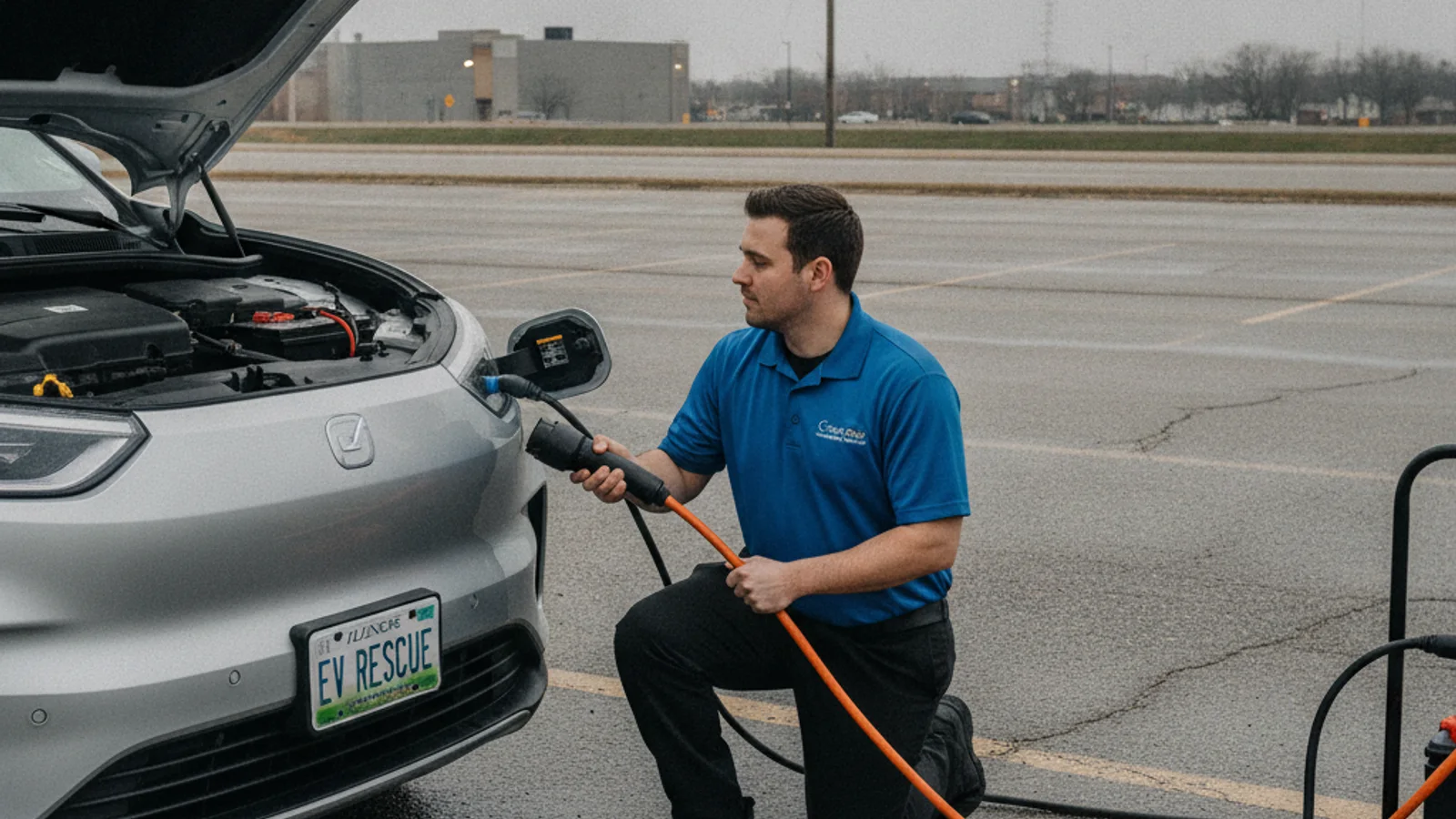
The second blackout is new information
A first jump only proved the computers could wake. It didn’t prove the 12V can keep them awake. When screens go dark a second time, treat that as a new stall. It isn’t the same job as the first wake-up.
Don’t file it all under dead battery. That phrase doesn’t tell an operator which warning appeared. Copy the exact line from the dash or center display. Use the official app or a key alert if the dash stays dark. Look for 12V, low voltage, propulsion, charging, or the main battery. Don’t rewrite that line into your own diagnosis.
Note whether the doors unlock and whether any screen lights. Note whether you can shift, and whether the app still reaches the car. Those notes describe the failure without assigning a cause.
Your owner’s booklet for that model year still owns the terms. Tesla, Ford, Hyundai, Chevy, and Rivian don’t share one jump map. Don’t follow a video shot for a different year.
If the display pointed at low-voltage power, start with symptoms, not a guess. Read what happens when an EV’s 12-volt battery dies. It can help you sort what you saw. It still doesn’t replace the pages in your glovebox.
Overnight sits in older Cook County housing
This call often starts after the car sat overnight at home. Inner-ring Cook County still has a heavy share of pre-1980 housing. Cicero sits at 90.2 percent pre-1980, and Berwyn sits at 90.0 percent. Evergreen Park is 87.7 percent, and Oak Park is 78.6 percent. Chicago is 68.6 percent pre-1980. The 2024 estimate is 2,721,308 people.
Park Ridge is 67.1 percent pre-1980, and Evanston is 71.2 percent. Skokie is 72.0 percent, and Wilmette is 74.3 percent. Glenview is 40.3 percent pre-1980, and Northbrook is 39.1 percent. The 12V can fail in both kinds of neighborhood. The housing around the car isn’t the same.
Lake County splits too. Waukegan’s pre-1980 share is 54.0 percent, and Highland Park is 60.6 percent. Gurnee is 9.5 percent, and Libertyville is 34.7 percent. A Waukegan driveway isn’t a Gurnee subdivision pin.
DuPage and Kane look newer on average. Naperville’s pre-1980 share is 11.7 percent, and Wheaton is 35.2 percent. Aurora is 33.1 percent, and Elgin is 41.5 percent. Will County’s Joliet is 39.0 percent pre-1980, and Plainfield is 6.7 percent. New Lenox is 7.9 percent. Huntley, in McHenry County, is 3.8 percent.
Include the street and garage level. Add the building name and gate code if you have them. A Schaumburg office lot isn’t a Cicero street stall. A Crystal Lake driveway is a third kind of handoff. Cook, Lake, DuPage, Kane, Will, and McHenry all sit in this service area.
Don’t treat last-shown range as the whole story. A repeat 12V death can leave a healthy pack sitting unused. The small battery is what woke, then quit.
Write the timeline before anyone grabs cables
Jot the sequence while it’s still in your head.
- What the car did before the first loss of power
- Every warning, in the order it appeared
- Who performed the first jump
- What equipment they used, if you know
- Whether they followed your model’s published points
- What functions returned afterward
- Whether the car moved, charged, or stayed parked
- What happened right before power failed again
Leave gaps blank if you didn’t see them. “Couldn’t be confirmed” is a useful line. A guessed converter fault isn’t.
If a neighbor did the first jump, ask what they connected. Note where they clipped on, if you saw it. Write that answer down. Don’t rebuild their setup to test a theory. The next professional needs a clean account, not a restaged experiment.
Shoot the full dash when it still lights. Don’t crop to one banner. If messages cycle, capture each one. Don’t clear warnings to tidy the screen. An app screenshot can stand in when the dash stays black.
Put make, model, model year, and the current city at the top of the note. Chicago alone isn’t enough if you’re in a gated lot. Oak Park, Naperville, and Joliet each need their own access details.
Don’t treat a second jump as the default
Read the official procedure for your exact make, model, and year first. Then ask whether the person in the garage actually supports that vehicle.
This article doesn’t publish repeat-jump steps. Covers, posts, and allowed tools change by model. Generic cable advice can miss yours.
If the manual says don’t try again, stop. If you can’t confirm the steps, don’t improvise. Call a qualified operator or the brand’s support channel. Read them the timeline.
Say this out loud: power came back once, then died again. That line changes the job from a first jump to a failed hold. Tesla owners often go next to a 12V replace versus a jump in the cold. Drivers in other brands should start with non-Tesla EV rescue.
Charge Pro CHI matches you with independent local operators. The pros we connect you with are licensed and insured. They do the physical work. They quote you before they start. They bill you directly, and Charge Pro CHI doesn’t.
If you see smoke, a cracked case, or leaking fluid, stop. Then call emergency services. Don’t keep a bystander on the cables.
An on-site replace is usually the next talk
When a garage jump holds for minutes, then drops, treat that as a failed hold. The 12V often can’t keep voltage. The next useful talk is usually a replace on site, not a third wake-up. That isn’t a remote diagnosis from this page. It’s what to ask the operator standing at the car.
The pros we send can jump a dead 12V or replace it on site. They cover Tesla and every major EV brand. They bring a native NACS plug, plus CCS or J1772 adapters for non-Tesla EVs. They can bring a 240V Level 2 source if the pack also needs miles. That typically adds 10 to 20 miles of range. Charging takes 15 to 30 minutes. That’s charging time, not an arrival time.
Ask three things before anyone opens a cover. Confirm they support this exact model. Confirm whether they’re replacing the 12V or only jumping it. Confirm what they’ll quote you for. You approve the work. You’ll pay that operator.
See EV 12V battery replacement signs and on-site help. It lists questions worth asking. Your warnings and model year still lead that talk.
A replace in the driveway can make the car usable again in that same spot. A dealer visit may still follow if a warning stays on. Don’t merge those into one vague request.
Pick roadside help or a service center by the immediate need
Roadside help fits when the car won’t unlock or wake. It also fits when it can’t leave where it sits. Ask whether the operator handles your model and this repeat 12V failure. EV roadside assistance is the general path. Tesla owners who already know it’s the 12V have a more specific path. Use Tesla 12V battery jump.
A service center fits when you need manufacturer testing, or follow-up after two deaths. Tell the advisor the car lost power again after a jump. Send the same photos and timeline you built for roadside help.
You may need both. The operator handles the immediate 12V so the car can move. The service center hunts a charging fault or a deeper electrical issue. Confirm that split before anyone discusses a tow. If transport comes up, follow the manufacturer’s current instructions for your model.
Don’t pick the path from the last range figure alone. Report that number. Report the warning text. Report that a jump already failed to hold.
The US Department of Energy’s electric vehicle overview is general background only. It can’t diagnose a post-jump stall on your driveway.
Before you approve anything, ask who will perform the work. You’ll contract with that independent professional.
How to call this in
Stay with the car if you can do so safely. Keep the notes in one thread. Make, model, year, city, warnings, and the first-jump story should sit at the top.
Charge Pro CHI is a referral line. We don’t hold a trade license, own trucks, or employ technicians. We don’t set prices or publish hours. We match stranded EV drivers with independent local mobile rescue operators across Chicagoland.
If the 12V has died twice, that’s the call to make. Share the model, the warnings, the exact location, and what followed the first jump. Call (858) 925-5546 and we’ll connect you with a local EV rescue operator.