A dark dash after a freeze is usually the 12V, not the drive unit. Frost on the terminals can keep a healthy traction pack from connecting. That’s the typical Chicagoland stall this time of year. Here’s how to jump start an electric car without frying that low-voltage system.
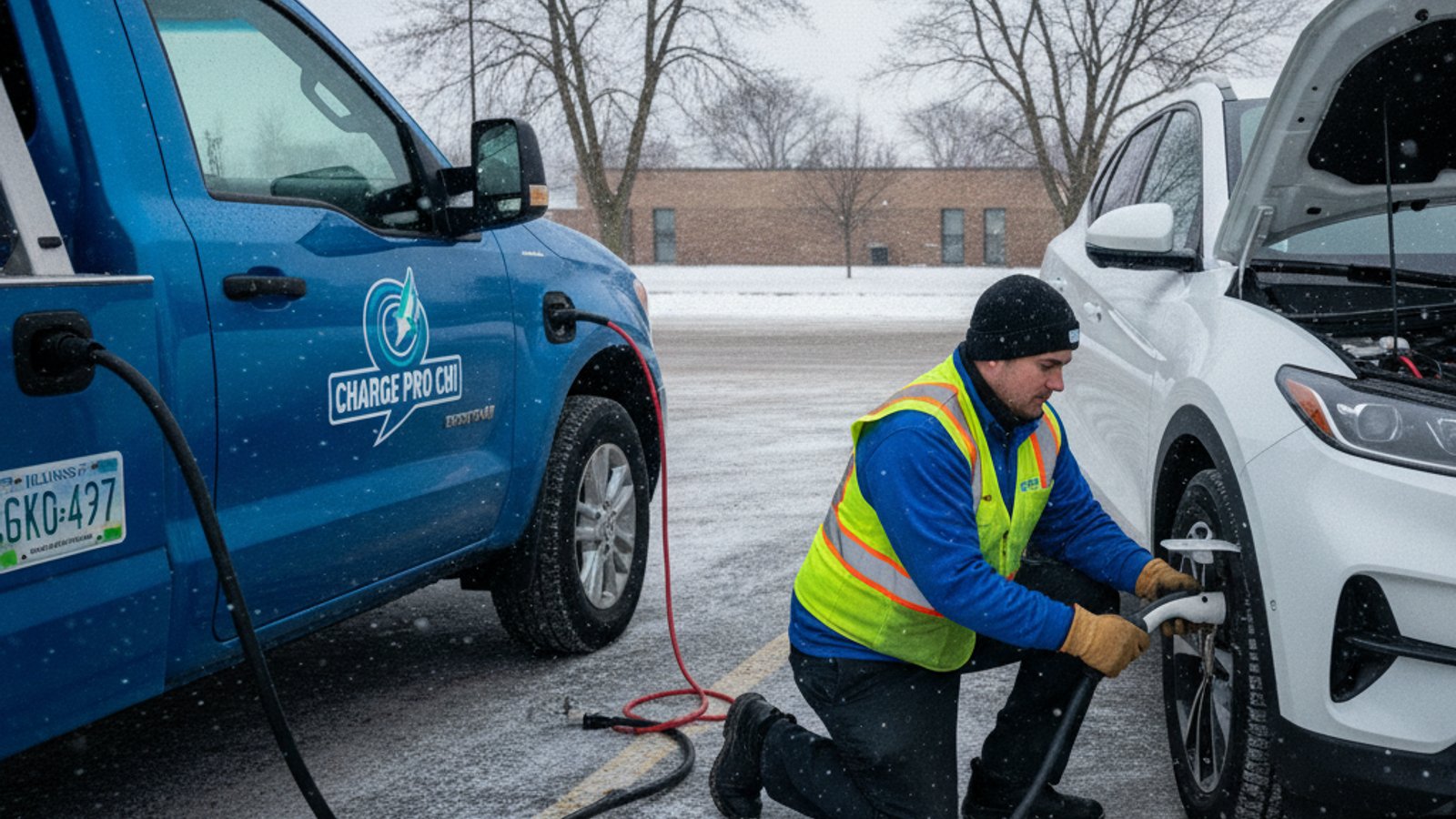
The traction battery moves the wheels, and the 12V wakes the computers, locks, and contactors. Those contactors have to close before the big pack can work. A flat 12V leaves you with a brick. Miles that showed last night in the app don’t matter until that 12V comes back.
Cold makes the small battery sluggish, and ice on the posts adds resistance. The car never gets the signal to boot. Drivers often treat it as a failed motor. It’s a winter 12V stall, not a dead drive unit. You see it on a Chicago side street and on a Naperville driveway. You also see it after a long sit on Lower Wacker. Overnight parking in Oak Park does the same thing.
Old housing, new suburbs, same 12V chemistry
Chicago’s ACS 2019-2023 profile is heavy on older buildings. About 68.6% of housing units were built before 1980. Oak Park sits at 78.6%, and Evergreen Park is 87.7%. Cicero is 90.2%, and Berwyn is 90.0%. Those blocks take the same overnight freeze every other parked EV takes. The 12V doesn’t stay warm just because the street is urban.
North Shore towns follow that older pattern more than people expect. Evanston’s pre-1980 share is 71.2%, and Wilmette’s is 74.3%. Highland Park, in Lake County, sits at 60.6%. Newer inland towns still lose 12V cars in January. Naperville’s pre-1980 share is only 11.7%, and Gurnee’s is 9.5%. Plainfield’s share is 6.7%, and Huntley’s is 3.8%. Chemistry doesn’t care about the year the house was built.
If the phone still talks to the car, read the traction figure first. A healthy pack plus a silent cabin is a 12V job. What happens when an EV’s 12-volt battery dies in the cold walks through those tells. A pack that’s already near empty needs a charge, not a clip on the 12V.
Leave the other car out of it
A running gas car can push well past 14 volts, and it can spike. That surge lands on the EV’s DC-DC converter and the modules around it. Tesla’s published guidance says not to jump from another vehicle. Use a dedicated lithium jump pack instead of another car. It puts out a controlled 12V and doesn’t behave like an alternator.
Clip red to the marked positive, then black to the marked ground. Don’t pick a random underbody bolt and hope it’s ground. Don’t clamp the battery’s negative post unless the manual says that post is ground. Reverse polarity is how the converter gets damaged. A pack with reverse-polarity protection should refuse a backwards hookup. Older jumper cables won’t stop a backwards hookup.
Keep a jump pack in the car, not in the house
A lithium jump pack is a small battery with leads built in. You want reverse-polarity protection on the pack you buy. You want enough output to wake a 12V, not to crank a gas engine. Store it in the frunk or the cargo area. Keep the pack charged so it’s ready after a freeze.
You don’t need another vehicle sitting next to you. You don’t need a shop visit for a simple wake-up. You do need the right posts, and you also need patience on the clips.
Clip in this order, then wait
The clip order stays the same across brands. Only the access points change from car to car.
- Confirm the jump pack itself still has charge. Empty LEDs mean you recharge the pack first.
- Find the marked 12V access for your model. That isn’t always on the battery case.
- Connect the red lead to the marked positive post.
- Connect the black lead to the designated ground point.
- Wait about 30 seconds so voltage can settle.
- Wake the car with a handle, the fob, or the app.
- Leave the pack connected about two minutes after it wakes. That lets the DC-DC take over.
- Disconnect the black lead first, then disconnect red.
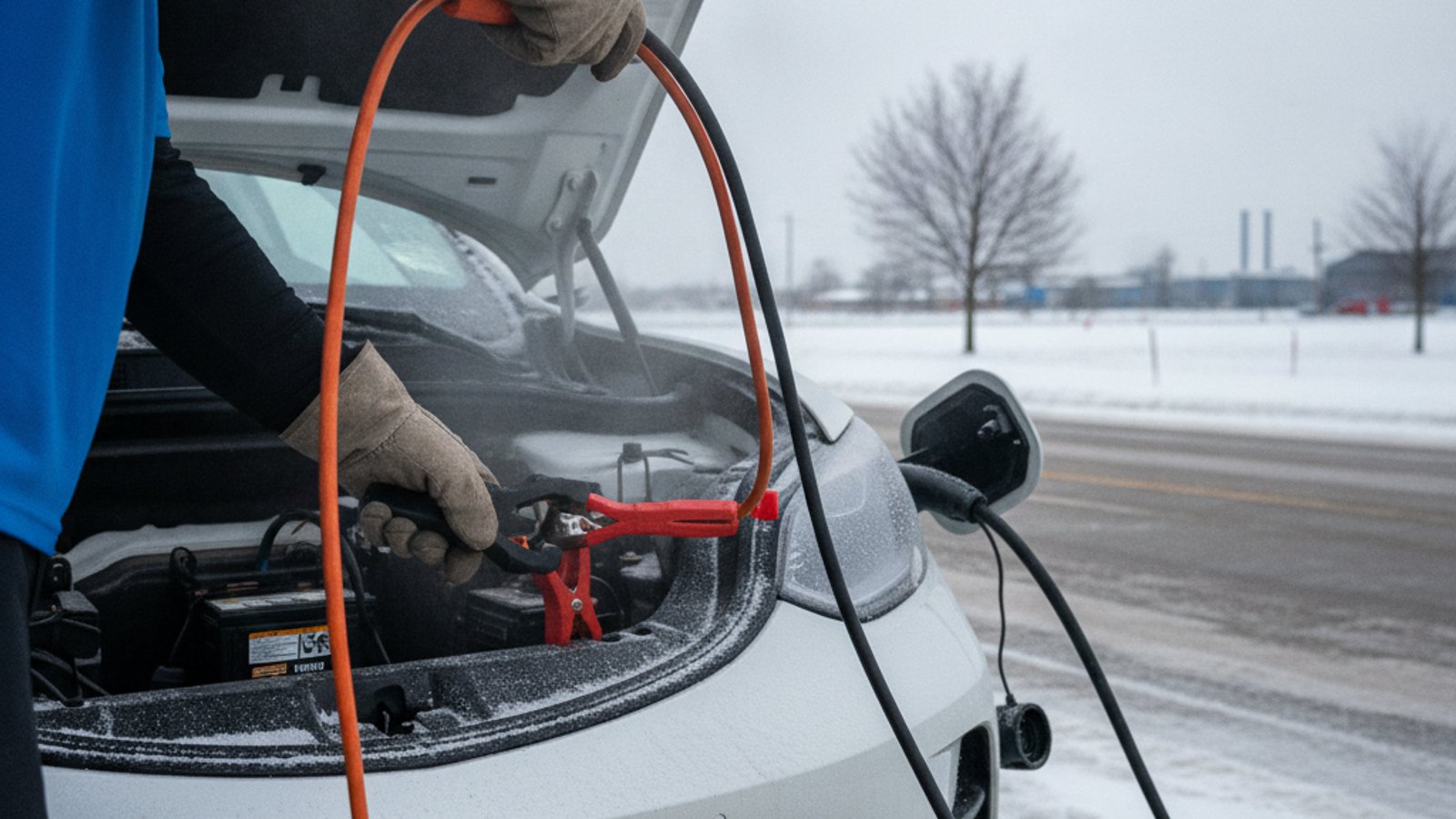
Keep red on positive and black on the labeled ground. That’s the polarity rule, and it doesn’t change by brand.
Where each brand hides the posts
Tesla Model 3, Model Y, and older S and X
Pop the driver’s-side tow-eye cover on the front bumper. Two pigtails sit behind it, red for positive and black for ground. Clip the pack there before you chase the frunk. When the frunk unlatches, open it and let the actual 12V take a longer top-up. Pre-2021 Model S and Model X use that same front fascia pair. The Tesla-only steps are in how to jump start a Tesla Model 3, Y, S, or X.
Tesla Model S and X from 2021 on
Use the mechanical door releases on both sides. Pull the frunk release under the carpet once you’re inside. Jump on the 12V terminals in the frunk.
Rivian R1T and R1S
A dead 12V means the fob won’t open the frunk. Use the manual pull cord behind the grille. A small cover comes off with a Phillips screwdriver. The 12V sits under a panel on the passenger side. Jump the positive post and the marked ground stud.
Ford F-150 Lightning
The power frunk release is dead if the 12V is dead. The mechanical loop is under the front bumper. Once the lid is up, the 12V is on the driver’s side with standard posts.
Hyundai, Kia, and the Bolt
Ioniq 5, EV6, and EV9 store the 12V under the rear cargo floor. They still give you jump terminals up front. Use the red positive post and the marked ground. The Chevrolet Bolt uses that same front-post layout. The 12V sits in back, and the labeled posts are in the front compartment.
Polestar 2 and Mustang Mach-E
Polestar 2 keeps the 12V in the frunk. If the lid won’t move, the manual cable sits behind the driver-side headlight housing. The Mach-E stores the 12V in the rear cargo area. Jump posts are in the frunk. If the app can’t open it, look for a manual cable behind a driver-side kick plate.
Non-Tesla layouts are also grouped under non-Tesla EV rescue.
After the screens come back
Drive the car or plug it in once the screens are back. Either path lets the DC-DC refill the 12V from the traction pack. If that pack was already low, plug into Level 2 while the 12V recovers. Operators in this network typically add 10 to 20 miles of range. That’s in 15 to 30 minutes of charging. That figure is charge time, not an arrival clock.
If the 12V fails again shortly after, it needs replacement. Another jump only delays the next stall. Cold can hide a weak 12V for one commute. Then it drops in a Wheaton lot or a Joliet driveway. Tesla 12V replacement vs a jump when it dies in the cold covers the Tesla version of that choice.
Tells you can catch before a morning stall
A “12V battery service” message is the loud warning. Slow wake from sleep is a quieter tell. Infotainment that resets while parked is another tell. The app dropping the car overnight shows up a lot here. Evanston winters make those hints harder to ignore. How to care for an EV battery through an Evanston winter is the longer read.
Don’t wait for a no-start on the Kennedy, the Eisenhower, or a Schaumburg office lot. The 12V was already telling you something was off.
When DIY should stop
Don’t clip leads if you don’t have a jump pack. Don’t guess at a ground point on the chassis. Don’t force a frunk that has a manual release you haven’t found. Rivian and Lightning owners hit that last case often. It shows up after a sit in Waukegan or Gurnee too.
Call if it woke once and then died. Call if you also need range added. A local operator can jump or replace the 12V on site. The same visit can use a 240V Level 2 source if the pack is low. They bring a native NACS plug for Tesla. CCS or J1772 adapters cover every other major EV brand.
Tesla 12V stalls go through Tesla 12V battery jump. Mixed stalls start at EV roadside assistance.
Charge Pro CHI is a referral line for stranded drivers. It matches you with independent local operators across Chicagoland. It doesn’t own trucks, and it doesn’t set prices. The operator quotes you before work starts, then bills you directly.
If you can’t safely reach the posts, call (858) 925-5546.