If a Chevy Equinox EV won’t start after hours in a mall or office lot, check the 12V first. The Ultium pack can still hold plenty of range. The small AGM battery under the hood has to wake every computer before the car will move. Until that happens, the fob stays quiet and the dash stays dark. Chicago’s 2024 population estimate is 2,721,308, so stacked work decks are a daily fact here. Drivers see the same dark car after long dwells from downtown Chicago to Schaumburg office parks.
Work these checks in order
Don’t start with a tow. Don’t hunt a public charger yet either. A Chevy Equinox EV that won’t start is usually a 12V failure, not an empty high-voltage pack. Work the list from the top. Stop when the car wakes. Stop sooner if a step means forcing a lock or guessing on live terminals.
1. Separate a dead 12V from a pack that’s only low
An Equinox EV that’s simply low on range still talks to you. Interior lights come on. The cluster shows a warning. You can usually shift into drive, even if you shouldn’t go far. A dead 12V gives you none of that. There’s no chime, no screens, and no unlock from the fob.
That mix-up is easy after a long sit. You walk back to a stall at work and the car looks asleep. You assume the commute burned the pack. Often it didn’t. Accessory loads, a weak AGM cell, and a cold evening can kill the 12V while the Ultium pack still has miles left.
If the car still powers on and charging is the failure, that’s a different path. Follow the Chevy Equinox EV won’t charge guide when the pack won’t take power. For the same 12V pattern across brands, read what you see when an EV 12V dies.
Stay in the lot and watch the symptoms. A car that wakes, shows a low-range warning, and then sits there still has a talking computer. A car that does nothing at all has a 12V that’s already gone. Treat those as two jobs, not one.
2. Open the liftgate with the hidden key blade
The Equinox EV hides a mechanical key blade inside the fob. Press the release and pull the blade free. Walk to the rear liftgate lock. That blade doesn’t open a front door the way many EVs do.
Turn the blade in the liftgate. Climb in through the cargo area. Find the interior hood release and pop the front hood. That’s the path to the 12V when the fob has gone silent.
People lose time at the driver’s door. They rattle the handle in a dark deck and assume they’re locked out for good. The override is at the back. Remember that in a Hoffman Estates mall or office lot after close, or in a Mount Prospect workplace lot when the shift ends.
If the blade won’t turn, stop. Don’t pry the liftgate. Don’t wedge a tool into a door seam. That’s the moment to call for help instead of making a body-shop problem.
3. Jump at the front hood, using a chassis ground
The 12V AGM battery sits under the front hood. A metal cage or bracket sits over it. Owners commonly describe four 10mm nuts holding that cage. You don’t need to unbolt it for a normal jump.
Clamp the positive jumper lead to the positive terminal. Clamp the negative lead to a bare, unpainted chassis ground. Never clamp the negative lead to the battery’s own negative post. The cage often blocks that post anyway.
Once the car wakes, the DC-DC converter should recharge the 12V from the high-voltage pack as you drive. Don’t shut the car down in the same stall and walk away. Give the system time to rebuild the 12V while you head home or to a shop that can test the battery.
For clamp order on any EV in this climate, use how to jump start an electric car in winter. If you have a small jump pack, some owners keep the car’s own positive lead out of the circuit at first. That can help a weak pack wake the computers. Then they finish the connection. Skip that trick if you’re not sure what you’re looking at.
Watch your hands around the high-voltage orange cabling. You’re only working on the 12V side. If a terminal looks corroded, melted, or loose, don’t keep clamping. That’s dealer territory.
4. Reboot the computers if the car feels frozen, not just flat
Some Equinox EVs don’t act like a drained battery. They act like the computers froze. An interrupted software update can leave the car unresponsive. The screens stay black even though the 12V still has some charge.
Before you jump, you can try a reboot. Disconnect the 12V negative terminal. Wait about 10 minutes so every module powers down. Reconnect it. That has cleared no-power complaints for some owners without a jump or a new battery.
If nothing changes, jump next. If a jump works and the car dies again in a few days, stop repeating the jump. That points to a DC-DC converter fault or a software drain. Those need a dealer, not another parking-lot workaround. When an EV 12V dies again after a jump covers that loop.
Some owners have needed a dealer to replace the 12V and reprogram the vehicle to stop a quiet drain. Ask for that check if the battery is new and the car still goes dark in the same lot. Software reloads show up in dealer work on low-voltage complaints often enough that they’re worth raising early.
The Equinox EV shares GM’s Ultium platform with the Blazer EV. The Blazer has its own 12V no-start pattern. If you’re comparing notes across the lineup, read Chevy Blazer EV no-start checks.
Why mall and office lots are where this shows up
Chicagoland Equinox EVs spend a lot of time sitting. A commute into Chicago, then a full work shift in a deck. A Saturday in a suburban mall stall. A weekday on a Schaumburg office campus. The car is locked, cold, and still sipping 12V power for alarms, modules, and keyless systems.
Hoffman Estates had a 2024 Census estimate of 50,920 residents. Mount Prospect was 55,460. Arlington Heights was 75,596. Those are work-and-errand suburbs where cars sit through a full shift. You don’t get a warning every time. Some owners see a dash message first and make it to a dealer. Others get nothing. The car is fine on the morning drive and dark when they come back.
Cold is the local stress. A January evening in a Mount Prospect lot, or a windy deck off the Eisenhower, pulls strength out of an AGM cell. Batteries that felt fine in October can fail after a long sit in February. Short hops don’t help. North Shore and near-west trips that never fully cycle the 12V system wear it quietly.
Oak Park’s housing stock is older, with 78.6% of units built before 1980. Street parking and tight lots are common there. Schaumburg is a newer mix, with only 15.9% of housing from before 1980, and a lot of office-campus parking. Naperville’s 2024 estimate is 153,124 people, mostly in newer homes, with commutes that still end in long-dwell lots. The housing is different. The no-start is the same. The car sits. The 12V sags. The Ultium pack never gets a chance to help.
A stall on Lower Wacker is a worse version of the same deck problem. Cold concrete, tight hood room, and traffic that doesn’t wait. The Kennedy and the Tri-State add the highway version: you’re not in a stall, you’re on a shoulder, and you still need the liftgate path before anyone can jump the 12V.
A charger in that stall wouldn’t wake a dead 12V. The computers still need the small battery first. If the Equinox still powers on and the range is actually gone, that’s the other fork. Treat it as an empty pack, not a 12V jump.
What each no-start usually means
| What you see | Most likely cause | What to do next |
|---|---|---|
| Fob does nothing, no chime, no dash | Dead 12V AGM battery | Liftgate key blade, pop the hood, jump the 12V |
| Sudden death, can’t shift to neutral | Weak or failed 12V | Same liftgate path, then a jump at the front hood |
| Warning showed up, then a no-start | 12V failing with some notice | Drive to a dealer if you still can, otherwise jump and get it tested |
| Glitchy or dark after a software update | Interrupted update or software drain | 10-minute negative-terminal reboot, then jump if needed |
| Starts after a jump, dies again in days | DC-DC converter or ongoing drain | Dealer diagnosis, not another jump |
| No jump pack, no donor car, stuck in a deck | No 12V source on hand | Call for a local operator |
Match the row to what you actually see. Don’t skip to the last row because you’re frustrated. The liftgate path is fast when the 12V is the only failure.
After the car wakes, don’t treat it as finished
A successful jump is a start, not a repair. Have the 12V load-tested. A cell that just woke up can sag again overnight in the same office lot. If the dealer needs to replace the battery, ask them to check for a software drain and to confirm the DC-DC converter is charging the 12V on the drive home.
Plan the next park. If you know the Equinox will sit through another full shift, don’t leave a weak 12V in that stall and hope. That’s how the same lot strands you again. Keep a jump pack in the cargo area only if you already know how to use the liftgate blade and the chassis ground. Otherwise you’re carrying a tool you can’t apply.
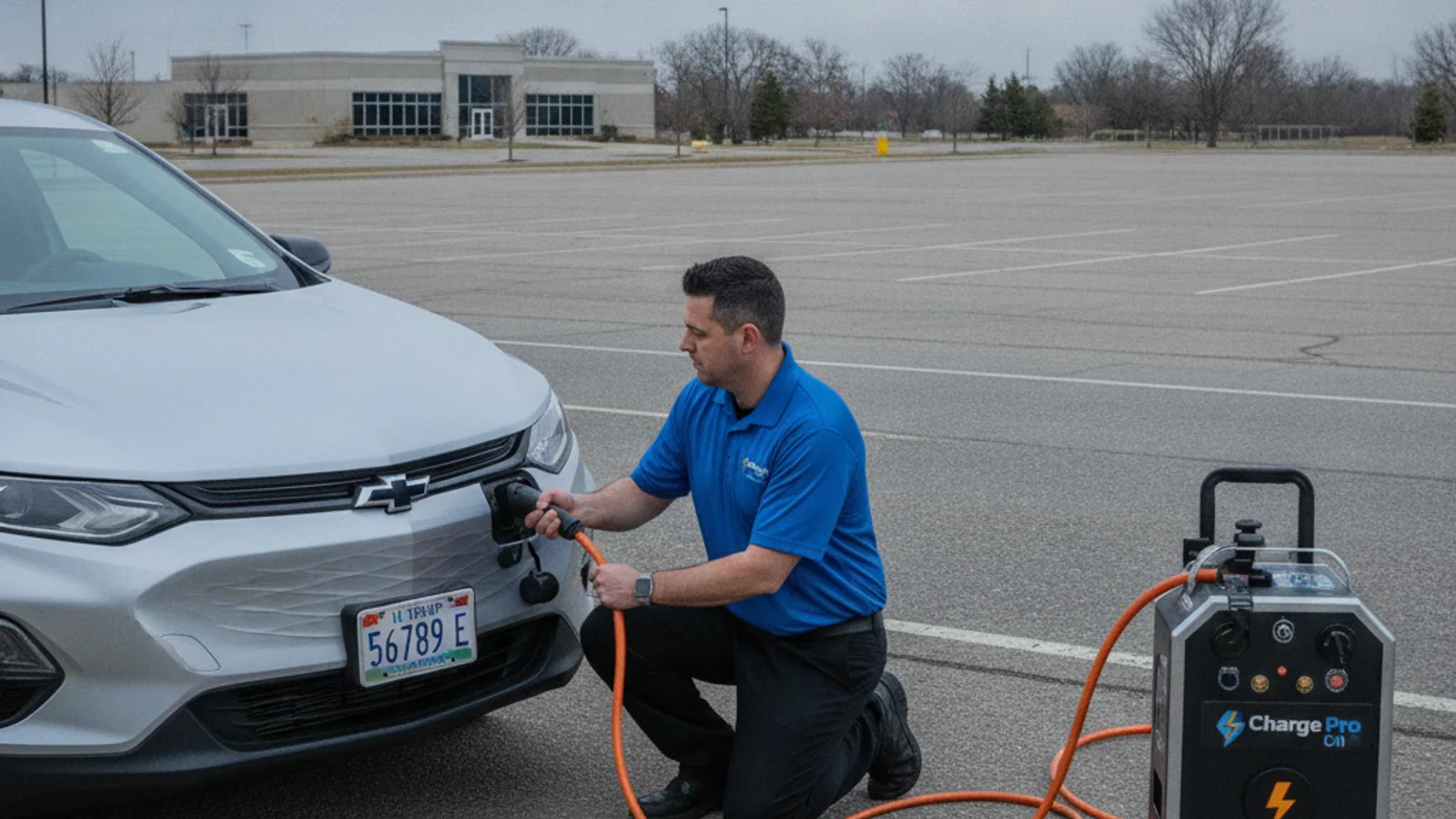
If the 12V was never the problem, and the pack is the part that’s empty, a jump won’t create range. You’ll still need a charge. The operators Charge Pro CHI connects you with can bring a 240V Level 2 source to a non-Tesla EV with a CCS or J1772 adapter. That boost typically adds 10 to 20 miles of range in 15 to 30 minutes of charging. That’s charging time, never an arrival time.
Drive somewhere the car can keep running if the 12V still feels weak. A dealer lot, a home Level 2 session, or even a long surface-street crawl beats another full shift in a Schaumburg garage. The DC-DC converter needs the car awake to refill that small battery. Parking it dark again undoes the jump.
When to stop and call for a local operator
Stop if the liftgate blade won’t turn. Stop if you can’t pop the hood once you’re inside. Stop if a clean jump leaves the car dark. Forcing a lock or grounding a clamp on the wrong metal can turn a simple 12V job into body or electrical damage.
A dark deck after closing is a bad place to guess. So is a shoulder on the Kennedy or the Tri-State. Get clear of traffic first. Then decide whether you’re jumping or calling.
Charge Pro CHI is a referral line. It matches stranded EV drivers with independent local mobile rescue operators. It doesn’t hold a license, own trucks, or send its own technicians. The operator quotes you before starting and bills you directly. The pros we connect you with are licensed and insured. They handle Tesla and every major EV brand, including the Equinox EV.
For a 12V that’s dead, the operator can jump on site. For a pack that’s empty, they bring the Level 2 source described above. If you need someone who works on non-Tesla EVs, start with non-Tesla EV rescue.
Call (858) 925-5546 when you want that match. Tell the operator it’s an Equinox EV that won’t power on. Say whether the fob is dead. They’ll quote the 12V jump or a pack boost before they start.
Frequently asked questions
Why won’t my Chevy Equinox EV start after work or shopping?
The usual cause is a dead or weak 12V battery, not the Ultium pack. The 12V has to wake the computers before the high-voltage system can engage. A long sit in a mall or office lot lets that small battery sag, especially in cold weather. Some owners get a dash warning first. Others get a completely dark car with no notice at all.
How do I get into a locked Equinox EV when the fob is dead?
Use the mechanical key blade hidden in the fob. Take it to the liftgate at the back of the car, not the front door. Turn the blade in the liftgate lock to get in. From there you can reach the interior hood release and pop the hood to reach the 12V.
Can I jump a Chevy Equinox EV in a parking lot?
Yes, on the 12V side. Connect to the positive terminal under the front hood. Ground the negative jumper clamp to bare, unpainted metal, never the battery’s own negative post. Once the car starts, the DC-DC converter recharges the 12V from the main pack as you drive. If the car feels frozen rather than flat, disconnect the negative terminal for about 10 minutes to let the systems reboot before you jump.