An electric car that died in a Chicago garage usually needs a charge or a 12V jump. A tow is the last option, not the first. If the traction pack is empty, talk charging. If the cabin is dark, talk 12V. Save transport for a stall that those two can’t fix.
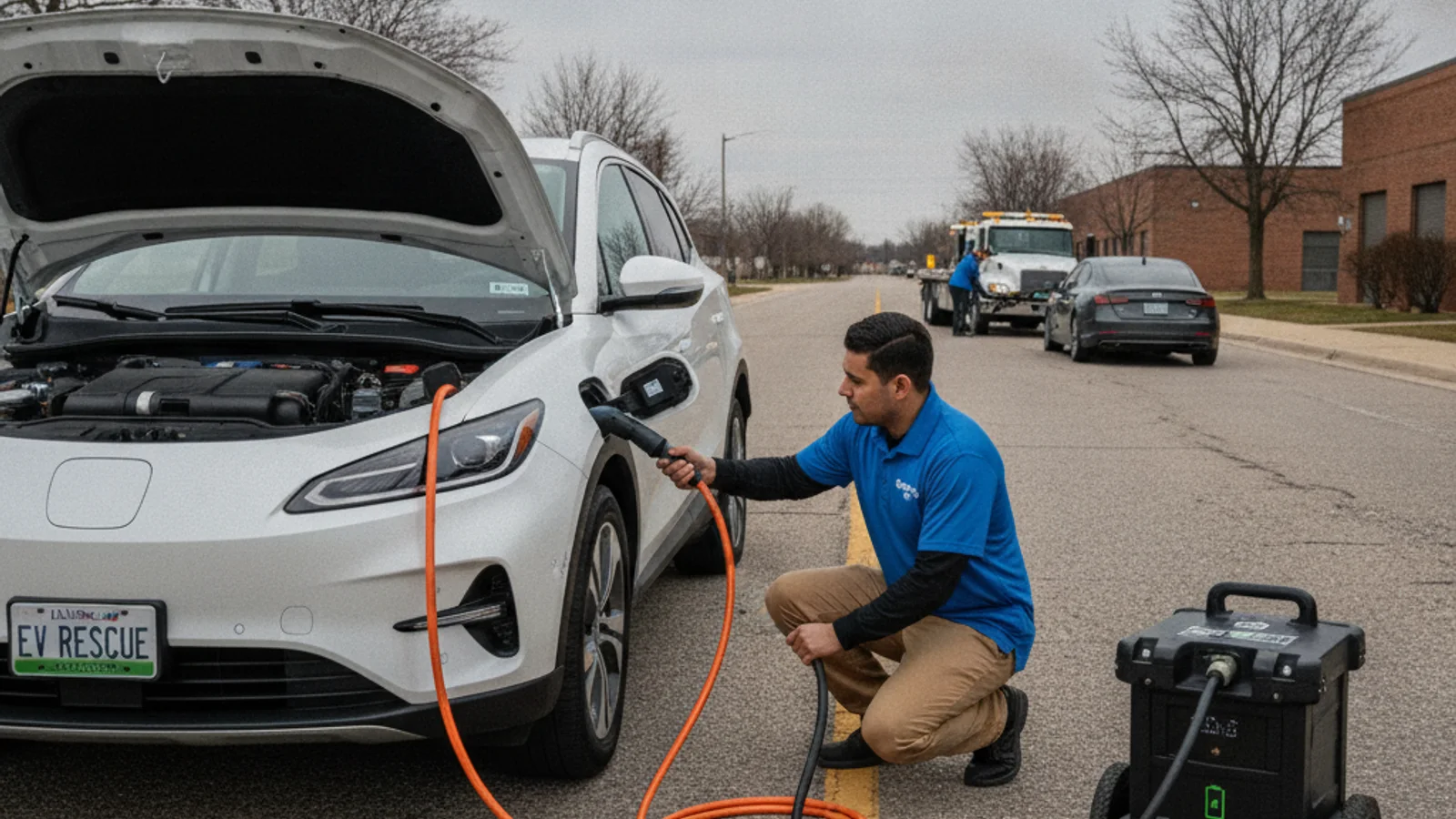
Two silent mornings in the same garage
“Died” is a driver word, not a diagnosis. One car sat all night on an empty traction pack. Another sat with range still showing and a dead 12-volt battery. Both look like a brick in the stall.
Chicago’s housing makes that overnight sit routine. ACS 2019-2023 data puts 68.6% of Chicago homes as pre-1980. Oak Park is 78.6%. Evanston is 71.2%. Skokie is 72.0%. Wilmette is 74.3%. Cicero is 90.2%, and Berwyn is 90.0%. Evergreen Park is 87.7%. Those Cook County blocks often mean a tight attached garage, an alley stall, or curb parking. The car sleeps still for hours.
Newer west and northwest towns change the building, not the batteries. Naperville’s pre-1980 share is 11.7%. Gurnee is 9.5%. Plainfield is 6.7%. Huntley is 3.8%. A two-car garage still hosts the same split. Empty pack or dead 12V. The operator still has to tell them apart.
Chicago’s 2024 population estimate is 2,721,308. That’s a lot of overnight sits. Inner Cook, Lake, DuPage, Kane, Will, and McHenry all see both failure modes. County lines don’t pick the battery. Schaumburg and Arlington Heights add long workday dwell. Orland Park and Tinley Park add weekend parking after a mall or a show.
Read the car before anyone opens a cover
Start with what the vehicle actually shows. Quote the dash message word for word. Don’t translate it into a guess.
Note which systems still answer. Interior lights. Door locks. The mobile app. Charge-port controls. The instrument cluster. A remaining percent, if one appears. Share that number as displayed. Don’t round it.
Then say how it stopped. It rolled to a halt on the Kennedy, or it wouldn’t wake in a Chicago garage. Those two stories point at different equipment.
A traction-pack warning supports a conversation about out-of-charge recovery. Dark screens and dead locks point at low-voltage power. That still isn’t a DIY jump. Access points differ by make, model, and year.
Keep the owner’s manual in reach if you have it. Search roadside, 12-volt, charging, and towing. If the manual isn’t in the car, say so before work starts. Our pack versus 12V guide helps you sort symptoms. It doesn’t diagnose your VIN.
The U.S. Department of Energy’s electric-vehicle overview explains the two energy systems in general terms. Your manual and the independent operator decide the next step.
Get people out of traffic first
If the car sits in a live lane, call emergency services and follow their directions. If the car still moves under its own power, follow the on-screen warnings. The maker’s instructions decide whether you may creep to a shoulder or a lot. If it won’t move, don’t invent a neutral-release trick. Tell the operator exactly what still works.
Location details change the whole call. A named Dan Ryan exit is usable. A pin that only says Chicago is not. Name the Kennedy, the Eisenhower, I-55, or the Tri-State. Name the Jane Addams or Lower Wacker when that’s where you are. Add direction, the nearest exit, and a visible cross street.
Describe the stall itself. Travel lane, shoulder, surface lot, driveway, alley, curb, or a parking deck. Mention gates, height bars, tight turns, and security desks. The operator needs to know whether a service vehicle can reach the car.
If police or fire already control the scene, say so. Their instructions come first. Diagnosis waits until an operator can actually reach the car.
Charge when the pack is the problem
A confirmed empty traction battery is a charging job. Share make, model, model year, displayed percent, and the exact warning text. Say whether the charge port opens. The independent operator then checks compatibility. That means the car, the connector, and the stall.
The operators we connect you with bring a 240V Level 2 source to the car. Native NACS for Teslas. CCS or J1772 adapters for other EVs. A typical connection adds roughly 10 to 20 miles of range in 15 to 30 minutes of charging. That’s charging time on the cable. It isn’t an arrival time.
Mobile charging still isn’t automatic. The car may not accept a charge. The stall may be too tight. The warning may point at a different fault. Ask the operator to confirm compatibility before anyone plugs in.
If you already know the pack hit zero, out of charge in Chicago walks through that empty-pack path. Don’t treat every dead morning as that path.
Jump only after the 12V is the suspect
Dark glass and silent locks often mean the 12-volt battery, not the big pack. The 12V wakes computers, pumps, and contactors. When it drops, the traction battery can sit full and still refuse to start.
Don’t jump because the screens are dark. Wait for the operator to match symptoms to the maker’s procedure. Battery locations and approved clamp points differ. A Tesla, a Rivian, and a Chevy Bolt aren’t the same 12V job.
The operators we connect you with can jump or replace a dead 12V on site when that’s the confirmed fault. They handle Tesla and every major EV brand. You still don’t pop a cover from a forum post.
A jump that works for ten minutes isn’t a finished repair. If the car dies again after you drive it, tell the operator. Replacement may be next. Towing still isn’t the first move.
Keep the tow for last
Towing belongs after charging and a 12V rescue don’t fit. Unknown faults belong here. Collision damage, smoke, and a blocked stall belong here. So does a car that won’t accept a charge. The maker may also require transport for a displayed condition. Share that message as written.
The method has to follow the current manual for that exact vehicle. Don’t coach the tow method unless the manual says it. Hand them the manual instead.
That’s why a wrecker waits. Our notes on the hidden costs of towing a dead EV cover the transport questions to ask. Follow the maker’s transport steps if a tow is still required.
Short rule: charge a confirmed empty pack. Consider a maker-approved 12V jump after confirmation. Tow when on-site service doesn’t fit.
Tell the operator the stall, not a guess
Start with make, model, model year, and displayed percent. Read warning messages exactly as written. Then say what happened just before it went quiet. Parked overnight. Plugged in. Rolling on a named road. Stick to what you saw.
If there was an impact, smoke, heat, or leaking fluid, tell emergency services and the operator. Don’t keep poking at the car.
List what still works. Lights, locks, app, port door, gear selector. “Nothing works” is thinner than a short list of tests. Stop testing if the manual or emergency staff say to stop.
Pin the location. Road, direction, nearest exit, cross street, garage level, space marker. Name the suburb. Oak Park, Evanston, Schaumburg, and Joliet are usable. “The suburbs” as a whole is not.
Access matters as much as the battery. Mention gates, height bars, paid decks, workplace badges, and tight alleys. Say whether you have the keys. Say whether someone who can authorize service is standing there.
How Charge Pro CHI makes the connection
Charge Pro CHI is a referral line. We match stranded EV drivers with independent local mobile rescue operators. The pros we connect you with are licensed and insured. We don’t diagnose the car or perform the work. We don’t own trucks, employ technicians, or hold a trade license. We don’t set prices, promise an arrival time, or publish hours.
The operator quotes you before starting and bills you directly. Ask for the service scope, current price, payment terms, credentials, and any warranty before you authorize work. Confirm the current quote with the operator before you pay.
When you call, share the vehicle and stall details you’ve already gathered. We use that to make the match. The independent operator reviews the symptoms and the stall. Then they say whether charging, 12V help, or a tow fits.
Our EV roadside assistance page explains the referral for stranded drivers across Chicagoland. That includes Chicago, the inner North Shore, DuPage, Kane, Will, Lake, and McHenry.
If the cause isn’t confirmed, say “unknown problem.” That’s the honest start.
When to call us
Call when the car has stopped, won’t wake, or shows a message you can’t classify. The independent operator decides the next step. That may be a mobile charge, a 12V jump, or a tow.
Call us at (858) 925-5546 and we’ll connect you with a local EV rescue operator.