Your Chicago EV just hit empty. The dash is dark, and the car isn’t going to limp to a plug. Call for a 240V Level 2 boost from an independent operator. Stay put until that charge is on the port.
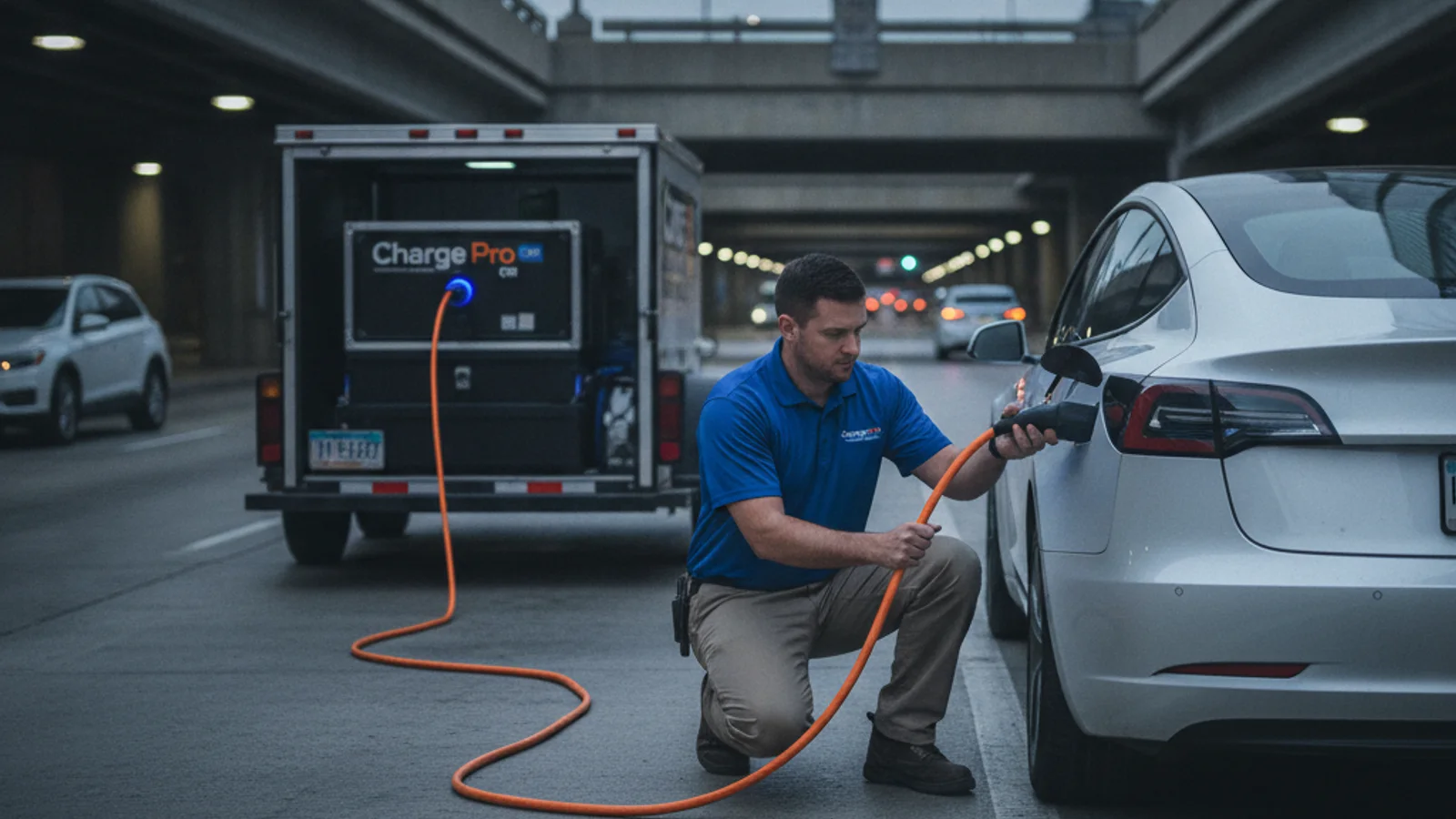
Charge Pro CHI is a referral line for Chicagoland. We match stranded drivers with independent local mobile rescue operators. Those operators bring the charge to the car. They don’t work for us.
How Chicago drivers actually end up at zero
This city has about 2.7 million people in Cook County. A lot of them park on the street. Logan Square, Lakeview, Pilsen, and Rogers Park are renter-heavy. Uptown and Albany Park follow the same pattern. Drivers there live on public charging between sessions. The pack runs down between those sessions. Winter street-parking bans and dibs make the curb even less friendly. About two-thirds of Chicago housing predates 1980.
That’s the empty-pack pattern here. It isn’t a suburban driveway problem. It’s a dense, street-parked neighborhood problem.
The other Chicago stall is different. You leave a Tesla or another EV in a downtown garage for a workday. Or you park under Grant Park at the Millennium Garages for a show. You come back and the car won’t wake. Door handles don’t present. That’s often the 12-volt battery, not the high-voltage pack. Lower Wacker has the same story after a long sit.
If you’re already low and still moving, don’t wait for zero. Read what to do when the pack is running down before it dies.
Empty pack versus a car that won’t wake
An empty high-voltage pack and a dead 12V get mixed up. They’re not the same job.
When the traction pack is truly spent, the car has no propulsion. You may have seen low-battery warnings earlier. Then the last of the range is gone. The car is a heavy object in a live lane. It can also sit dead on a side street or in a garage stall.
When the 12V is dead, the main pack can still hold plenty of energy. The 12V runs the computers and the contactors. No 12V means no wake and no drive. Operators we connect you with can jump or replace that 12V on site. They handle Tesla and every major EV brand.
A stall on Lower Wacker after an event looks like a dead car. It often isn’t. Loop garages near Millennium Park see the same thing. So do lots by Navy Pier and McCormick Place.
Flychicago’s Green Vehicles page lists Level 2 charging in O’Hare’s main terminal garages. It also lists Level 2 in the Multi-Modal Facility, Economy Lot F. Midway lists Level 2 in the Terminal Garage and the Economy Garage. A car that sits for days in winter can still drain the 12V. The Chicago Department of Aviation parking office handles garage jumps. Use the call boxes near the elevators. That’s a 12V jump, not a pack fill. If the high-voltage pack is empty, you still need a mobile boost.
Get the car out of the live lane first
If the car is still rolling, coast to the shoulder. Use hazard lights while you still can. The Kennedy, the Dan Ryan, and the Eisenhower are unforgiving. A dead EV in a travel lane is a crash risk. Lake Shore Drive and the Stevenson are the same story. Stay in the car with your belt on if traffic is flying past.
Don’t try to shove the car yourself. Traction packs make these vehicles heavy.
If you’re blocking a lane and can’t get clear, call 911. Officers can hold the scene. Then call for EV help, not a random tow as the first move. A dead EV that won’t go into neutral is a bad hook-and-drag job. A flatbed is the usual safe tow path. You might not need a tow if a boost will wake the car.
Stopped January traffic is its own trap. Heat running, speed near zero, range falling. That’s the Kennedy pattern.
What a mobile 240V boost actually is
That’s emergency EV charging in Chicago: a 240V Level 2 boost at the car. The operator we send brings that source to you. Teslas take a native NACS plug. Other brands use a CCS or J1772 adapter. This isn’t a full charge to 100%. It’s a roadside boost. Typical on-site charging time is 15 to 30 minutes. That’s charging time, not a clock on arrival. Drivers usually leave with about 10 to 20 miles of range. That’s enough to reach a charger you already know.
Charge Pro CHI doesn’t own trucks. We don’t employ technicians. We don’t set the price. The operator quotes you before starting and bills you directly. If you want the hardware picture, read how a mobile EV charging truck works.
Mobile EV charging is the boost call. Out-of-charge recovery is the path when the pack is already at zero.
Cold is why empty-pack calls spike here
January in this metro isn’t mild. NWS Chicago normals put the January average high at 31.6°F. The average low is 18.8°F. The city sees about 38.4 inches of snow in a year. Cabin heat eats range while you’re creeping through the Loop.
Recurrent Auto’s fleet study is a useful rule of thumb. At 32°F an EV keeps roughly 78 to 80% of rated range. At 20°F with cabin heat on, that drops to roughly 70%. Heat-pump cars hold about 10% more than resistive-heat cars in the cold. AAA ran SAE J1634 tests in 2019. At 20°F with the heater on, range fell about 41%. AAA’s 2026 update reports about a 39% decrease in the cold. Those aren’t Tesla-published numbers. They’re independent tests.
DC fast charging also slows when the pack is frozen. The car protects the cells. A preconditioned pack takes power faster than a cold one. In January 2024, O’Hare hit about -10°F. Wind chills sat around -30°F. News coverage from that snap described Tesla drivers at Oak Brook Superchargers. Cold packs needed to warm before they’d take a charge. The 2019 polar vortex was harsher. O’Hare hit -23°F on January 30, 2019. Chicago stayed below zero for 52 hours.
A 12V battery also hates that air. Near 0°F it delivers much less than its warm rating. A Logan Square curb overnight can leave the car refusing to wake. ComEd keeps the grid up in the city. It doesn’t refill a pack that’s already at zero on the curb.
Where this shows up on the map
Street stalls cluster where people park without a garage. You can hunt a public plug after a boost. You can also have an operator charge the car where it sits.
Expressway stalls follow the big corridors. I-90/94 is the Kennedy north of the Loop. It’s the Dan Ryan south of it. I-290 is the Eisenhower. I-55 is the Stevenson. I-94 becomes the Bishop Ford on the far south side. Lake Shore Drive is US-41 along the water. None of those roads is a place to experiment with pushing a car.
Event parking is the other downtown cluster. Soldier Field, the United Center, Wrigley Field, and Guaranteed Rate Field all mean long sits. The car can look dead when you return. Ask the operator to check the 12V first if the car won’t unlock.
Oak Park, Cicero, Berwyn, Evanston, and Skokie sit next to that same street-parking story.
What to tell the operator
When you call, give a pin drop, not a vibe. Neighborhood, garage name, or mile marker. Make, model, and whether the car wakes. Say if the charge port door will open. Say if you’re on a shoulder, a one-way, or a downtown ramp.
They’ll walk you through a boost versus a 12V jump. They’ll quote before they start. You take the quote or you don’t. Nobody here publishes a citywide fee, because we don’t set one.
Make the call when the car is done
You’ve already tried the apps. The car isn’t going to invent range. Stay out of the travel lane.
Charge Pro CHI covers Chicago and the rest of Chicagoland. We connect you with an independent operator. That operator can put 240V on the car where it sits. Call (858) 925-5546. The operator quotes you before starting.