When a Chicagoland EV stalls, EV battery types collapse to one split. You either emptied the traction pack, or the small 12V system quit. Overnight sits in older Cook County housing often look like the 12V. Stops on the Kennedy or Reagan Tollway often look like an empty pack. Sort that first, then let chemistry, cell brands, and pack size wait.
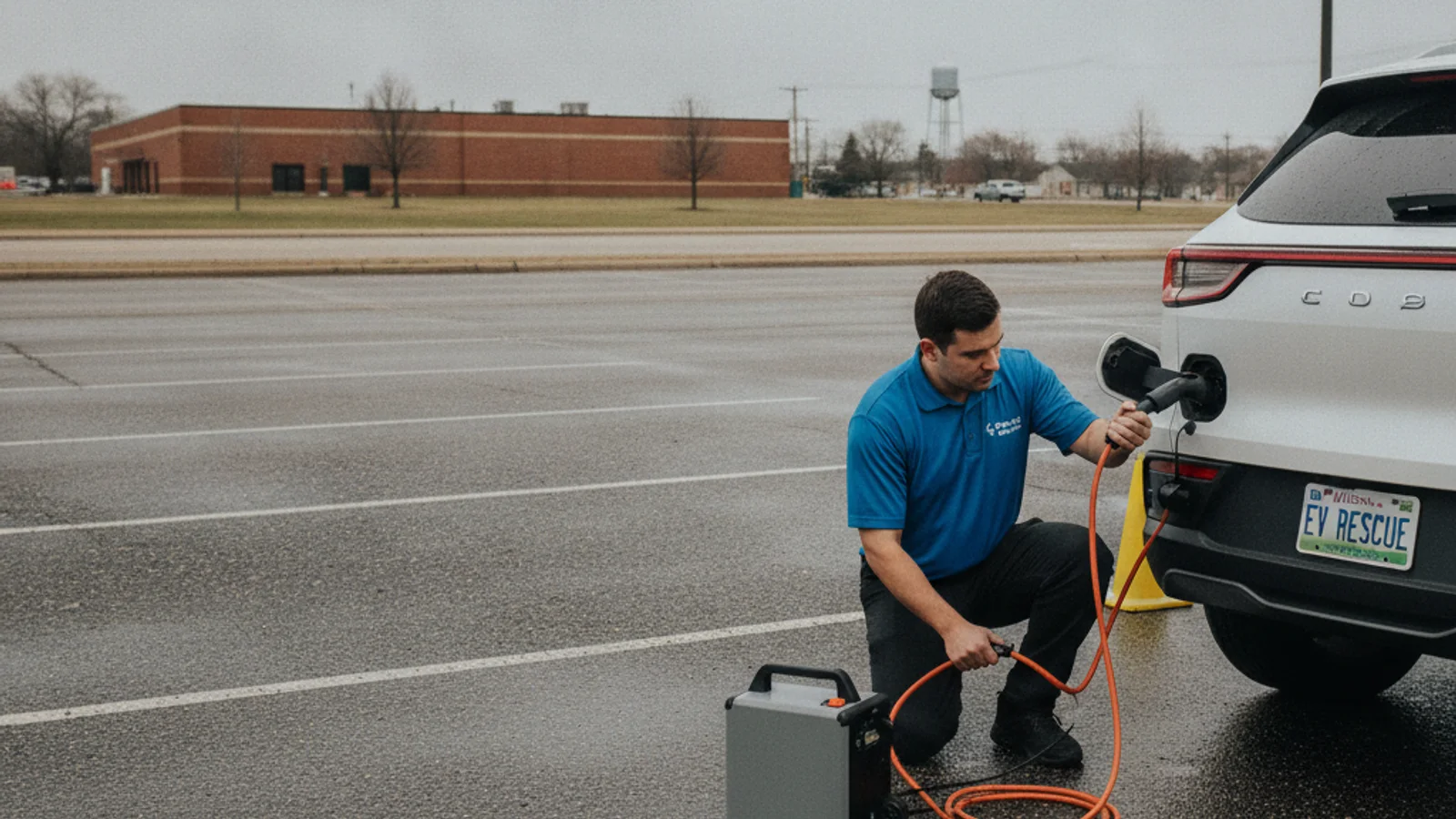
Start with the traction pack versus the 12V
Every EV around here carries two battery systems. They don’t share a job, and they don’t share a fix.
The traction pack lives under the floor. It stores the energy that turns the motor. You fill it at home, at work, or at a Supercharger. When people say EV battery types, they usually mean this pack. Chemistry talk lives here too, from nickel manganese cobalt to lithium iron phosphate. None of that’s the first roadside question.
The 12V battery is the other system. It’s closer to the battery in a gas car. It doesn’t drive the wheels. It runs the computers, door locks, and lights. It also runs the relays that let the pack connect. Kill that small battery and the car can go fully dark. The pack underneath can still be full.
An empty pack is an energy problem. The car needs a charge, or a ride to a charger you can use. A failed 12V is a low-voltage problem. Some models allow a maker-approved jump. Some need a replacement on site, and some need a shop. Your model decides that, not a forum thread.
If the dash is black, start with the 12V. Our note on what you see when an EV 12V dies stays on that failure. Tesla pack versus 12V is the Tesla version of the same split. This post stays one step earlier. You’re still naming which system failed.
Garage calls and tollway calls feel different
Place matters because the sit looks different. It doesn’t change the two batteries.
A car that slept in an Oak Park garage is a common 12V pattern. Evanston and Cicero overnight sits look the same way. A lot of Cook County housing predates 1980. Chicago’s share is 68.6 percent. Evanston’s is 71.2 percent. Oak Park’s is 78.6 percent. Cicero’s is 90.2 percent. Those blocks often mean alley garages and tight street parking. They also mean long overnight sits. Cabin features can pull on the 12V while you sleep. The pack can still show range in the morning. The car still won’t wake.
A stall after a Dan Ryan crawl is more often range. You watched the miles fall, then you stopped. That’s the traction pack. The same read fits I-55, I-90, and I-80 in Will County. Don’t treat that like a jump. Don’t treat a silent garage car like an empty pack.
West and far-north housing is newer. Naperville’s pre-1980 share is 11.7 percent. Gurnee’s is 9.5 percent. Plainfield’s is 6.7 percent. Those driveways still produce 12V no-starts. Schaumburg and Arlington Heights office parks produce long dwell stalls of both kinds. Highland Park and Wilmette lots do too. Name the place when you call. It helps the operator plan access. It doesn’t replace the pack versus 12V question.
Chemistry is a shopping question
Forums spend hours on EV battery types as chemistry. Which pack lasts longer. Which one charges faster. Which automaker uses which supplier. None of that changes what happens on the shoulder tonight.
Lead-acid versus lithium in the 12V slot is another type debate. Newer Tesla Model 3 and Model Y cars moved to a lithium 12V. Older ones used lead-acid. That changes how you store and replace the small battery at home. It still doesn’t change the first roadside split. The car is out of pack energy, or the 12V won’t wake.
An operator isn’t diagnosing cells from the curb. They ask what the dash still shows. They ask what the app can wake. They ask whether the car is in a garage, a lot, or a live lane.
It’s easy to over-read the wrong thing while you wait. Pack chemistry won’t explain a dead Ioniq or Model 3. The message on the screen will. Save the chemistry reading for the next car you buy.
Charge Pro CHI has no verified pack capacity, voltage, or cell mix for any model. Those numbers shouldn’t drive a roadside choice. If you need them, use the current owner’s manual or the automaker’s published specs. Nothing else is worth trusting for that.
Give the model, the year, and the exact wording
Two pieces of information beat a chemistry lecture. Give the exact vehicle and the exact dash wording.
The model matters because jump points and approved steps change. They change across brands. They often change across years of the same brand. A Tesla jump point in the frunk isn’t a Rivian layout. It’s not a Hyundai Ioniq. It’s not a Mustang Mach-E. Non-Tesla EVs also need the right adapter on a charge call. Native NACS for Tesla, and CCS or J1772 for most others. That’s why non-Tesla EV rescue is its own path.
A range readout at empty points at the traction pack. So does a zero-miles warning. A blank screen points at the 12V. So does a handle that won’t present. So does a line that names the 12V. Repeat the message, and don’t smooth it into a summary. “It died” leaves the operator guessing.
Also say what still works. Interior lights and the mobile app run on 12V. So do the fob and the charge-port door. If some still answer and the car won’t drive, say so. If nothing answers, say that too.
Charge, a 12V fix, or a ride
Once the car and the message are on the table, most calls fit three buckets.
Charging fits when the pack is empty and the vehicle can be reached. The operators we connect you with bring a 240V Level 2 source. A typical boost adds 10 to 20 miles of range. That takes 15 to 30 minutes of charging. That window is charging time, not an arrival time. Read mobile EV charging for how that visit works.
A jump fits when the small battery failed and the maker allows it. An on-site 12V swap can fit the same way. Some EVs hide a jump point behind a cover or in the frunk. Others don’t. Don’t copy a video shot on a different car. Confirm the steps with the operator and the manual before anyone touches a terminal. Tesla owners can start with Tesla 12V battery jump. After you’re moving, 12V replacement signs covers the longer fix.
Transport fits when the cause isn’t confirmed. It also fits when the car can’t be reached safely. It fits when the maker’s process for that message wants a shop. Ask if the operator is unsure. Starting with “we don’t know yet” beats a guessed category.
Charge Pro CHI is a referral line. It matches stranded EV drivers with independent local mobile rescue operators. It performs no work and owns no trucks. It employs no technicians, sets no prices, and publishes no hours. The operator quotes you before starting and bills you directly. The pros we connect you with are licensed and insured. They handle Tesla and every major EV brand.
Confirm details on your car, not on a blog
Every claim here is general on purpose. A blog can’t tell you where your jump points sit. It can’t decode every warning string. It can’t say your manufacturer allows a roadside 12V jump.
The current owner’s manual for your exact year is the first check. Tesla’s own service documentation is the next stop for Tesla owners. Rivian owner resources and each brand’s support channel fill the same role.
The U.S. Department of Energy’s electric vehicle overview is useful background. It won’t replace the manual for anything model-specific. After you’re rolling, the Chicagoland EV charging hub is the local ownership map.
If you can’t classify the stall, say so. Say you don’t know if this is the pack or the 12V. That opening beats a guess.
When to call
Call when the EV won’t power on or won’t charge. Call when a warning you can’t place is on the dash. The matched operator will use the vehicle details and the exact message. That’s how they sort a charge, a 12V fix, or a ride. Call (858) 925-5546 and we’ll connect you with a local EV rescue operator.