When a delivery EV dies in Elk Grove Village, the packages don’t wait. You need a mobile charge on the route. A 12V jump can also wake a dark van. Either one lets the driver finish the run. A tow pulls the van and the cargo off the day’s map.
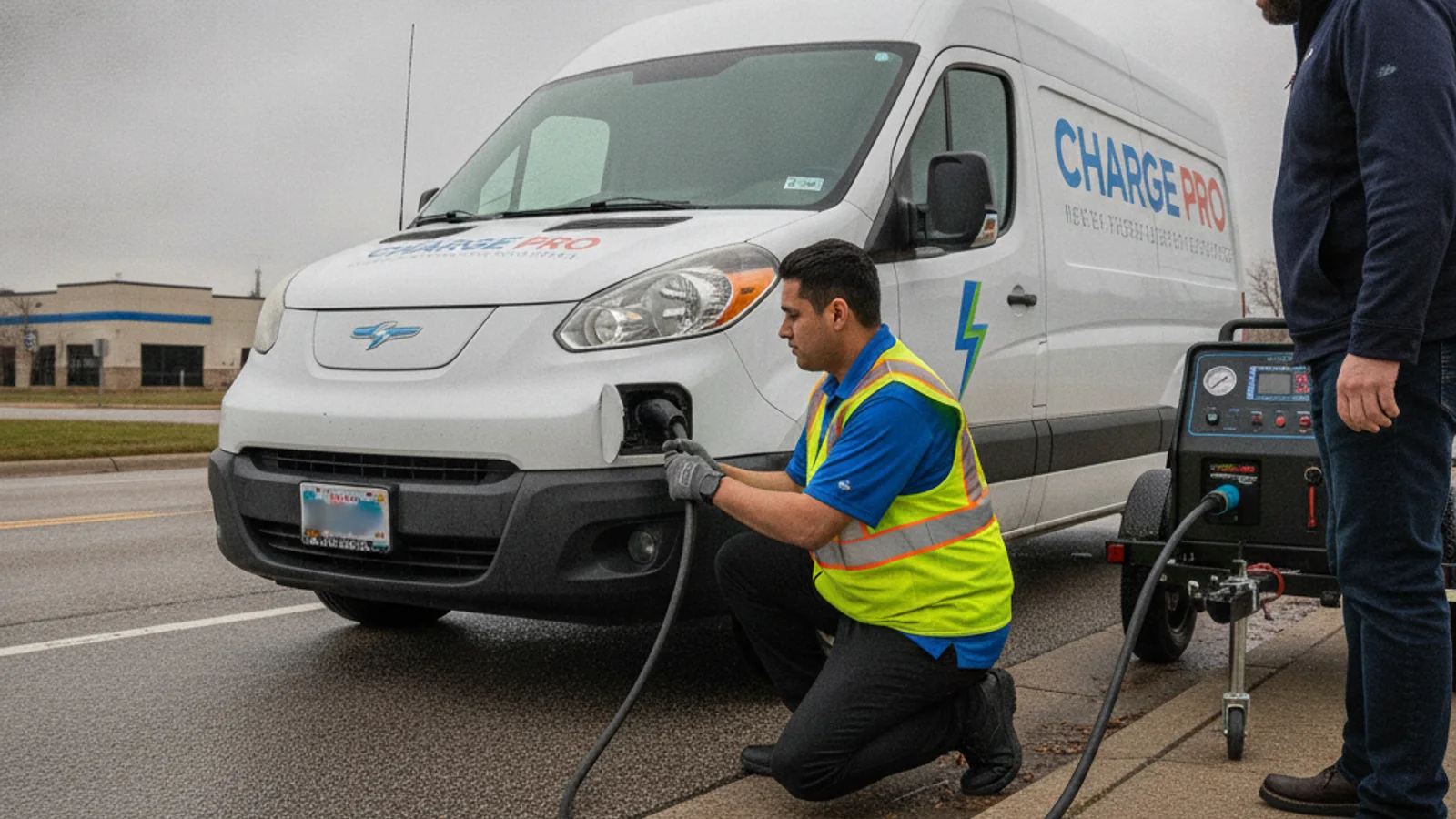
Fleet vans stall in this park for a reason
Elk Grove Village sits in Cook County, on O’Hare’s western fence. The industrial park here is one of the largest contiguous parks in North America. Last-mile vans and cargo EVs work those yards all day. Then the pack hits empty, or the 12V dies. The route stops with freight still in the back.
The Busse Road industrial area is the usual pin. A night shift ends and the van won’t wake. Dispatch still has windows to hit. Residential Elk Grove Village sees the same vans on porch stops. South Elk Grove and the O’Hare-adjacent streets catch overflow from the lots. Busse Woods marks the green edge of town. The stall is still a commercial clock problem.
Roads feed the park from every side. I-90, the Jane Addams, runs the north edge. I-290 and Route 53 come in from the south and west. US-12 and US-45 share Elmhurst Road. Higgins Road, Devon Avenue, and Arlington Heights Road stitch the yards together. A van can die on any of those corridors. The cargo doesn’t get lighter when it does.
About 32,132 people live here per recent Census figures. The 2024 estimate is 31,802. ZIP codes 60007, 60018, and 60172 cover the village. ComEd, Commonwealth Edison, is the utility here. This page doesn’t name public chargers we couldn’t verify. Follow the depot list your fleet already uses.
Des Plaines, Mount Prospect, and Schaumburg sit next door. Bensenville is just south of the airport fence. If you’re writing the dispatch note, add the door number and the nearest named road.
For the broader village rescue pattern, read fleet EV stall help in Elk Grove Village. Local charging context is on the Elk Grove Village EV page.
Empty pack or dead 12V: two different stalls
Most delivery van deaths look like every other EV stall. The high-voltage pack ran out, or the 12V gave up.
Stop-and-go miles, cargo weight, and cabin climate control all cut range. A van can look fine at midday. It can sit dead at the last dock. If the dash still wakes and range reads zero, that’s the pack. It needs a 240V Level 2 boost on site.
If nothing wakes, start with the 12V. That small battery runs computers, telematics, and often the lift gate. You’ll see no dash lights, no fob response, and no ready state. An on-site jump usually brings those systems back. Some vans then need a 12V replacement in the same stop.
Neither case requires you to unload the van. Packages stay in the bay, and the driver stays with the vehicle.
What the operator actually brings
Charge Pro CHI is a referral line. We don’t own trucks, and we don’t employ technicians. We match stranded drivers with independent local operators.
The operator brings a 240V Level 2 source to the van. NACS is native for Tesla inlets. CCS and J1772 adapters cover other EV brands. A typical boost adds 10 to 20 miles of range. Charging itself usually runs 15 to 30 minutes. That’s charging time. It’s not an arrival time. The operator quotes you before they start. They bill you directly.
For the truck itself, see how a mobile EV charging truck works. Service details are on mobile EV charging.
Why a tow is a poor fit for a loaded van
A loaded delivery van is a hard flatbed job. Freight has to be secured. The bed has to fit. After the drop, the van still needs a charge before it works. The route is already broken.
A boost on the lot skips that chain. The van never leaves the stop. The driver never splits the cargo. Once the pack or the 12V is up, the run can resume.
If you’re choosing between those paths, read mobile charging or a tow when you’re stranded.
What to do when the van won’t move
Get off the travel lane if you can. Keep the hazard lights on. Stay with the load. Note the nearest cross street. Busse Road, Higgins, Devon, or Elmhurst Road is enough for a pin. A Jane Addams shoulder stall is a different scene. Use out of charge on I-90 for that corridor.
Tell the matcher the make and whether the dash wakes. That split, 12V versus empty pack, is the first useful fact. Then wait for the operator’s quote. They set the plan with you. Charge Pro CHI doesn’t set that clock.
Don’t keep hitting the fob on a dead 12V. Don’t leave the load if your fleet forbids it.
After the boost
Most jobs add 10 to 20 miles of range. Drivers often use that to finish the loop or plug in at a charger they already use. We don’t publish a station list we haven’t checked. Use your fleet’s own map.
If the operator finds a fault that isn’t range or 12V, they should say so. A boost won’t clear a drivetrain lockout. That’s a shop call, or your fleet service line.
Frequently asked questions
Can a commercial delivery van get the same on-site boost as a car?
Yes, they can. The 12V jump and the Level 2 boost are the same jobs. Delivery vans and passenger EVs both stall that way. The operator checks the inlet before they plug in.
Does cargo have to come out before a charge?
No. A jump or a range top-off doesn’t need an empty bay. The driver stays with the van. When the boost is done, the route can continue.
How much range does a typical stop add?
Most jobs add 10 to 20 miles. Charging time is usually 15 to 30 minutes. That isn’t a window for arrival. Ask the operator for the quote when they call you.
A dead battery doesn’t have to kill the rest of the route. Call Charge Pro CHI at (858) 925-5546 to get matched with a local operator.