A Tesla that sits through a Chicagoland night can refuse to wake. Range left on the display doesn’t save you here. The Model 3, Y, S, and X still need a 12V jump in this cold. You’re not charging the pack under the floor. You’re waking the small battery that runs computers, latches, and lights.
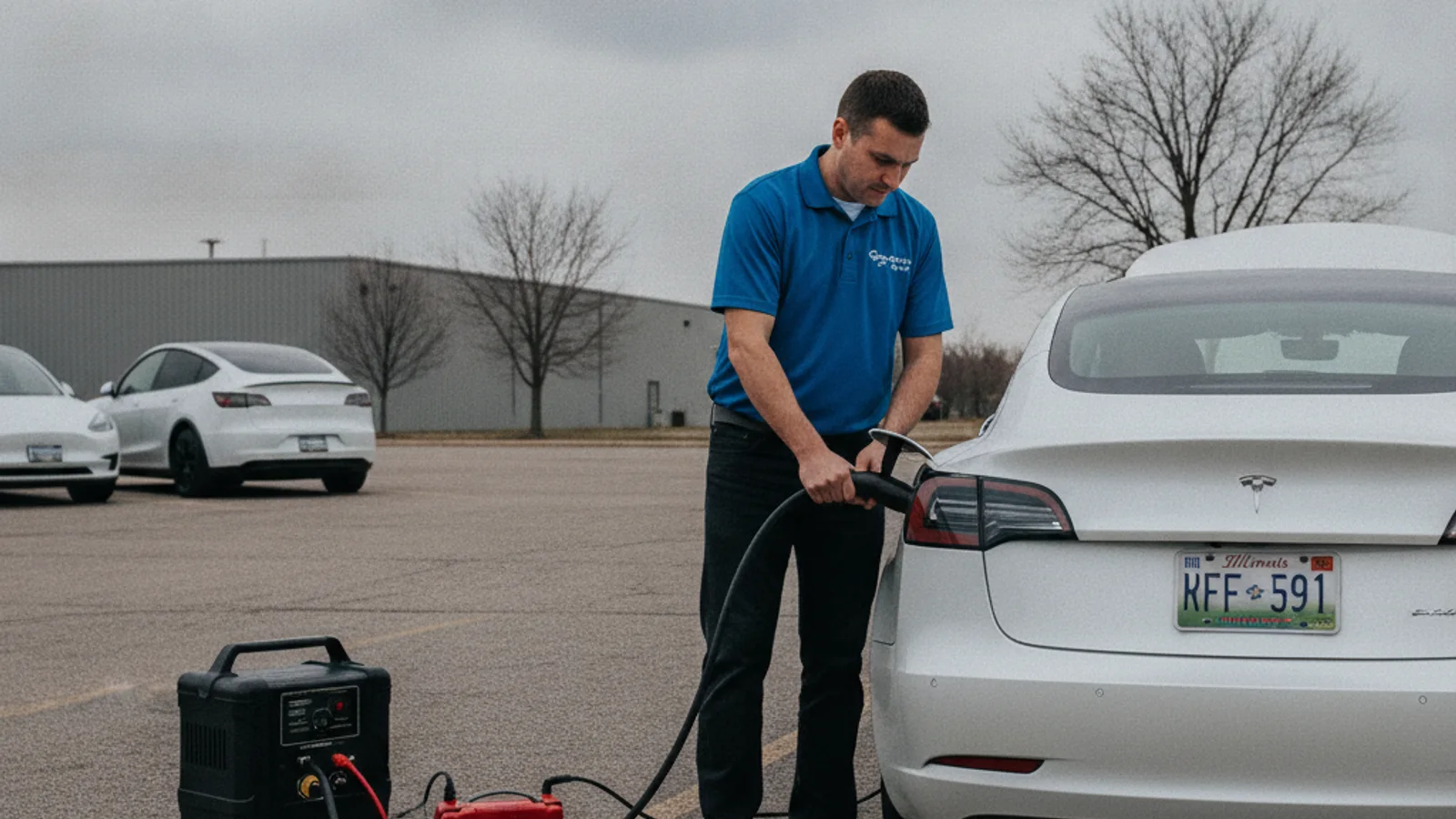
Why a Chicagoland sit still flattens the 12V
The traction pack under the floor is what moves the car. The 12V battery wakes every module that lets you in. When that 12V is flat, door handles go dead. The app stays quiet and the screen stays black. That stall looks like a dead EV, and it usually isn’t.
Where the car sat overnight changes how hard the 12V works. Chicago still has 68.6% of housing built before 1980. Oak Park is 78.6%, and Evanston is 71.2%. Cicero hits 90.2% pre-1980 stock, and Berwyn 90.0%. On those blocks a Model 3 or Y often sits on the street. That’s a different overnight than Naperville, where only 11.7% of housing predates 1980. Gurnee’s pre-1980 share is only 9.5%. Newer garages don’t make the 12V immortal. They just change how long the car soaks in the cold.
Lead-acid and lithium 12V packs both lose punch in this climate. Sentry and cabin climate will drain that small battery. A car that keeps waking itself does the same. A jump gets the computers up, but it doesn’t rebuild a weak 12V. You also shouldn’t treat this like a gas car. A long drive doesn’t refill a Tesla 12V the old way. Tesla’s DC-DC converter tops the 12V from the high-voltage pack. That happens once the car is awake, or once you plug in.
Tell a dead 12V from an empty pack
Run this check before you clip on cables.
- Black screen, silent app, and a key card that does nothing: start with the 12V.
- Dim exterior lamps or flickering cabin lights: still the 12V.
- Doors work and the display warns about range: that’s the high-voltage pack.
If the car unlocks and says it’s empty, a 12V jump won’t add miles. You need a charge path, not clamps. Slow boots and random warnings for weeks are a clue. Read how to tell a dead Tesla 12V and then jump it. A jump may get you moving, so plan on a replacement after that.
What to bring, and what not to use as a donor
A portable lithium jump pack is the right tool on the curb. You don’t need a running gas car beside you. Another Tesla is the wrong donor, so don’t clip to one. Tesla tells owners not to use their car as a donor. You can hurt the donor car’s electronics.
Bring gloves, the jump pack, and your key card. Confirm the pack itself has charge, then park it close. Keep clamps off fans, coolant lines, and orange high-voltage cables. Those orange cables aren’t 12V posts. There’s a wider winter walkthrough if you want 12V steps for other EVs. See how to jump start an electric car in winter. For these four Tesla models, stay with the steps below.
Jump a Model 3 or Y from the front bumper
Model 3 and Model Y share a bumper path. Use it when the frunk latch has no power.
- Find the small rectangular cover on the front bumper. It’s the lower corner on the driver’s side.
- Pry it at the notch. Fingers or a flat screwdriver both work on frozen plastic.
- You’ll see a red positive post, and a chassis ground sits nearby.
- Clip red to the red post first. Seat it so it can’t slip and arc.
- Clip black to the unpainted ground, and skip random painted bolts.
- Switch the jump pack on if it has a switch. Give the car a short wait so modules see voltage.
- Tap the key card or try a door handle. The screen should start to come up.
- Once it’s awake, pull black first, then red. Don’t let the clamps touch each other.
- Plug in, or drive, so the DC-DC can refill the 12V.
Don’t yank a cover that’s iced in. If the bumper is damaged or blocked, stop. That’s a job for a Tesla 12V battery jump from a local operator.
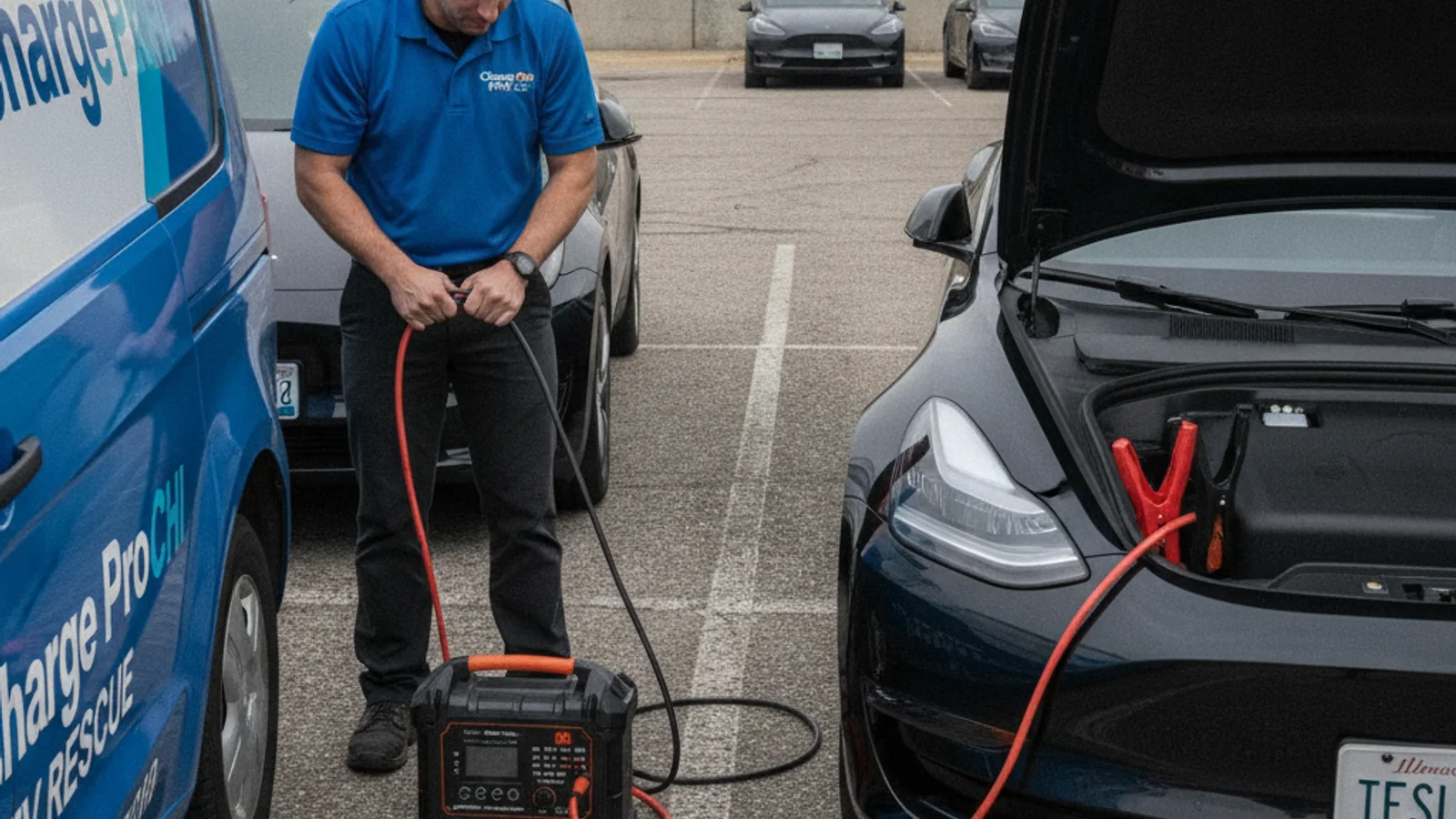
Model 3 and Model Y: bumper posts versus the battery in the frunk
The 12V itself lives under the frunk floor on both cars. Tesla also gives you bumper posts for a jump with the hood still shut. That’s the path to try first in this cold.
If the frunk already opens, lift the carpet and the foam pad. The positive post has a red cover, and the negative is black. Use the same clamp order, red first. Put black on a clean chassis ground when you can find one.
Newer Model 3 and Y cars may use a lithium 12V, not lead-acid. The jump points still matter, and the chemistry still hates a long, cold sit. If the car dies again after it wakes, treat the 12V as failed. Our newer Model 3 and Y lithium 12V guide walks that case.
Model S and Model X: the year changes the posts
On older Model S cars before the 2021 refresh, the 12V sits in the frunk. Model X uses that same frunk layout. Lift the floor mat and pull the foam insert. Terminals are labeled, so clip red to positive first. Use a chassis ground for black when you can.
On refreshed Model S and Model X from 2021 on, Tesla moved the jump posts. Look for a red positive post behind a small cover. It’s on the driver’s side of the frunk, near the firewall. The chassis ground is on that same side.
If you’re unsure of the year, check Tesla support. Your phone copy of the owner’s manual helps if you can open it. Don’t mix a 2021+ post layout with an older walkthrough.
When the frunk will not open
A dead 12V starves the frunk motor. Model 3 and Y owners should use the bumper posts first. Don’t fight the hood in this cold.
Model S and Model X often hide the posts inside the frunk. You may need the manual release before you can clip on.
On Model S, look in the front wheel wells. Pull loops sit behind the access panels there. Older cars use a flap in the driver’s side liner. The loop is yellow or orange on many cars. Pull once for the primary latch, then again for the secondary.
On Model X, it’s the same wheel-well idea. The loop is often orange. It sits back from the front of the liner. Pull firmly and the frunk should rise a little.
Tesla has moved those loops across years. If what you see doesn’t match, stop yanking. Search your year on Tesla support, or open the manual on your phone. A cable that feels stuck rather than stiff isn’t a roadside tug. That’s a tow, not a DIY save.
If you’re fully locked out, use our dead Tesla lockout walkthrough with this jump sequence.
After it wakes, keep the 12V from dying again
A Tesla jump doesn’t charge the 12V the old gas-car way. A highway run won’t refill it by itself. Once the computers boot, plug in at home if you can. A public post you already use is fine too. If you can’t plug in yet, drive so the DC-DC converter can work. Then get the 12V tested as soon as you can.
Turn off cabin overheat and sentry if you don’t need them tonight. A car that keeps waking itself will flatten a weak 12V before morning.
If it dies again in minutes, another jump is the wrong next step. See Tesla 12V replacement versus a jump in the cold.
When to put the cables down
Stop DIY if any of this is true.
- You can’t reach the bumper posts or the wheel-well loops.
- The car wakes, then dies again right away.
- You’re in a live lane or a tight garage aisle.
- You’re not sure which post is positive.
Wrong clips can damage body modules, so guessing isn’t a save. Charge Pro CHI is a referral line, and it isn’t a shop with a yard. We match stranded Tesla drivers with independent local mobile rescue operators. Those pros jump or replace a dead 12V on site. They handle Tesla and every major EV brand. They quote you before they start, and they bill you directly. We don’t own trucks, and we don’t employ technicians. We don’t set prices, and we don’t promise when someone arrives.
If the pack is empty rather than the 12V, that’s a different call. Operators we send can bring a 240V Level 2 source to the car. They use a native NACS plug on Tesla. Non-Tesla cars get a CCS or J1772 adapter. That boost typically adds 10 to 20 miles of range. Plan on 15 to 30 minutes of charging for that. That’s charging time, never an arrival time.
A Model Y after an Evanston overnight still has the same 12V split. The local difference is the sit: street, older garage, or a newer suburban bay. For a wider owner checklist, see our Tesla no-start checks before a tow.
When to call Charge Pro CHI
If the 12V is dead and you can’t safely jump it, call. Driveway, street, or garage, the operators we connect you with do this work. Call (858) 925-5546 and we’ll match you with a local operator.