You walked back to Orland Square Mall after a long visit, and the car stayed dark. That’s the main ev roadside assistance pattern in Orland Park. It’s usually the 12-volt battery, not an empty traction pack. You likely left home with plenty of range. Most housing here was built after 1980, so a wall box at the house is common. The pack is still fine. The little battery that wakes the car is not.
A long Orland Park errand is hard on the 12V
Orland Park is the retail hub of Cook County’s southwest suburbs. Orland Square Mall and Orland Park Crossing sit on LaGrange Road. That’s US-45 through the heart of town. Shoppers roll in from I-80, Harlem Avenue, 159th Street, and 143rd Street. People park once and stay. The car sits in an open lot while cameras, locks, and cabin modules keep sipping power. After a movie, a full mall loop, or dinner at the Crossing, that sip adds up.
The 12-volt battery runs computers, lights, and door latches. It doesn’t move the car. The high-voltage pack does that. When the 12V sags, the car looks fully dead. Screens stay black. Handles may not present. The app may not connect. You might still have plenty of range in the pack. That mismatch is why a tow feels like the only move. It often isn’t.
The 2024 population estimate is 58,020. The ACS 2019-2023 count was 57,961. Only 11.8% of housing predates 1980. That newer stock is why so many local EVs charge at home on ComEd power. Then they spend the day in a lot. The call isn’t that you couldn’t charge last night. It’s that you shopped for hours and now nothing works.
Weekdays look like a store run that turned into three stops. Weekends look like a mall afternoon that ran into dinner. Either way, the dwell is long. Orland Park isn’t a street-park neighborhood like much of Chicago. The lots are large, and you leave the car and walk. That’s the point of this retail corridor. It’s also why the 12V fails here first.
Shoppers also come in from Palos Heights, Homer Glen, Mokena, and Tinley Park. They treat Orland Square as the regional stop. That’s a destination dwell, not a five-minute errand. Destination dwells are what flatten a weak 12V.
What a dead car looks like in these lots
You might be in the Orland Square area, where the parking fields are wide. Stays run long because the mall is the plan, not a stop. You might be downtown at the Triangle. A Metra SouthWest Service errand turned into dinner, and the car sat through both. South Orland Park and west Orland Park have their own big-box pads. The symptoms match across those pockets.
The fob does nothing. The charge port won’t open. Climate pretends it never heard you. On a Tesla, that cluster is a classic 12V story. On a Ford, Hyundai, Kia, Rivian, or Chevy, it shows up as a no-start. The range number from last night still looked fine. For the on-site checks, see what happens when an EV’s 12-volt battery dies.
Cold makes it worse. Chicagoland winters shrink 12V capacity. A battery that limped through a mild October Saturday can fail after a January sit on 159th Street. You don’t need a blizzard. A long, cold soak in an open lot is enough. Summer heat on blacktop is rough too. The 12V lives under that heat while you’re inside.
Don’t assume the pack is empty because the car is silent. Think about what you knew when you parked. If the dash showed a normal charge at noon, a long shop didn’t empty the traction pack. Accessory drain hits the 12V first. That distinction changes the call from a tow to on-site help.
A replace-battery warning from last week matters. So does a car that needed a jump last month, then sat again at the Crossing. Repeat deaths after short drives are a weak battery, not bad luck. Get it replaced. Don’t wait for the next Orland Square Saturday to prove it.
LaGrange Road, I-80, and the two ways people stall
Two local patterns feed EV roadside help in Orland Park.
The first is retail dwell. LaGrange Road, Orland Square Mall, and Orland Park Crossing keep cars parked while owners walk between stores. Harlem Avenue and 143rd Street add more of the same. You came from a charged garage in west Orland Park. Or you came from a newer subdivision south of 159th. The pack never got low. The 12V did.
The second is I-80. The interstate runs along the south edge of town. Drivers between the city and the southwest suburbs treat Orland Park as a stop. So do people continuing toward Joliet. If the high-voltage pack is actually low after that drive, you need a different fix. Then you want a mobile Level 2 boost, not only a 12V jump. The operator you’re connected with can do both. They bring a 240V Level 2 source to the car. Native NACS covers Teslas. CCS or J1772 adapters cover other brands. Charging time is typically 15 to 30 minutes. That window is for adding about 10 to 20 miles of range. It isn’t a promise of when someone arrives.
Name the problem before you name the fix. A dark car after a mall sit is usually 12V. A car that rolled in on fumes from I-80 may need energy in the pack. Mixed cases happen. A low 12V can also block charging. The operator checks that on site. They quote you before any work starts. They bill you directly.
Harlem Avenue is SR-43. It’s the eastern approach for a lot of Cook County trips. LaGrange Road is the spine through the retail core. 159th and 143rd are the east-west pair that feed the pads. If you describe your stall, use those names. Near the mall is vague after dark. Orland Square, LaGrange Road side, after a long shop is useful. So is a Crossing store name. So is a Triangle cross street by the Metra line.
How the 12V actually fails after a long sit
Every modern EV keeps modules awake. Security cameras, Bluetooth, scheduled climate, and phone-app pings all cost 12V energy. A short grocery run barely matters. A long Orland Park Saturday does. The mall visit isn’t a five-minute in-and-out. You park once and stay.
If the 12V was already weak, that sit finishes it. Age, heat, and prior short trips leave it near the edge. Then one long dwell drops it under the voltage the computers need. The high-voltage contactors never close. The car looks bricked. You didn’t run out of traction energy. You ran out of the tiny battery that lets the big one connect.
Tesla owners see this often enough that a Tesla 12V jump is its own call. Non-Tesla owners hit the same wall. The 12V is still a 12V. Lead-acid packs in older EVs hate cold soaks. Some newer cars use a small lithium 12V. Those fail too, just with different warning screens. Either way, you can’t push-start an EV. You need a jump or an on-site replacement. Sometimes a wake-up lets the pack recharge the 12V.
A jump that dies again in the same lot means the battery is done. Replacement on site beats a second stall in Tinley Park on the way home. Neighboring lots there see the same long-show and mall dwell pattern. A dead EV after a long Tinley Park sit is the same physics in the next town.
If you know you’ll be inside Orland Square for hours, turn heavy 12V features down before you walk away. That won’t save a battery that’s already at the end. It can keep a healthy 12V from dying during dinner.
What you can check before you call
Stay with the car if you can. Orland Square lots and Crossing pads are busy. You don’t want to leave a silent EV without knowing whether it’ll lock. Try the app once. If the car is offline, stop looping the app. That won’t raise a dead 12V.
Note the last state of charge you saw. Note interior lights, any clicking, and whether the charge port door moves. Those details help the operator. They also keep you from ordering the wrong help. A pack that was healthy at lunch, with a black screen at dinner, isn’t an empty-pack job. It’s a 12V job.
If doors still open, don’t sit with climate and audio running. That draws the 12V down further. Keep people warm another way if it’s cold. Don’t keep trying to start on a repeating loop. Each wake attempt costs more of the little battery you have left.
Don’t jump from a random gas car unless your manual spells out the exact 12V posts. Wrong clamp points can damage modules. The independent operators in this network handle Tesla and every major EV brand. Let them pick the posts and the adapter.
Confirm you’re actually in Orland Park when you call. The Triangle, the mall, and west Orland Park lots can look alike on a map pin. 159th Street and 143rd Street are easy to mix up after dark. A clear cross street, a mall entrance letter, or a Crossing store name reduces confusion. Charge Pro CHI is a referral line. It matches you with a local mobile rescue operator. It doesn’t run the truck. A precise pin still matters because the operator is the one rolling to you.
Have the make, model, and color ready. Say how long the car sat. Say whether you drove in off I-80 on a low charge. Say whether you charged at home last night on ComEd power. That short script is enough. You don’t need to diagnose the pack yourself.
What the operator does in the lot
The person who arrives is an independent local pro. Charge Pro CHI doesn’t own the truck, the chargers, or a yard. The operator quotes before work begins. You pay that operator.
For a dead 12V they jump the battery on site. If the battery won’t hold, they can replace it on site when the right battery is on the truck. Once the 12V wakes, many EVs let the high-voltage pack keep it healthy on the drive home. You still want a proper test. A battery that failed after one Orland Square sit will fail after the next one.
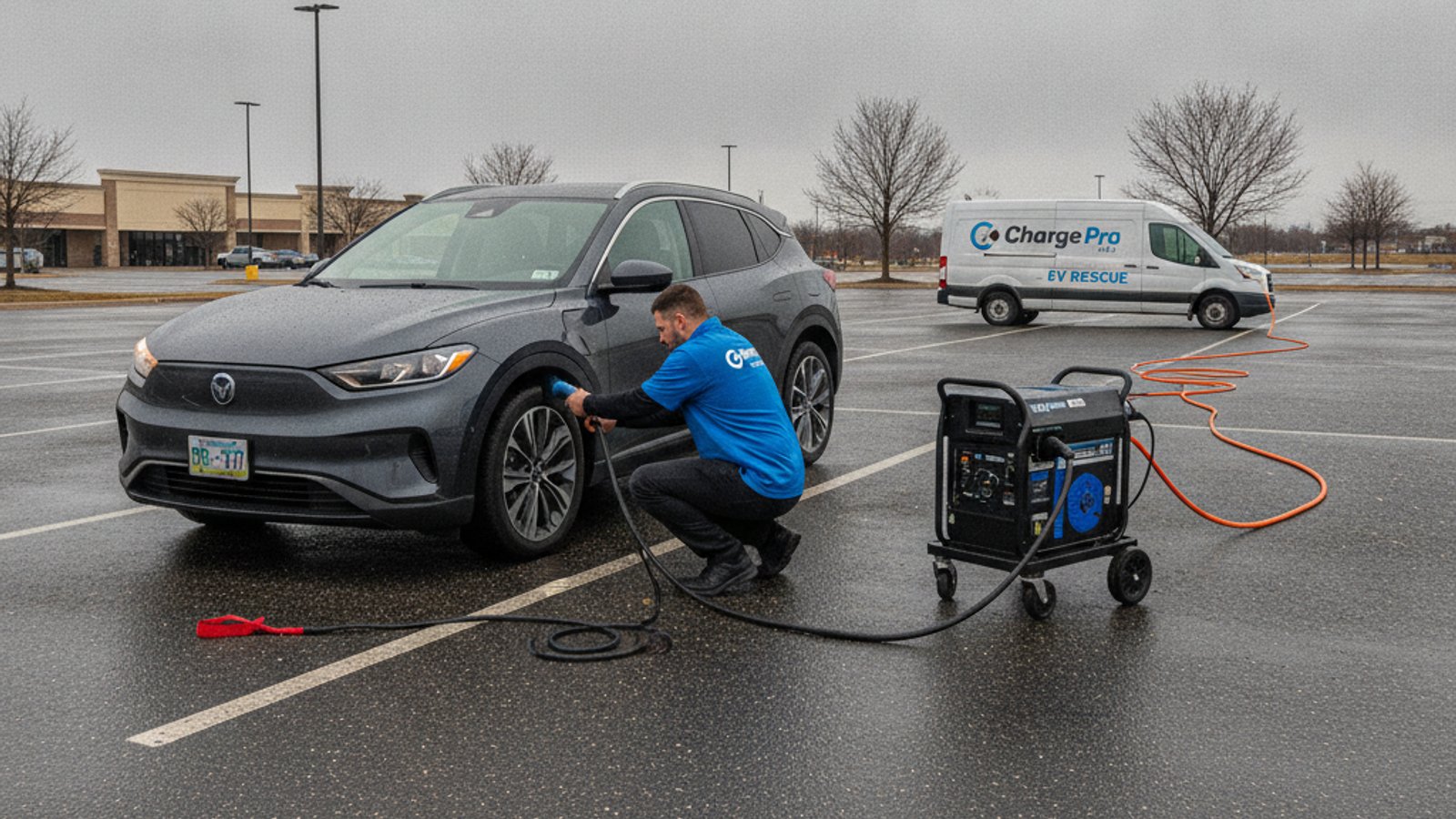
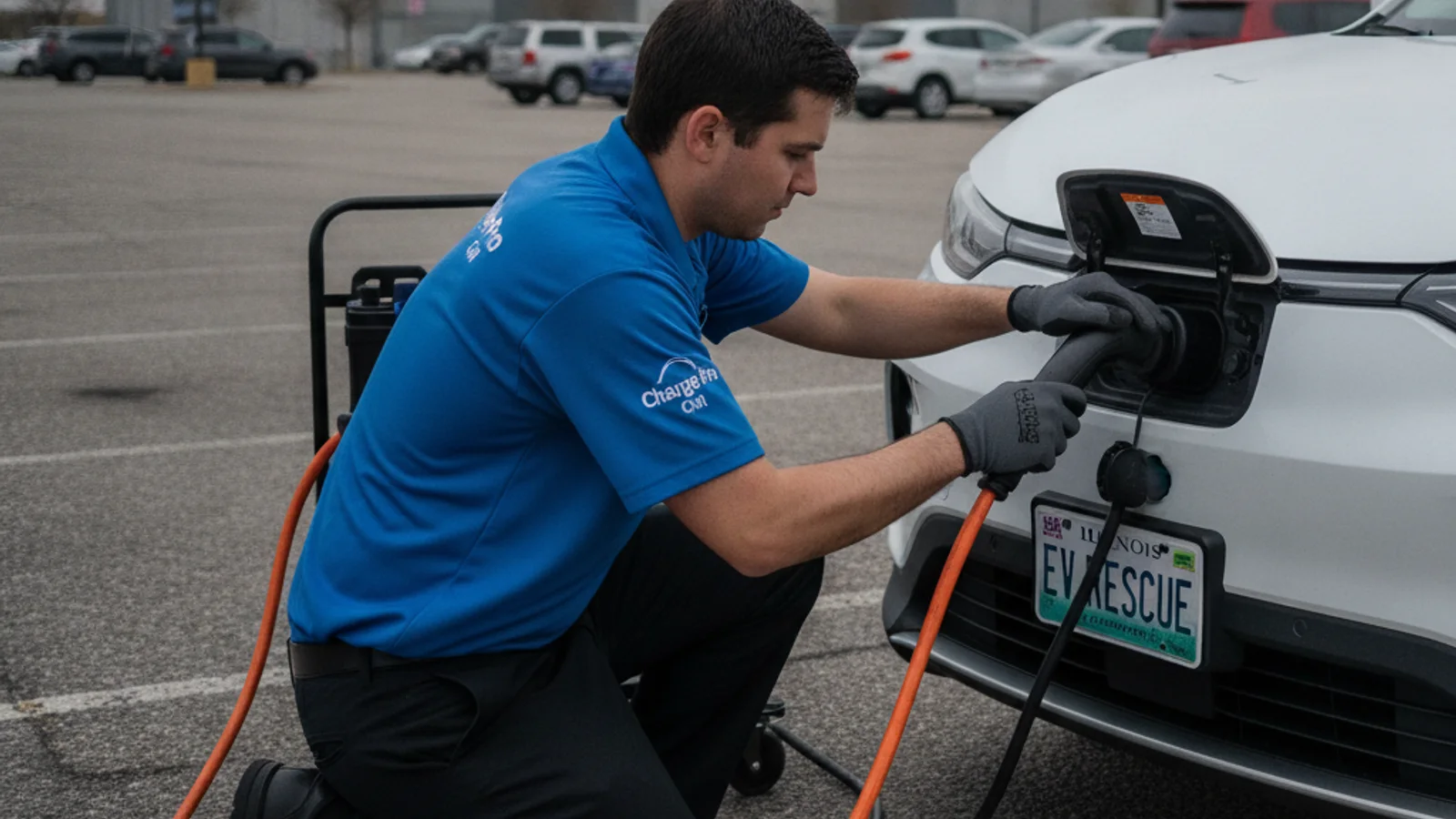
If the pack is low, they connect 240V Level 2. Teslas take a native NACS plug. Other EVs take CCS or J1772 through an adapter. Typical charging time is 15 to 30 minutes. That’s how long the cable is on the car. In that window you usually pick up about 10 to 20 miles. That’s enough to reach a ComEd-fed wall box at home. Or it’s enough to reach a public charger you already trust in your app. It isn’t a fill-up. It’s a rescue.
They don’t set Charge Pro CHI prices, because Charge Pro CHI doesn’t set prices. Ask for the quote before they start. If you also want a tow quote, get that as a separate figure. Towing a silent EV has its own rules. Many cars must ride a flatbed with specific wheel settings. A 12V wake plus a short boost often avoids that. Compare both options in the lot.
The same operator can handle a Tesla, a Mustang Mach-E, an Ioniq 5, a Lyriq, or a Lightning. Plug type is the variable. Tell them the make and model when you call. The pros we connect you with are licensed and insured. Charge Pro CHI itself isn’t the licensed installer. It’s the match.
If the 12V comes back and the pack is healthy, drive home and get the battery tested. Don’t plan another long Crossing sit tomorrow on the same weak 12V. If the pack is low, use the boost miles to reach home charging. Public stalls change status. Confirm live availability in your charging app before you roll to one. This page doesn’t publish a station list. A verified live inventory wasn’t part of the research behind it.
Home charging is common. The lot is still the problem
ComEd is the electric utility in Orland Park. A lot of households here can charge at home. The housing stock is young compared with Chicago, Oak Park, or Berwyn. Only 11.8% of local homes were built before 1980. Chicago’s figure is 68.6%. Oak Park’s is 78.6%. Berwyn’s is 90.0%. That gap is why Orland Park stalls skew toward retail parking. They don’t skew toward having nowhere to plug in at the house.
None of that helps you late in an Orland Square lot. The wall box is in the garage. The car is here. A mobile boost or a 12V jump is what closes that night. Overnight programs, credits, or time-of-use details are set by ComEd. This page doesn’t publish a rate. A verified current figure wasn’t confirmed in the research behind it. Check ComEd’s EV pages, or your own bill, before you plan home charging costs.
If the house charger failed this morning, that’s a different day. Then you may have arrived at Orland Square already low. Say so when you call. The operator needs to know whether to treat this as a 12V sit or a pack that never got filled.
The Triangle, Metra, and a quieter kind of long dwell
Downtown Orland Park, the Triangle, isn’t the mall. It’s still a long-dwell zone. A Metra SouthWest Service trip, a downtown errand, and a meal stack the same way a mall movie does. The car sits. The 12V sits with it. Weekend events make it worse because the stay stretches.
West Orland Park has newer subdivisions and more driveway charging. People leave full, drive a short local loop, then park at the Crossing. Range was never the issue. South Orland Park closer to I-80 mixes both worlds. You get mall traffic and interstate traffic. If you rolled off I-80 with a low pack, don’t shop for two more hours hoping the car will be fine. Accessory loads plus a low pack is how a simple stop becomes a no-start.
Land area is about 22 square miles. It isn’t a tiny downtown grid. A pin that says Orland Park can still be a long walk from the entrance you meant. Stay with the vehicle when you can. If you already walked back into the mall, give the operator the entrance and the row. Lot letters help. Store names help more.
Tesla, other brands, and what roadside even means
Tesla’s own roadside path is a separate product. It isn’t Charge Pro CHI. What Tesla sends, and what it covers in Illinois, is Tesla’s policy. Confirm that in the Tesla app or with Tesla directly. This page doesn’t invent a coverage list. If Tesla can’t jump the 12V or can’t put energy in the pack, a local operator is the backup. OEM roadside, a motor club, and a local mobile rescue are three different calls.
Motor clubs often think in gas-car jumps and tows. Some will try a 12V jump. Many won’t charge the traction pack. If the club is only offering a tow from Orland Square to a shop, ask whether a 12V wake was even attempted.
Rivian, Ford, Hyundai, GM, and the rest have their own assistance lines too. Same rule. Confirm with the brand. Don’t assume a roadside button charges an empty pack. For a mall 12V death, the useful on-site work is a jump or a 12V replacement. Add a Level 2 boost only if the pack is also low.
What not to do in an Orland Park lot
Don’t keep a child or a pet in a sealed, dead EV in heat or cold while you wait. If the car won’t restart climate, change the plan. Get people into a store or a heated vestibule. The mall and the Crossing both give you that option. A quiet office pad in south Orland Park may not.
Don’t accept a bumper-tow. Many EVs can’t roll that way. A flatbed with the right wheels off the pavement is the usual tow method when a tow is truly required. Ask the tower about EV procedure. If the 12V can be woken, you may not need them.
Don’t open high-voltage orange cables. There’s nothing for a driver to service there. The 12V is the owner-accessible battery. Even then, follow the manual’s jump points. The operator you’re matched with already works those points.
Don’t count on a charger you haven’t confirmed in an app. This page doesn’t map public stalls in town. Availability changes. If you can open the car and the pack still has range, navigate to a station you can see as available. If you can’t open the car, you need on-site 12V help first.
How Charge Pro CHI fits, and how it doesn’t
Charge Pro CHI is the referral line for stranded EV drivers in Chicagoland. It matches you with independent local mobile rescue operators. It holds no trade license for the work. It employs no technicians. It owns no trucks, no chargers, and no parts warehouse. It publishes no business hours and no arrival clock. The operator quotes you. The operator bills you. The pros in the network are licensed and insured.
That structure matters in a lot at Orland Square. You aren’t waiting on a brand-owned fleet. You’re waiting on a local operator who can jump a 12V, replace one when they have the battery, and put 240V into the pack when that’s the need. Teslas and non-Teslas are both in scope.
Service covers Orland Park and the rest of the Chicagoland area, including nearby Tinley Park. The city page for local context is EV charging in Orland Park. Use it for the place. Use this post for the stall after a long sit.
Frequently asked questions
Why did my EV die after a long day in Orland Park parking?
Long stays at Orland Square Mall, Orland Park Crossing, and lots along LaGrange Road keep 12V loads running while the car sits. The traction pack usually still has range because so many local drivers charge at home. The 12V is what drops first, especially in the cold. I-80 traffic can create a true low-pack stall, but the retail-dwell call is the 12V call.
How can I tell a dead 12V from an empty pack?
Use the last range number you saw when you parked. A normal charge after a short local drive, followed by a black car hours later, points to the 12V. A car that arrived from I-80 already flashing empty may need pack energy. If screens are dark, you can’t read the pack anyway. Tell the operator both facts: last known charge, and how long you sat.
What does on-site help actually include?
The independent operator can jump or replace a dead 12V on site. They can also add a 240V Level 2 boost, typically 10 to 20 miles in 15 to 30 minutes of charging time. They quote before they start and bill you directly. Charge Pro CHI doesn’t perform that work. It connects you.
If the car is dark in an Orland Park lot, call (858) 925-5546. Ask for EV roadside help, give a tight pin, and say whether this was a long mall sit or a low pack off I-80. The operator takes it from there.