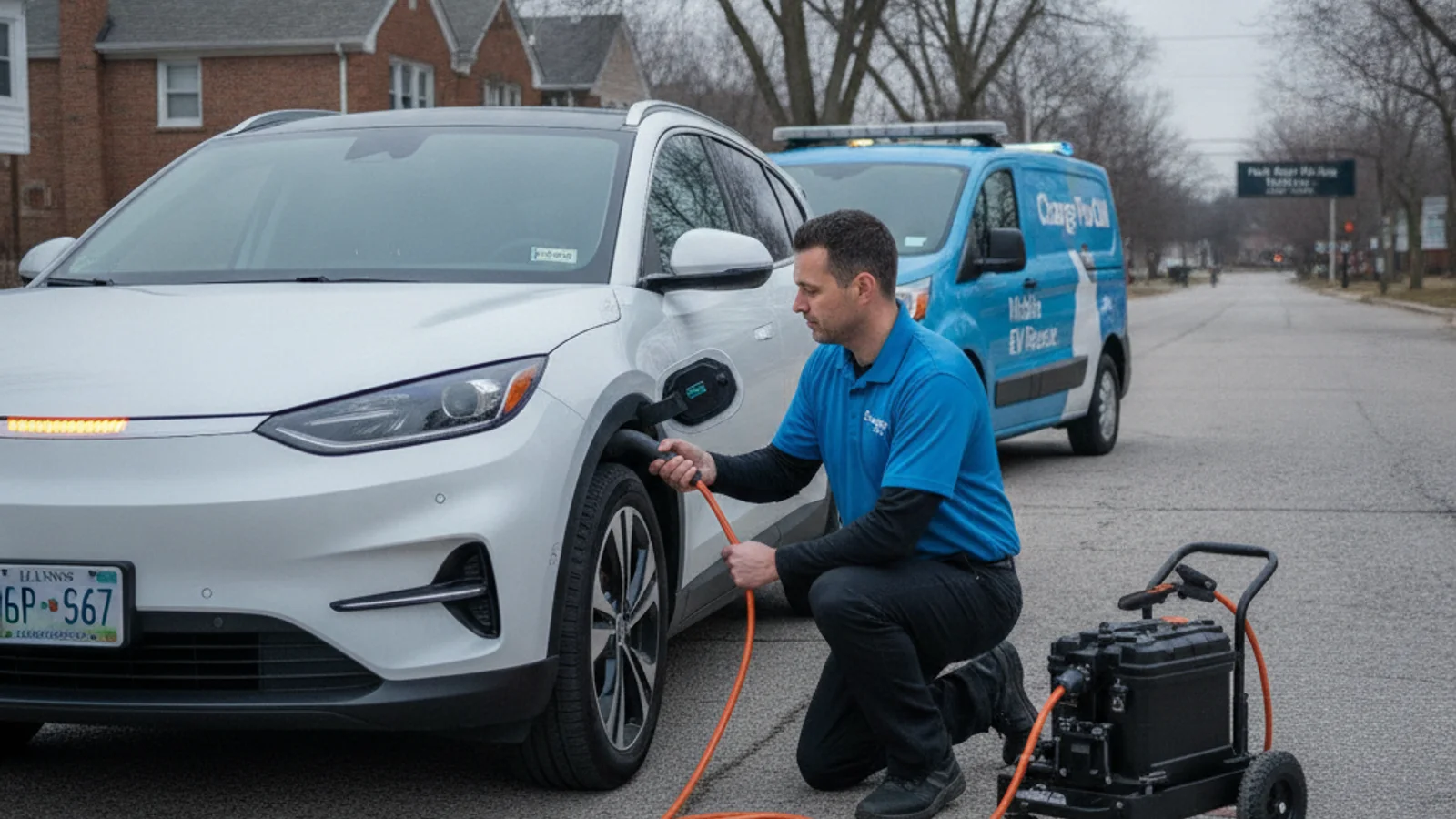
EV roadside assistance in Park Ridge is a 240V boost at the curb. The stall often follows an O’Hare stay or a cold night on the street. Charge Pro CHI matches you with an independent local operator. That operator quotes you before starting and bills you directly.
Park Ridge sits on the O’Hare doorstep
Park Ridge covers 7.088 square miles in Cook County. The ACS 2019-2023 population is 39,241. The 2024 estimate is 38,445. It’s a dense suburb pressed against O’Hare. I-90 runs the southern edge. Locals know that road as the Kennedy. Farther west it becomes the Jane Addams.
ZIP codes 60068 and 60016 overlap the city. Touhy Avenue, Dempster Street, Cumberland Avenue, and Talcott Road carry most local trips. Airport pickups share those same cuts with school runs and grocery loops. That’s why a quiet block can still host a stranded EV.
Uptown Park Ridge orients around the Pickwick Theatre. South Park Ridge sits closer to the interstate. The O’Hare-adjacent streets take hotel and terminal overflow. North Park Ridge is the tighter residential grid. About 67.1% of housing here was built before 1980. In that stock, a wall charger often isn’t installable.
ComEd is the electric utility. We couldn’t confirm a published ComEd EV charging rate for this page. Ask ComEd for current details before you add a home charger. Charge Pro CHI doesn’t sell power and doesn’t set a rate. It also doesn’t hold a contractor license, own trucks, or employ technicians.
After an O’Hare stay, the car won’t wake
The Park Ridge pattern often starts at the airport, not in a driveway. You leave the car on a side street near Touhy or Cumberland. You fly, then come back tired to handles that don’t present. The app spins and the dash stays dark.
People assume the pack is empty, and sometimes it is. Airport miles plus a Kennedy crawl can spend the buffer you thought you had. After a long sit, the 12V is the more common culprit. The high-voltage pack can still hold energy. The computers never boot, so you can’t use it.
A flatbed to a public stall doesn’t reboot a dead 12V. Jump that small battery first. Then see whether the car will accept charge. Operators in this network jump or replace the 12V on site. They also bring a 240V Level 2 source for the pack. Tesla cars take a native NACS plug. Other brands use a CCS or J1772 adapter.
Typical charging time is 15 to 30 minutes. That window usually adds 10 to 20 miles of range. It’s charging time only, never an arrival clock. The operator quotes the job before any cable goes in.
If the pack simply hit empty, mobile EV charging puts miles back at the bumper. If the car is a silent brick, start with a Tesla 12V battery jump path. EV roadside assistance covers both jobs through independent local operators.
Two failures, two different calls
Treat the signs in front of you.
If the car unlocks and the display shows single-digit miles, the pack is the story. Stay put if you can’t roll to a plug you trust. Confirm live stalls in your charging app. Don’t guess from memory. A Level 2 boost is enough to reach home or a working public stall.
If the car is a brick, start with the 12V. Locks, contactors, and the charge port all need that small battery. Tesla owners see this after a long sit more than they expect. Other makes fail the same way in the cold. There’s a Park Ridge note on non-Tesla EV rescue in Park Ridge. It covers CCS and J1772 ports on these streets.
Charge Pro CHI is a referral line. It matches stranded drivers with independent mobile rescue operators. It performs no work. The person who shows up works for their own shop. They quote you, then bill you. The pros we connect you with are licensed and insured.
Streets, lots, and the Kennedy edge
Give the operator a pin and a cross street. Uptown near the Pickwick is easy to describe. South Park Ridge near I-90 is a different approach. The O’Hare-adjacent pocket might be a hotel lot. It might be a residential curb. It might be a last-block stop after the terminals. North Park Ridge is the tight grid where winter street parking is common.
Touhy is the airport-adjacent cut, and Dempster runs farther north. Cumberland and Talcott feed the O’Hare approach. If you made it home and died in the driveway, say so. Driveway jobs and curb jobs are both normal here.
If you’re still on I-90, you’re not on a neighborhood street. That’s the Kennedy or the Jane Addams, depending on the mile. Get to a safe spot if you can. Don’t walk traffic. For that scenario, use the Kennedy out-of-charge guide. Des Plaines is the next city along that edge. The Des Plaines city page covers that side of the line. Park Ridge’s hub is the Park Ridge charging page.
Rosemont and Chicago sit on the airport flank. Niles sits just east of the city line. We serve Park Ridge and the rest of Chicagoland. Coverage isn’t a promise of how soon a truck appears.
Winter, street parking, and older houses
Two-thirds of local housing predates 1980. That stock often can’t take a home charger. Cars then live on the street or in unpowered garages. A January night on a Park Ridge block is hard on a weak 12V. In the morning the car may not wake. That’s the winter street-parked call this suburb actually generates.
Cold also cuts the range the dash advertised yesterday. You left Uptown with what looked like enough miles. Cabin heat and a slow Kennedy crawl spent them. You roll onto Talcott and the car warns you. Pull onto a side street if you can. Waiting in a through lane on Touhy helps nobody.
We couldn’t verify a public-charger inventory for Park Ridge on this page. Open your charging app and read live status. If the car can’t move, bring 240V to the bumper. Don’t treat an empty map pin as proof that a site is close enough.
Home charging questions belong to ComEd and a licensed electrician. Mobile rescue doesn’t replace a wall box. It’s the stopgap when the car is already stranded.
What the operator actually does
The truck is a mobile 240V Level 2 source. It isn’t a Supercharger on wheels. It isn’t a shop bay. The operator plugs in, adds a modest range buffer, and you drive. Ten to twenty miles is the typical range add. That takes fifteen to thirty minutes of charge. That’s enough to reach a working stall or your own driveway.
They handle Tesla and every major EV brand. Adapters ride with the unit. Tell dispatch the make, model, and what the dash shows. Say whether the car unlocks. Say whether you just got back from O’Hare. That detail changes the 12V-versus-pack guess before anyone rolls.
You’ll get a quote first. If you don’t like it, you decline. There’s no published fee table on this site. Confirm the number with the operator before they start. They bill you directly. Charge Pro CHI doesn’t set prices and doesn’t collect the invoice.
Frequently asked questions
Does Charge Pro CHI send operators into Park Ridge?
Yes. Park Ridge is inside the Chicagoland service area. That includes Uptown, south Park Ridge, the O’Hare-adjacent streets, and north Park Ridge. Coverage isn’t an arrival-time promise. The operator on the call gives you the quote and the plan.
Why is the car dead after an O’Hare trip?
A long sit often kills the 12V, not the pack. Locks and computers never boot, so the car looks fully dead. An empty pack after airport miles is the other pattern. Tell the operator which signs you see. Jumping the 12V and boosting the pack are different jobs.
Can a non-Tesla get a curb boost here?
Yes. Operators bring a CCS or J1772 adapter for non-Tesla EVs. Tesla uses a native NACS plug. Hyundai, Kia, Ford, Chevy, VW, Rivian, and other major brands are in that mix. Give the make and port type when you call.
For a stall anywhere in Park Ridge, call Charge Pro CHI at (858) 925-5546. We’ll connect you with a local operator. That operator quotes the job before any work starts.