If your EV stalls in Wilmette, you need EV roadside assistance at the car. That usually means a 240V boost or a 12V jump. Charge Pro CHI is a referral line for this village. We match you with an independent local operator. The operator brings a 240V Level 2 source to your Tesla or other EV. Home charging is the norm on this Cook County lakefront. Lake-effect cold still strands cars in their own driveways.
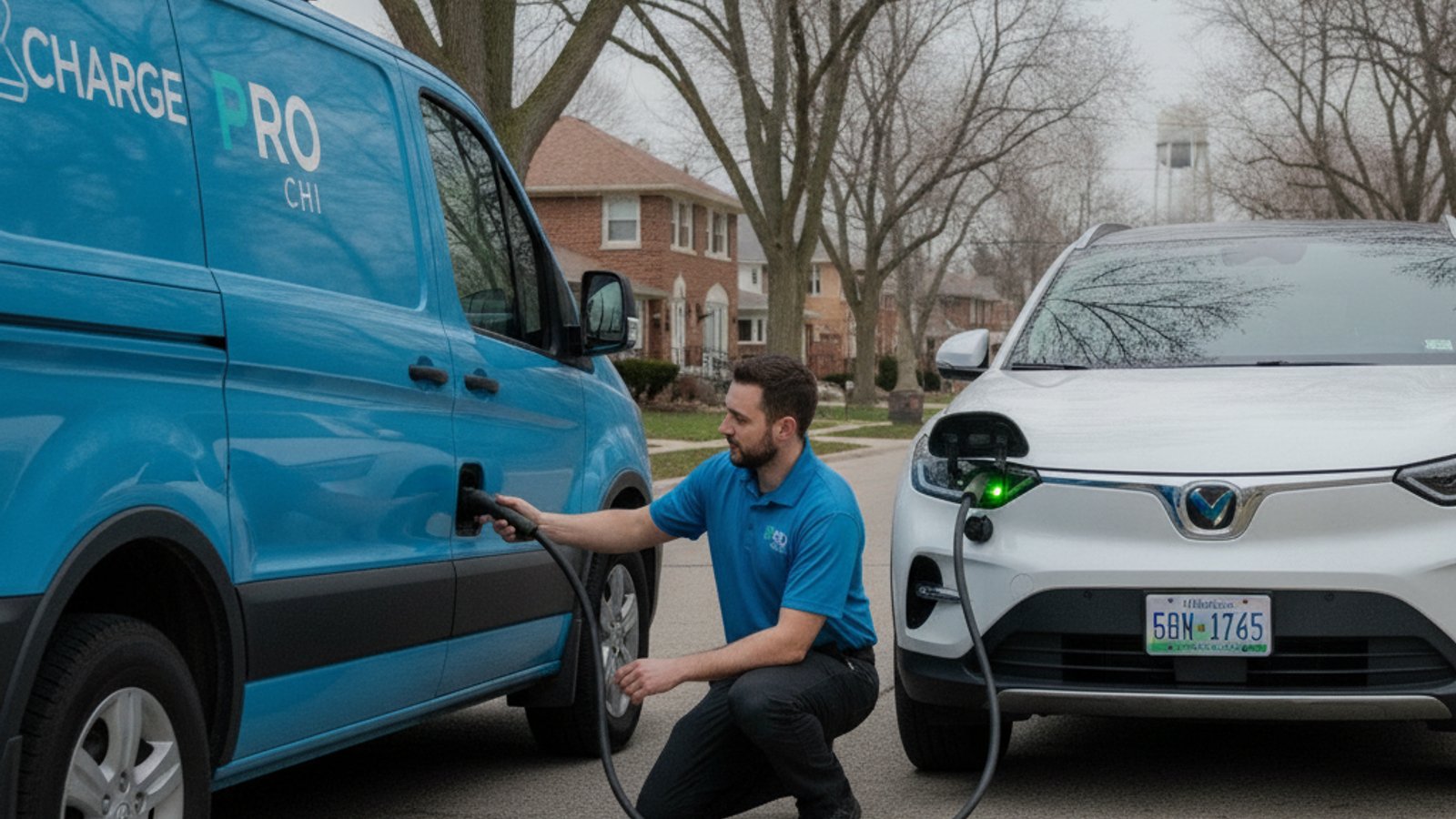
Home charging still fails on this stretch of lake
Wilmette covers 5.401 square miles in Cook County. ACS 2019-2023 counted 27,550 residents. The 2024 estimate is 27,443. It’s an affluent North Shore village with high EV use. Most of that use hangs off a wall box at home. The stall pattern still starts at home. Calls skew toward the drive home and the long dwell. A garage charger doesn’t cancel wind off Lake Michigan.
East Wilmette and the lakefront have narrow lots and street parking. You can live near Gillson Park and still wake up to a dead car. The car sat in the wind. Preconditioning pulled from a thin pack. Or the 12V died while the big pack still had miles.
West Wilmette meets I-94, the Edens, along the village edge. That commute looks short on a full charge. Heat, defrost, and Edens traffic chew the estimate. You exit toward Green Bay Road or Ridge Road and come up short. You’re in a driveway that didn’t finish charging.
Charge Pro CHI doesn’t own trucks. We don’t employ technicians. We don’t set prices. We don’t publish arrival times or hours. The operator quotes you before any work. That operator bills you directly. The pros we connect you with are licensed and insured.
East Wilmette, Sheridan Road, and street parking
Sheridan Road runs with the lake. Lake Avenue crosses the village east to west. A stall near Gillson Park puts you in the wind. A stall by the Bahai House of Worship still sits in that east-side pattern. Older blocks and tighter parking leave a car without a garage stall tonight.
ACS 2019-2023 says 74.3% of Wilmette housing was built before 1980. Compare that with Glenview at 40.3% and Northbrook at 39.1% on the same tables. Wilmette’s stock is older. Many garages were never planned around a wall box. Some houses park on the street because the lot is narrow. That’s a home-charging constraint. It isn’t a claim about public chargers.
The CTA/Metra station area is the long-dwell version. You park for the Metra Union Pacific North line. You come back hours later. The pack is lower than you left it. Cameras, climate, and a cold soak all sip. You needed a few miles down Sheridan or Lake Avenue. You don’t have them.
Long dwell here isn’t a mall-lot story. It’s a Metra morning. It’s a visit that ran long. It’s a car left on an east-side street while you walked toward the lake. The pack looks fine when you lock it. Hours later the wind and the 12V have other plans.
If you’re actually on the water, stranded help along the Wilmette lakefront goes deeper on that strip. This page is the village-wide call. Driveway, side street, station lot, or the Edens edge.
West Wilmette and the Edens
The Edens is the western hinge. I-94 traffic spills onto local streets. Those streets don’t feel like a highway stall at first. Then you’ve already stopped. Green Bay Road and Ridge Road take that overflow. A low-pack warning on the Edens feels different from a dark dash on an east block. The on-site job can still be the same mobile EV charging visit.
Don’t treat the west side as a different climate. The village is 5.401 square miles. Lake wind still reaches west Wilmette. Range still falls. The 12V still sits in the cold. The setting is the commute more often than Gillson Park.
Lake Avenue is the east-west spine. It ties the lakefront to the Edens side. A low-pack drive on Lake Avenue can start at Sheridan and fail before Ridge Road. That’s still a Wilmette stall. It isn’t the park. It’s the cut-through after a cold errand.
ZIPs that overlap Wilmette include 60091 and 60093. Tell the operator the street. Don’t stop at the ZIP. 60093 runs past the village line. A pin on the curb beats a postal guess.
Evening returns off the Edens are a classic Wilmette miss. You left with enough charge in your head. Cabin heat was on. The estimate was optimistic. You wanted the garage on the west side. You stop short on Ridge Road instead.
Lake-effect cold hits the pack and the 12V
Lake Michigan doesn’t hand Wilmette a soft winter. Wind comes off the water. East-side streets feel it first. The rest of the village still gets it. Cabin heat, seat heaters, and defrost all pull from the pack. That’s ordinary EV behavior in the cold.
Displayed range lies in this weather. The number you saw at noon isn’t the number you have at 9 p.m. Speed on the Edens makes it worse. Short hops on Sheridan with a cold soak make it worse in another way. Both are reasons a home-charged car still dies.
The 12V is the other winter failure. It wakes the car. It runs the computers that close the high-voltage contactors. If that small battery is dead, the car can look fully dead. Doors may not play along. The charge port may not open. The dash may stay black. The pack can still hold energy.
Operators in this network can jump or replace a dead 12V on site. That’s a different job from filling an empty pack. Tell the operator what you see. A dark car after a windy night on Sheridan is often the 12V. A car that’s awake and reading zero is often the pack. You can guess wrong. The person at the bumper will sort it.
If it’s a Tesla, the Tesla 12V battery jump path is the right request. Other brands fail the same way. The small battery is still the wake-up battery.
A parked EV can drain itself. Scheduled preconditioning and always-on systems sip overnight. After a long dwell at the station, that sip can strand you for the last mile. That’s a parked-car problem.
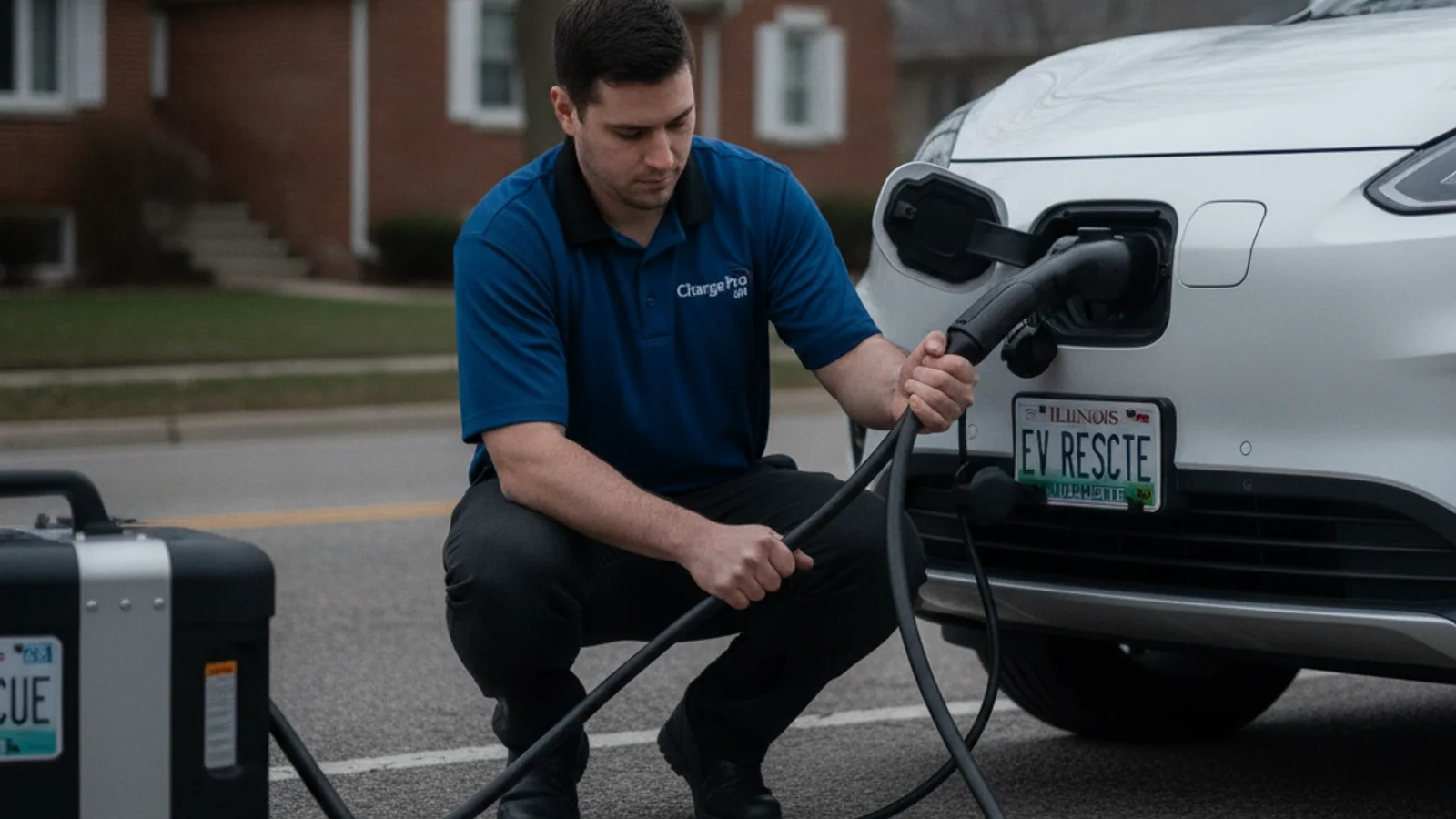
What a mobile rescue adds
The operators we connect you with bring a 240V Level 2 source. Tesla gets a native NACS plug. Other EVs use a CCS or J1772 adapter. The goal isn’t a full pack. It’s enough range to reach the charger you already meant to use. Or it’s enough to reach your own wall box.
Charging time is typically 15 to 30 minutes. That window usually adds about 10 to 20 miles. Those figures are charging time. They aren’t an arrival time. Weather, model, and how empty you are all change the result. The operator quotes that before work starts.
Charge Pro CHI doesn’t promise a clock. We don’t publish a response window. The operator you book confirms a realistic window. Edens traffic, a Metra crossing, and weather all move it.
A mobile boost isn’t a repair shop. If a charge port is frozen, say so. If the car won’t wake, say that. If the car can’t accept a charge, a tow is a different handoff. This network’s job is the boost and the 12V.
For the hardware, how a mobile EV charging truck works is the plain version. It’s a Level 2 source that travels. It isn’t a Supercharger on wheels.
How the referral call works
You call the referral line. You give a Wilmette pin a driver can find. Sheridan near Gillson Park. Lake Avenue west of Ridge Road. A side street east of Green Bay Road. The CTA/Metra station area. Your driveway. Make and model matter. Tesla versus a CCS car changes the adapter.
We pass that to an independent local operator. Charge Pro CHI performs no work. We hold no trade license for the charge. We own no fleet. The operator contacts you. They quote the job. They bill you if you accept.
Stay with the car if you can do it without stepping into traffic. Hazard lights help on the Edens edge. On a quiet east-side block, still make yourself seen. Don’t stand in the travel lane.
When the operator is on site, they connect the 240V source to your inlet. You wait through the charge. You leave when you’ve got the miles you agreed to. Home is often the right target in Wilmette. A public plug you already trust is the other. This page won’t guess the site.
If the dash is dark, the operator may start with the 12V. A jump can wake the car. A replacement is on the table if the battery won’t hold. You’ll hear the quote first.
Older houses, ComEd, and the overnight plug
ComEd is the electric utility in Wilmette. This page couldn’t confirm an EV home-rate figure that applies to every household here. ComEd sets those prices. They change. Confirm the current rate with ComEd before you plan overnight charging around a forum number.
Housing age is the other constraint. With 74.3% of homes built before 1980, plenty of panels predate wall-box demand. A tripped breaker at night is a stall at breakfast. The car sat. The circuit didn’t.
Glenview and Northbrook sit close by with newer housing shares on the same Census tables. Their pre-1980 stock is much lower. Wilmette’s older east side is why a house with a charger still fails. The house is older than the car.
Don’t take a permit path from this article. The Village of Wilmette and Cook County set building rules. No ordinance number was verified for this page. Ask the village or a licensed electrician if you’re adding a wall box. Charge Pro CHI doesn’t pull permits. We don’t install chargers.
Overnight charging fails for ordinary reasons. A loose plug. A scheduled charge that never started. An app that said charging while nothing moved. A cold soak that cut morning range. You still need a way to move the car now.
Nearby North Shore if you crossed the line
Wilmette’s neighbors are Evanston, Glenview, Northbrook, and Winnetka. The village line doesn’t care about your map app. A stall on Sheridan can change towns in a few blocks. Tell the operator the name on the street sign.
Evanston sits south with 76,552 ACS residents. It’s larger and less of a single lakefront village. Glenview and Northbrook sit west of the Edens pattern. Winnetka sits north. The same lake wind hits that inner North Shore. The same 12V winter pattern shows up. The operator still needs a pin.
Charge Pro CHI’s service area is Chicagoland. Wilmette is inside it. So are those neighbors. The Wilmette EV charging city page is the local hub. The roadside call is this referral.
Boost, jump, or tow
Match the symptom to the job.
If the car is awake and the pack is empty, you want a 240V boost. You buy miles. Then you drive.
If the car is silent, start with the 12V. Jump first. Replace if the quote says the battery is done. A tow doesn’t fix a 12V.
If the car can’t take a charge, you’re in tow territory. This page isn’t a towing manual. Ask the operator. Then ask a tow company that handles EVs if that’s the path.
AAA and OEM roadside lines are a separate comparison. They may send a tow. They may not send a 240V source. If you want the local boost, say you need mobile charging.
For 12V signs before a stall, what happens when an EV 12-volt battery dies walks through the clues. Read it while the car still wakes. It’s harder from a dark seat on Lake Avenue.
What to say on the call
Give the village. Give the nearest cross street. Sheridan and Lake Avenue is enough to start. Add a landmark only if it’s real. Gillson Park. The Bahai House of Worship. The Metra Union Pacific North stop. Don’t describe a charger you can’t name. Don’t estimate how far the next plug is.
Say Tesla or not. Say if the dash is on. Say the indicated miles if you have them. Say if the charge port is frozen, open, or locked. Say if you’re on the Edens shoulder or on a residential block. Those details change how the operator stages the vehicle.
Say you want a quote before work. That’s how this network runs. You’re not negotiating a brand price. Charge Pro CHI has no fee menu on this site. We don’t bill the job.
Stay out of live traffic. If you’re on I-94, keep people off the travel lanes. This page couldn’t confirm a Wilmette-specific police protocol for EV stalls. If you need traffic control, that’s a 911 decision.
Frequently asked questions
What EVs can a Wilmette operator help
The operators we connect you with handle Tesla and every major EV brand. Native NACS covers Tesla. CCS or J1772 adapters cover the rest. Model 3, Y, S, X, and Cybertruck sit in the Tesla set. Ford, Chevy, Hyundai, Kia, Rivian, BMW, Audi, and other common EVs use the adapter path. Confirm your inlet on the call so the operator brings the right plug.
How much charge does a mobile boost add
Plan on about 10 to 20 miles after 15 to 30 minutes of charging. That’s a typical Level 2 boost, not a full charge. Your efficiency in lake-effect cold will sit below a mild-day estimate. The operator stops when you’ve got enough to reach home or the charger you named. Charge Pro CHI doesn’t sell a guaranteed mile count.
What if the car won’t wake up at all
Treat it as a 12V problem until someone proves otherwise. A dead 12V looks like a dead EV. The pack may still have energy. Ask for a jump or an on-site 12V replacement quote. If the car wakes and then shows a truly empty pack, switch to the 240V boost. If it won’t accept a charge after it wakes, you’re past a roadside boost.
Call the referral line when you’re stuck
A stall in Wilmette is usually a cold night, a long dwell, or a wall box that didn’t finish. Charge Pro CHI matches you with a local operator for the boost or the 12V. We don’t do the work. The operator quotes you. You decide.
For EV roadside assistance in Wilmette, call (858) 925-5546. That’s the Charge Pro CHI referral number. Use it when you’re already stopped. Use it when you know the car won’t make the last stretch home.