The battery icon is at zero and the car won’t roll. You might be on the Eisenhower after a crawl. You might be in a Naperville garage that never got a wall box. You might be on Lower Wacker with no room to think. A mobile EV charger truck is the vehicle that brings 240V Level 2 to that spot. It’s not a tow truck with different paint. Independent operators in this network carry a Level 2 source. They bring a native NACS plug and CCS or J1772 adapters. Tesla and every major EV brand can take a charge in place.
What a mobile EV charger truck actually carries
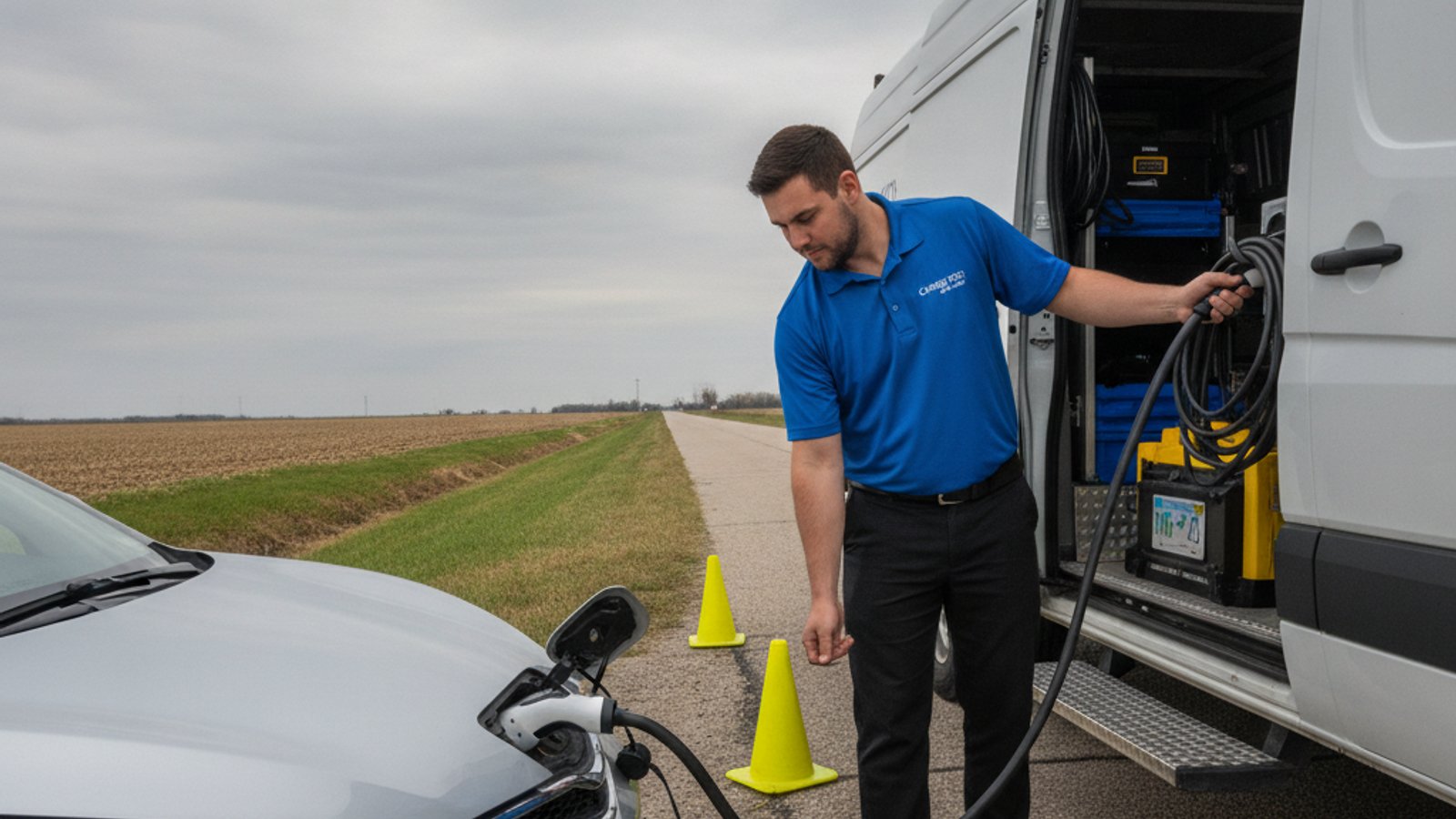
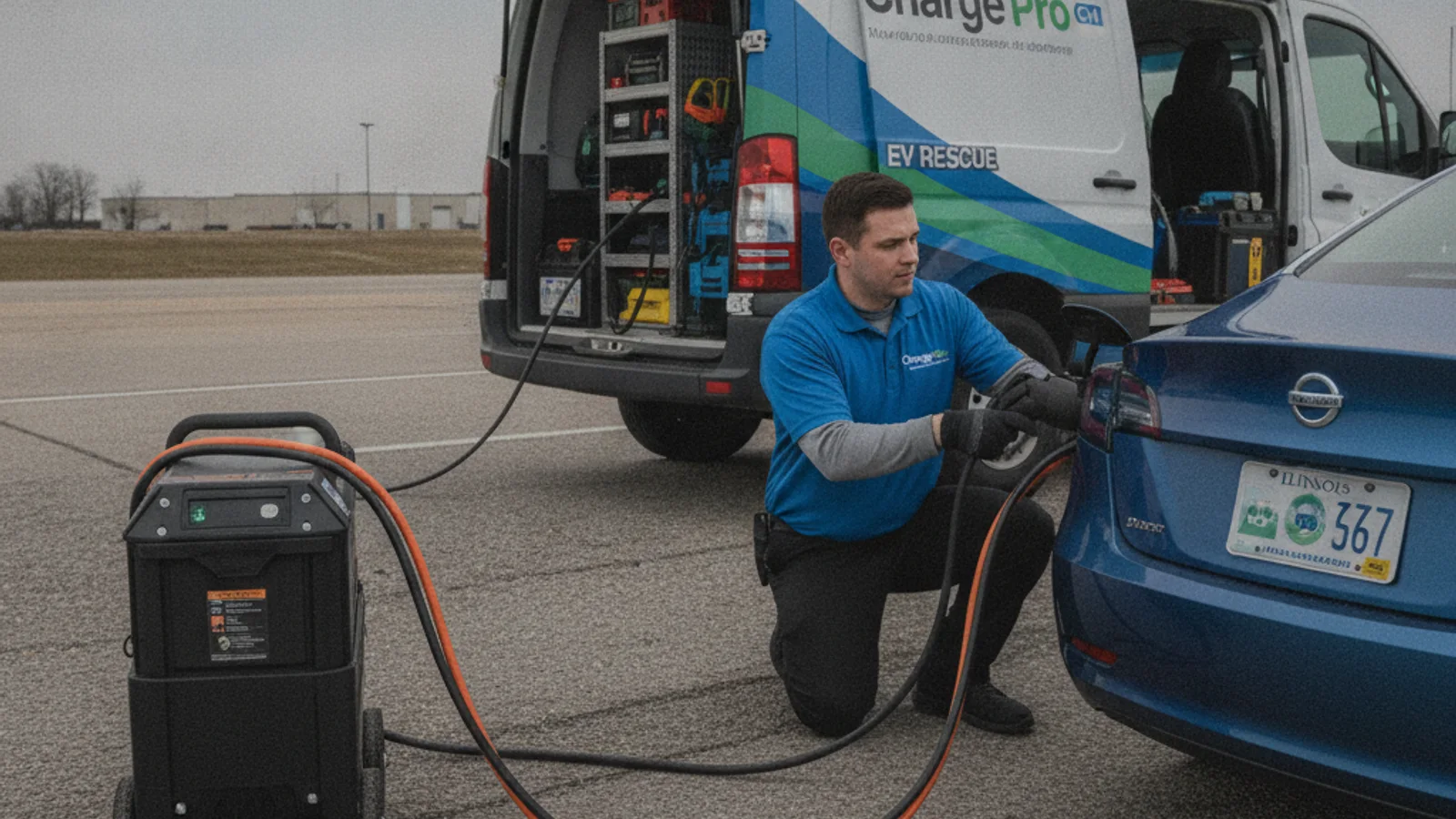
People picture a boxy truck and a mystery hose. The real kit is more specific. The operators we connect you with bring a 240-volt Level 2 source to the car. That’s the same voltage class as a serious home charger, not a household outlet. They carry a native NACS plug for Tesla. For everyone else they bring a CCS or J1772 adapter. They can also jump or replace a dead 12V battery on site. A silent EV is often a 12V problem, not an empty pack.
Charge Pro CHI doesn’t own the van. We don’t stock parts. We don’t employ technicians. We match stranded drivers with local mobile rescue operators. The operator quotes you before any work starts. They bill you directly. You know the number before a cable goes in.
The 240-volt Level 2 source
Level 2 is the useful roadside speed. A travel brick on a 120-volt outlet is Level 1. That trickle can take hours to add a few miles. A mobile EV charger truck is built around 240 volts. Typical charging time on a stop like this is 15 to 30 minutes. In that window the car often picks up about 10 to 20 miles of range. That figure is charging time at the curb, not a promise of when anyone arrives. Ten to twenty miles is usually enough to leave a shoulder, a garage, or a lot. From there you drive to a public charger you already trust.
If you want the Level 1 versus Level 2 distinction in plain language, we wrote it up in EV charging levels, explained for stranded Chicagoland drivers. The mobile EV charging page covers what the operators we send actually do with that 240-volt source.
The van isn’t a Supercharger on wheels. DC fast charging is a different class of hardware. Roadside rescue here is a Level 2 boost. You’re not filling the pack to 80 percent on the shoulder of the Dan Ryan. You’re buying enough range to move.
NACS, CCS, and J1772 on the same call
Tesla owners plug in with NACS. That’s the native connector on current Teslas. Operators bring it as a first-class plug, not an afterthought. Non-Tesla EVs in this metro still show up with CCS or J1772 ports. A Hyundai, a Mach-E, a Chevy Equinox EV, and a Rivian don’t share one charge door. The adapter kit is how one van covers that mix.
If your car isn’t a Tesla, the call is still the same network. The non-Tesla EV rescue page is the dedicated path for CCS and J1772 cars. You should still tell the operator the make and model when you call. That’s how they know which adapter to pull first.
The 12V kit sitting next to the charge cables
A lot of dead EV calls aren’t empty packs. The high-voltage battery can show plenty of range while the 12-volt battery has given up. Contactors won’t close. The screen stays black. Door handles won’t present. You can’t put the car in drive. Operators we send can jump that 12V on site. They can replace it when a jump won’t hold. Tesla Model 3, Y, S, and X all have a 12V, or a low-voltage lithium pack on newer 3 and Y cars.
That’s a different job from a range boost. The operator still needs to know which failure you have. If the car woke up with range on the display and then went silent in a Park Ridge driveway, start with the 12V. If the guessed range counted down to zero on I-55, you need energy in the pack. Say which one you’re looking at when you call. The kit that comes off the van depends on it.
How a roadside charge actually runs here
Forget a branded fleet rolling out of a warehouse. You call. We pass the job to an independent operator who can reach you. They confirm the car, the plug type, and the quote. Nothing starts until you accept that quote.
On scene they park with the van protecting the work area when the road allows it. Shoulders on the Tri-State and the Reagan Tollway aren’t the same as a Cicero alley or a Wilmette driveway. The operator has to read the site. Cones, lights, and cable routing are their call. You stay out of the travel lanes.
They open the charge port, confirm the connector, and plug in. Level 2 current starts to move. You wait through that 15 to 30 minutes of charging. The dash should show range climbing. When there’s enough to drive, they unplug, close the port, and you leave under your own power. The operator can talk through a next stop if you want the extra set of eyes. They don’t pick a charger for you as a guarantee. Public stations change status.
If the 12V was the real fault, the sequence looks different. Cables go to the 12V posts, not the charge port. The car may wake, then need a short drive to keep a jumped 12V healthy. Either way, you get a quote first.
Why the kit matters in this metro
Chicagoland isn’t one housing stock and isn’t one commute. Chicago itself holds about 2.7 million people. Roughly 68.6 percent of its housing was built before 1980. Cicero and Berwyn sit even older. About 90 percent of those homes predate 1980. Oak Park is in the same older band at 78.6 percent. A lot of those buildings never planned for a 240-volt wall box in the garage. Some have no garage. Some share a building with one outlet in the alley.
Newer suburbs look different. Naperville’s pre-1980 share is about 11.7 percent. Gurnee is about 9.5 percent. Plainfield is about 6.7 percent. Huntley is about 3.8 percent. Those figures come from the Census ACS 2019-2023 tables, read in 2026. Newer houses are more likely to have a garage circuit that can take a charger. They aren’t immune to a stall. A wall box still trips. A guest still leaves with a low pack. A work lot in Elk Grove Village can still leave you unable to plug in where you sit.
The vehicle mix splits the map too. Wilmette, Highland Park, Libertyville, and Northbrook sit at the high end of household income in this metro. Cicero, Waukegan, and Chicago sit much lower. That mix means Teslas on the inner North Shore and a lot of other EVs on the same roads. The van has to handle all of it.
Expressways, lots, and streets that actually strand people
The Jane Addams (I-90), the Eisenhower, the Reagan Tollway, and I-55 are daily grind roads. So are the Dan Ryan, the Bishop Ford, the Kennedy, and the Tri-State. I-80 on the Will County side and Randall Road in Kane County add long stretches of their own. Traffic eats range because you sit in climate control with the motor barely working. A crawl on the Eisenhower after a storm is a classic drain. You can arrive at a Downers Grove exit with less in the pack than you budgeted.
Then there’s the stall that never makes the highway. Schaumburg office parks. Orland Park and Tinley Park mall lots after a long dwell. A Bolingbrook day that ran long. Lower Wacker, where the walls close in and you can’t just roll to the next block. A Highland Park or Wilmette lakefront street in winter. An Evanston overnight when the cold takes more than the trip planner admitted.
We’re not going to claim a given ramp has no public charging. That isn’t something we can verify from here. A nearest-charger number would be a guess, and we don’t publish guesses. What we can say is this. When you’re already at zero, hunting a stall on a phone with a dying handset is a bad plan. A mobile EV charger truck comes to the car you can’t move.
For the Chicago-proper empty-pack case, start with out of charge in Chicago. The metro hub at EV charging in Chicago maps the city pages if you want the local version of the same problem.
Winter is the other passenger
A Chicagoland January isn’t a gentle season. Cabin heat and battery thermal management show up in the same week. So does a 12V that’s been working harder all night. Range estimates get optimistic. Charge ports ice. A car that made the Naperville-to-Chicago trip in October may struggle in February on the same indicated miles. Operators still bring the same 240V Level 2 kit. The physics just take a little more of that 15 to 30 minute window to show on the display.
What this van isn’t
It isn’t a tow. A wrecker moves the car. It doesn’t put energy in the pack. A flatbed is the right call when something is broken. It’s also the right call when the car can’t accept charge, or you need a shop, not a boost. If you’re weighing those two quotes, read mobile EV charging or a tow. Don’t assume one path until you know whether the car can still take a charge.
It isn’t your suitcase Level 1 cord. That cord is for a wall outlet at a hotel or a relative’s house. On a live lane it’s slow, and you still need an outlet that’s safe to use. A mobile EV charger truck carries its own 240-volt source. You’re not hunting a random outdoor outlet.
It isn’t Tesla’s own roadside program, AAA, or an insurer’s dispatch. Those programs send what they send. Sometimes that’s a tow contractor. Sometimes it’s advice. A local operator with Level 2 on the van is a different product. Tesla roadside policy is Tesla’s to explain. We match you with the operator who quotes a boost.
It isn’t Charge Pro CHI’s warehouse on wheels. We hold no licence for the work. We own no trucks. We publish no arrival window and no hours. The operator who accepts your job sets those with you on the call.
What to tell the operator so the right kit comes off the van
Make, model, and year. Tesla versus not-Tesla is the first split. Then port type if you know it: NACS, CCS, or J1772. Then the symptom. Empty pack, black screen, or a charge port that won’t open. Or a car that started this morning and died in a lot. Then a pin a stranger can actually find. A Berwyn driveway beats a vague cross street. Highway calls need the direction, the mile marker if you have it, and which shoulder you’re on.
Stay in the car with hazards on if you’re in a live lane and it’s safe to stay buckled. If you’re in a lot, stay with the vehicle so the operator isn’t guessing which EV is yours. Keep the charge port clear of ice and debris if you can do that without standing in traffic.
After the boost
Ten to twenty miles is a bridge, not a full tank. Plug in when you get where you’re going. If a home charger in older Cicero or Chicago housing isn’t in the cards, use a public Level 2 or a DC fast charger next. If the 12V was replaced or jumped, watch whether the car dies again. A 12V that fails twice in a week is telling you it’s done.
The same network covers the North Shore, the west suburbs, the south suburbs, and the far edges of the map we serve.
If you’re stranded now, call (858) 925-5546. Charge Pro CHI connects you with an independent operator. They quote before they start. They bring the 240V Level 2 source, the NACS plug, and the CCS or J1772 adapter the car needs.
Frequently asked questions
What is actually on a mobile EV charger truck?
A 240-volt Level 2 source, a native NACS plug, and CCS or J1772 adapters. Operators we send can also jump or replace a dead 12V battery. The van is there to add enough range to drive, or to wake a car whose 12V has dropped out. It isn’t a DC fast-charge station and it isn’t a tow truck.
How much range does a mobile boost add?
Typical charging time is 15 to 30 minutes. In that window many cars add about 10 to 20 miles of range. That’s time spent charging, not a clock on when the van shows up. Exact miles depend on the car, the state of charge, and the weather. The operator’s job is a bridge to a charger or home, not a full pack.
Can it charge a Tesla and a non-Tesla on the same kind of call?
Yes. Tesla takes the native NACS plug. Other major EV brands use CCS or J1772, and the operators carry those adapters. Tell them the model when you call so the right connector comes off the van first.