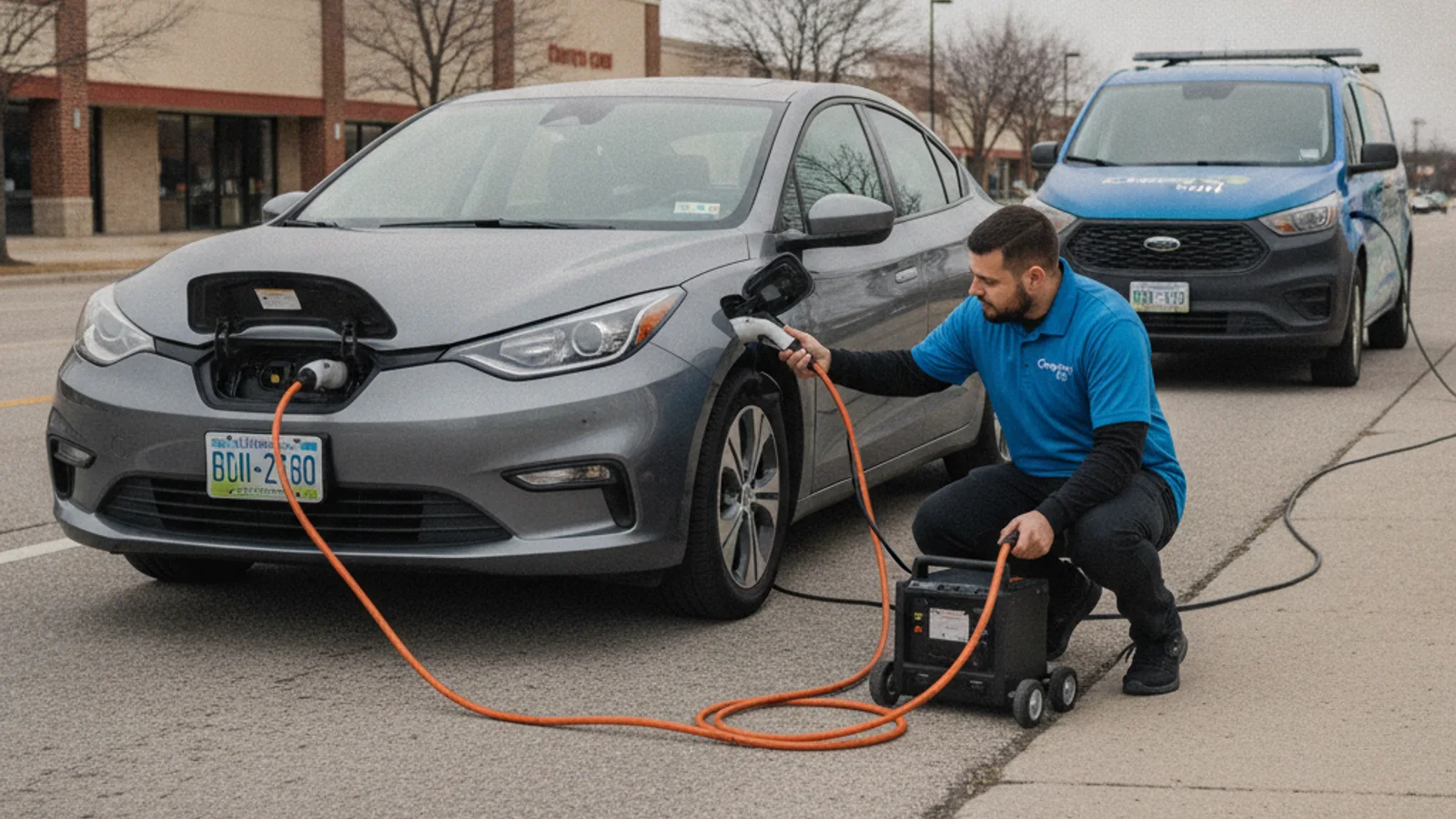
EV charging levels are the three ways an electric car takes power. Level 1 is a 120-volt household outlet. Level 2 is 240-volt AC. DC fast charging is the high-power public stall. If you’re stranded in Chicagoland with an empty pack, this is the level that matters. A 240-volt Level 2 boost is usually the roadside tool that fits. Independent operators we connect you with typically add 10 to 20 miles of range. That happens in 15 to 30 minutes of charging. That window is charging time only. It isn’t a clock on when someone arrives.
Charging levels as power, not as a brand
A charging level names an electrical class, not a network. It doesn’t promise a stall on your street. The DOE Alternative Fuels Data Center publishes the specs behind those labels. Your car still caps how much of that power it will take.
Start with the dash, not with a chart. An empty traction pack points toward charging or recovery. A car that won’t wake up often has a 12-volt problem instead.
Level 1, the 120-volt overnight trickle
Level 1 uses 120-volt AC from a standard household receptacle. Verified equipment in this class is listed at 1.9 kW. The connector is SAE J1772 on most non-Tesla cars. It adds about five miles of range per hour of charging. Eight hours can put roughly 40 miles into a midsize EV. Pack size, starting charge, and temperature all change the result. Use those figures to plan, and don’t treat them as a promise for your car.
A cord in the trunk doesn’t turn a random outlet into a rescue. You need a circuit that’s rated for the load, and you need to sit still for hours. That’s a driveway or garage call, not a curb call.
Housing age is the Chicagoland split you can actually verify. Cicero’s stock is 90.2% pre-1980, and Berwyn is 90.0%. Oak Park is 78.6%, and Chicago is 68.6%. Those older Cook County streets have plenty of 120-volt receptacles. A dedicated 240-volt EV circuit is still something you confirm at the panel.
Huntley, in McHenry County, is only 3.8% pre-1980. Naperville, in DuPage County, is 11.7%. Younger housing doesn’t prove a wall box is installed. It only means the panel may be a different generation. Confirm the circuit before you leave a car plugged in overnight.
Don’t treat an unfamiliar receptacle as approved just because the plug fits. Read the vehicle manual and match the cord to the outlet. Our guide to what a Level 1 charger is, and when it isn’t enough covers that home-versus-street fork.
Level 2, the 240-volt class roadside help uses
Level 2 uses 240-volt service at a house. Many commercial buildings use 208-volt instead. The verified power band runs from 2.9 kW to 19.2 kW. DOE lists 7.2 kW as the common residential figure, with about 25 miles of added range per charging hour. Connectors include J1772 and J3400, Tesla’s NACS name.
On the road, this is the class that matters for a stall. Mobile EV charging in Chicagoland is a 240-volt source brought to the car. Operators we send use a native NACS plug on Teslas. They use a CCS or J1772 adapter on other major EV brands.
The goal isn’t a full battery. It’s enough miles to reach a place you can sit and finish charging. A typical session adds 10 to 20 miles in 15 to 30 minutes of charging. Cold air, a large pack, or a slow-accepting car can land at the low end. No verified figure covers every make at every temperature.
Overnight Level 2 at home is a different job. That’s about filling the pack at the DOE 7.2 kW planning number. A street session is about getting you rolling again. Ask the operator to confirm method, connector, and expected output before you authorize the work. The operator quotes you and bills you directly. Charge Pro CHI doesn’t set that quote.
A mobile EV charging truck is this Level 2 idea on wheels. It isn’t a DC fast stall that follows you.
DC fast charging, high power you still have to reach
Drivers often call this Level 3. Verified equipment can deliver up to 500 kW. It may add about 100 to more than 200 miles in 30 minutes. CCS, CHAdeMO, and J3400 all show up on that connector list.
The car’s charge curve still rules, and so does pack temperature. DC fast hardware lives at fixed public and commercial sites. A 500 kW rating doesn’t put that stall on a shoulder in Joliet. It doesn’t follow you into Schaumburg either. If the pack is at zero, you still need miles to reach a stall. The other option is a boost where you sit.
Hunting a rapid charger versus calling for a boost is the real fork. A verified stall count for each Chicagoland city could not be confirmed. Check live status in the car and in the station host’s app. The host is the authority on whether a stall is up.
The plug has to match, whatever the level
J1772 is the AC plug on most non-Tesla Level 1 and Level 2 sessions. J3400 is Tesla’s NACS shape, and it also appears on the DC fast list. CCS pairs AC hardware with extra contacts for DC. CHAdeMO is another DC fast connector on some older models.
A plug that looks right still needs a check against the owner’s manual. Give the make, model, dash reading, and port when you call.
Empty pack, or the 12-volt that runs the brains
Charging levels only help if the high-voltage pack is what’s empty. Many no-starts are the small 12-volt battery. That battery wakes the computers, locks, and contactors. Operators we connect you with can jump a dead 12-volt on site, or replace it there. They handle Tesla and every major EV brand.
If the car is dark, start with the 12-volt. Stubborn doors or a low-voltage warning point there too. Don’t assume you need a Level 2 boost. Which battery type matters when you’re stranded is the split to run first.
If the traction pack is empty, a 240-volt session may fit. The car still has to accept the operator’s equipment. If the port won’t take the connector, or charging never starts, say that. Those signs don’t prove a single fault, but they do change the next step.
Where you sit changes what’s practical
Chicagoland spans Cook, Lake, DuPage, Kane, Will, and McHenry Counties. Chicago’s 2024 population estimate is 2,721,308. Libertyville’s ACS count is 20,493. The same charging-level chart applies in both.
A stall in a Naperville garage gives an operator room to work. A Cicero driveway can too. A car in a live travel lane does not. If the vehicle is a hazard, contact the authority that handles that roadway and follow their instructions. Don’t stand in moving traffic. Don’t drag charging gear across live lanes.
Mention a parking structure, a gate, or a blocked port when you call. The operator decides whether the 240-volt kit can set up where you are.
Charge Pro CHI doesn’t bring the electricity, and we don’t perform the charge. We connect stranded drivers with independent local operators who serve Chicagoland. You contract with the operator and pay them directly.
When moving the car may be the better next step
A charging-level chart can’t fix every stall. Mobile Level 2 may not fit if the operator can’t reach the port. It may not fit if the car refuses the session. It also may not fit if the position isn’t safe to work. DC fast’s 500 kW ceiling doesn’t rescue those scenes. That’s a maximum on equipment that isn’t here.
Transport can be the honest option in those cases. Don’t copy a tow method from a different model. Use the manufacturer’s manual, and confirm the method with the operator who’ll move it.
Our out-of-charge recovery path is for an empty pack that needs a next-step call. The matched operator says whether a boost, recovery, or a move fits. If a spec can’t be confirmed from the manual, ask the operator to check the vehicle docs.
For a wider local briefing, start with the Chicagoland EV charging hub.
When to call
A 240-volt boost may fit when the pack is empty. The car still has to take a charge, and the operator has to reach you. Ask for method, compatibility, scope, and the quote before you say yes. Charge Pro CHI doesn’t set quotes or warranties. Terms come from the independent operator. The pros we connect you with are licensed and insured. If charging isn’t the right tool, the operator can talk through recovery or transport. Call (858) 925-5546 and we’ll connect you with a local EV rescue operator.