An empty EV on Randall Road is a Fox Valley stall. Work it in order. First, make the scene as safe as you can. Then send a pin with a town, a heading, and a cross street. Copy the dash word for word. The operator can quote a 240V boost, a 12V jump, or a tow.
Why Randall Road catches EVs in winter
Randall Road is a long north-south run through the Fox Valley. It ties Kane County commute towns to McHenry County. This is an arterial with lights, retail, offices, and long stretches between stops. You’re not stuck on a quiet side street. Randall Road is not the Dan Ryan or the Jane Addams. A dead car in a turn lane is a different job than a freeway shoulder.
Aurora had a 2024 Census estimate of 180,710 people. Elgin sat at 114,701 on that same estimate. St. Charles, Geneva, and Batavia sit on the Fox River commute. Algonquin and Crystal Lake sit farther north in McHenry County. Randall Road is how a lot of that traffic actually moves.
Winter does the rest. A pack that felt fine in October can sag once cabin heat is on. Short hops between lights still spend energy. You planned a buffer, and the buffer is gone. That’s a Chicagoland winter pattern, not a personal failure.
This page does not invent a range-loss percent. Check your own trip history in the car’s app after you’re safe. Tesla owners can start with how a charge holds through a cold day here.
Treat the travel lane as the first problem
Your first decision is traffic, not kilowatts. If the car can still creep, a lot beats a live lane. If it’s already stopped in traffic, stay with what is safe. Don’t stage a last roll on a guess.
No verified Kane County or McHenry County shoulder rule turned up for this corridor. This article can’t tell you to stay inside, step out, or cross lanes. If the scene is dangerous, call 911. Follow the officer, firefighter, or road worker who arrives.
Report whether it can select drive, roll, steer, or release the parking brake. Don’t test those if the test would put someone in a lane.
Name the setting: traffic, shoulder, turn lane, or parking lot. Those are four different jobs. “Stopped on Randall” hides that difference.
If someone in uniform is already directing you, repeat their instructions to the operator. That can change whether a charge at this spot is even possible.
Pin the stall like a Fox Valley local
Name the town if you know it. Aurora, Elgin, and St. Charles are not the same stop. Add northbound or southbound. Read the nearest cross street off the sign, not from memory. Drop a live map pin. Screenshot the map so the route and the pin both show.
If the sign and the app disagree, send both. Don’t pick a winner. Operators can sort a conflict. They can’t sort a blank.
Say which curb you’re on. A pin on the right road can still send a van to the far curb. Mention a closed drive, a snow pile, or a car boxing you in.
Retail lots along this arterial often sit behind a throat or a light. Tell the operator how to enter. If you’re on private property, say whether you can admit them. Keep the live pin handy, and resend it if you roll.
Read the dash before you name the failure
A car that won’t go hasn’t told you which battery failed. Copy the text. Don’t upgrade it into a story.
Send the percent or the miles remaining, if the car still shows them. Send any out-of-energy wording. Send any low-voltage or 12V warning. Say whether the main screen is still alive. Say whether doors and the charge port still respond. Say what you were doing when it quit: driving, parked, or plugged in.
Empty pack versus a dead 12V
The 12V battery runs the computers that close the high-voltage contactors. A pack with range left can still sit dark behind a dead 12V. An empty traction pack can still show interior lights. Which EV battery matters when you’re stranded spells out that split.
Use the phone app if it still connects. Missing app data is not a diagnosis. Report the last update time. Screenshot warnings before they vanish.
Don’t open panels or take a jump from a gas truck on a hunch. The matched operator should confirm the vehicle and the method. Charge Pro CHI doesn’t inspect the car and doesn’t perform the work.
Share make, model, and year. Tesla, Ford, Hyundai, Chevy, and Rivian all show up on this run. Connector layout and 12V access differ by model. Operators we send can jump or replace a dead 12V on site. That only fits if the 12V is the actual fault.
What a local 240V boost can do
Mobile EV charging is one recovery path. It isn’t automatic. The operator has to see that the car can accept energy where it sits.
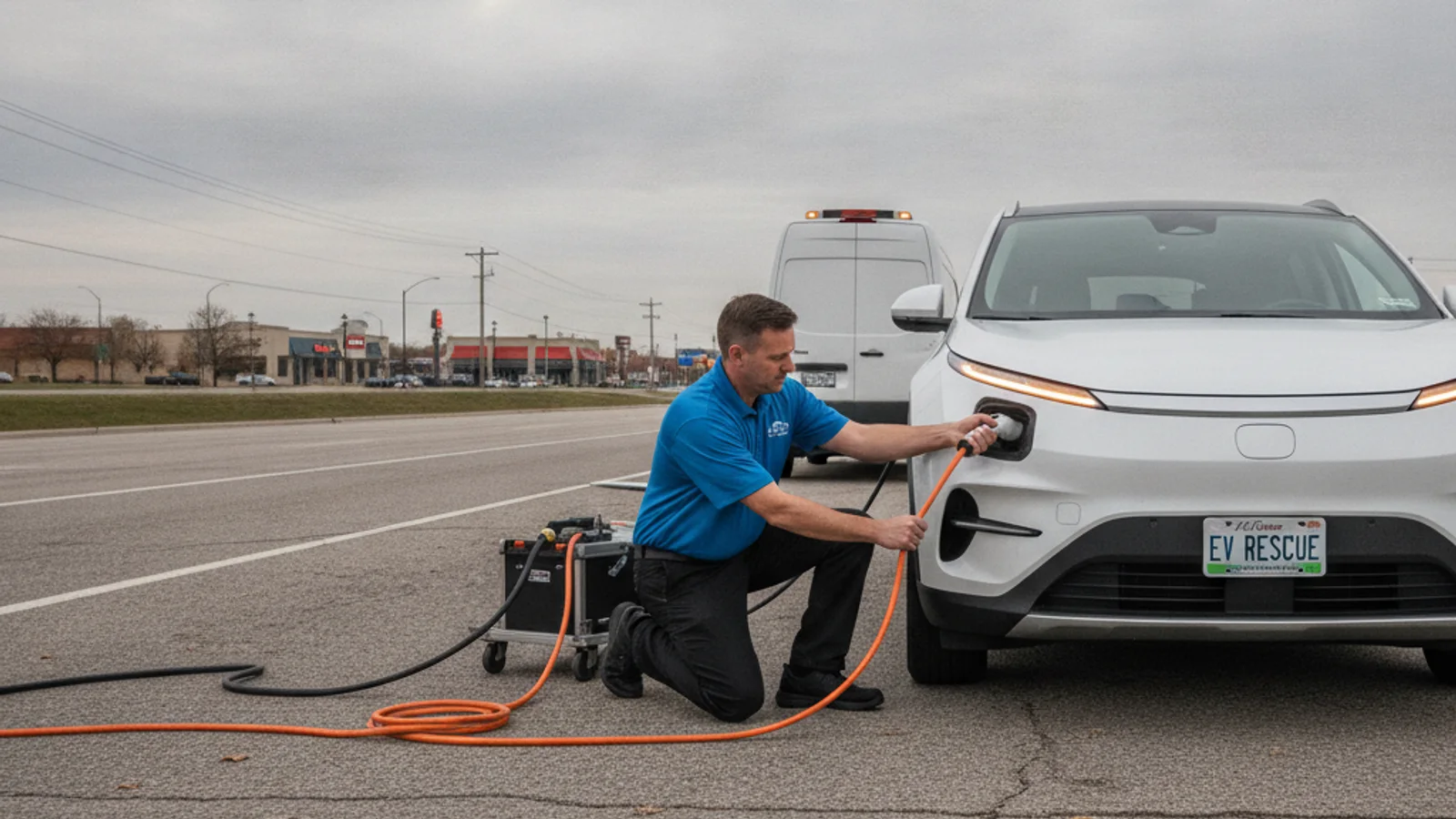
The operators we connect you with are licensed and insured independent pros. They bring a 240V Level 2 source to the car. Teslas use a native NACS plug. Non-Tesla EVs use a CCS or J1772 adapter. A typical charge adds about 10 to 20 miles of range. That takes 15 to 30 minutes of charging. That clock starts when the plug is in. It isn’t an arrival time.
Ten to twenty miles is a bridge, not a fill. Agree on the next destination before the session starts. Use the car’s map and a live charging app to pick a reachable plug. Confirm that site yourself. Research for this page did not verify a named public charger on Randall Road. This article will not invent one.
Ask the operator to confirm whether charging fits the symptoms. Ask whether their connector matches your inlet. Ask where the van or truck would stand. Ask what output they can provide at this stop. Ask whether transport is the cleaner option.
Get the price from the operator. Charge Pro CHI doesn’t set rates, own equipment, or run a yard. The operator quotes you, then bills you directly.
If charging isn’t right, out-of-charge recovery covers the wider path. That includes a conversation about a tow. Mobile charging versus a tow lays out that choice for this kind of stall.
Describe the last few feet of access
A correct pin still hides height bars, ice, and a jammed charge port. Say which side the port is on. Say whether a van can sit beside it without blocking a lane.
Mention gates, garages, parking-garage clearance, and other vehicles in the way. Don’t roll the EV just to make room. Hold still unless the operator or an officer asks you to roll.
Locked doors, a silent fob, a flat, or crash damage can block a charge. Say those things before someone is booked. A dead 12V can also keep the port door shut. Report that, and don’t pry it.
Winter slush in the inlet is worth mentioning. Water and freeze-up belong on the call. Don’t keep plugging into a port full of ice.
The U.S. Department of Energy charging guide covers levels and connector types. Read it if you want a primer while you wait.
When transport is the honest next step
A boost only works if the car can take energy where it sits. Crash damage or a second electrical fault can force a flatbed. A live-lane stop can do the same.
The transport provider should confirm the load method, destination, access, and price. Charge Pro CHI doesn’t set those terms and doesn’t tow you.
Don’t treat a nearby lot as a destination unless you can enter it. Don’t assume a workplace garage is open. Check before you agree.
Once you’re moving again, rebuild the winter buffer. Cabin heat and a cold pack spend range faster than a September evening. Precondition while plugged in at home when you can. That uses wall power instead of the pack.
When to call
Call when the EV has stopped on Randall Road. You need an independent local operator to quote the job. That quote may be on-site charging, a 12V jump or replacement, or a tow. Charge Pro CHI is a referral line. It holds no trade license, owns no trucks, and employs no technicians.
Call (858) 925-5546 and we’ll connect you with a local EV rescue operator.