A Tesla that won’t unlock in a Chicago airport lot is usually the 12-volt battery. Every Tesla still carries that smaller pack, apart from the traction battery.
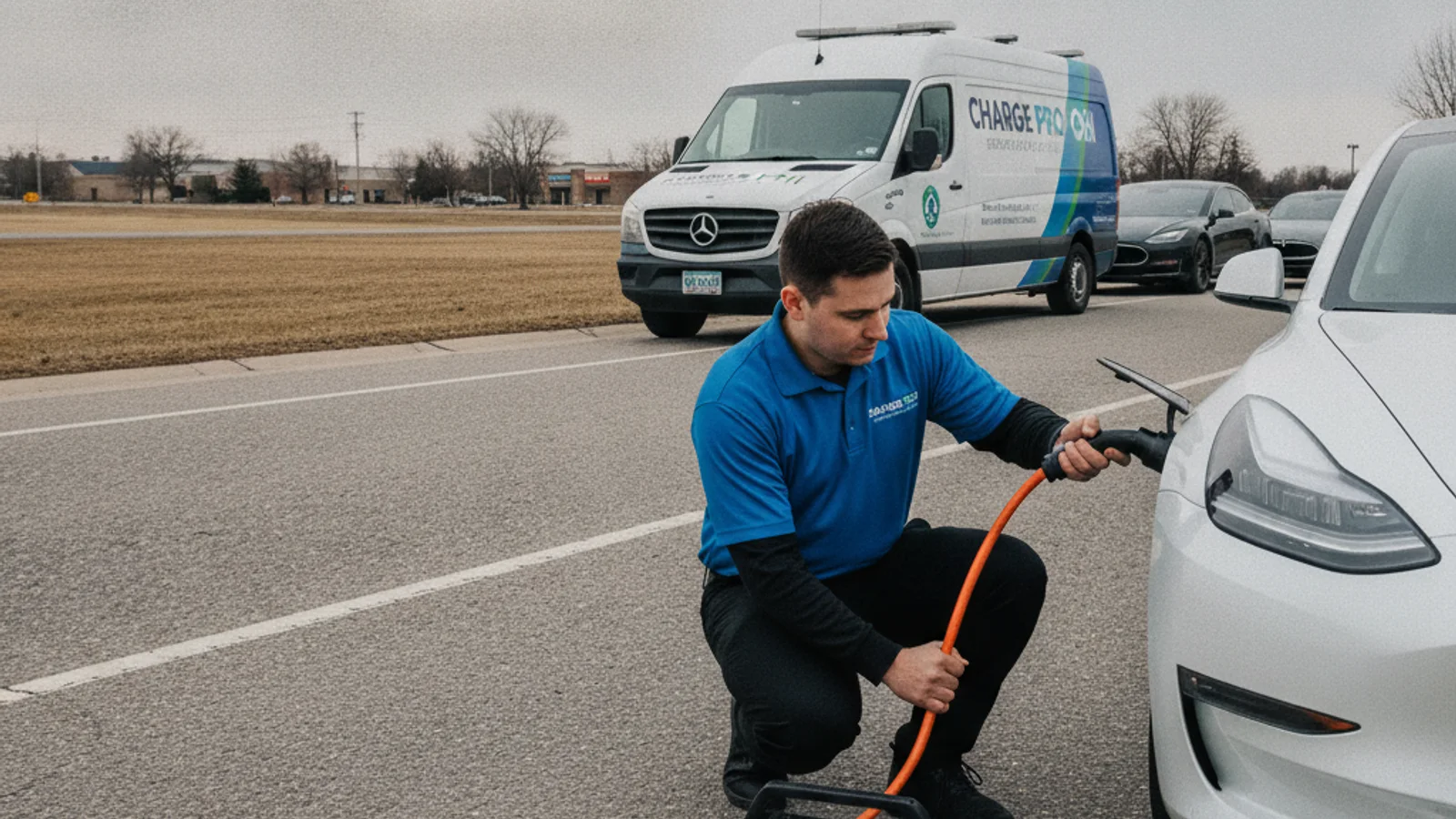
Every Tesla has two electrical systems
Yes. Every Tesla on the road has a 12-volt-class battery. It isn’t the pack that sets your range.
The traction battery moves the wheels. The 12-volt battery wakes the computers and cameras. It also powers the door handles and the contactors. Those contactors are the relays that connect the high-voltage pack. Without 12-volt power, they never close. The car stays inert.
That’s why a lockout after a long sit feels so strange. You last saw a healthy range number. Now nothing wakes. The traction pack can still be fine.
This layout isn’t a Tesla quirk. Nearly every production EV keeps a low-voltage battery beside the traction pack. The U.S. Department of Energy has an overview of how electric vehicles work. It describes this split without naming one brand’s parts.
Why airport-lot lockouts point at the 12-volt
O’Hare and Midway long-stay lots are a common setting for this call. The car sits for days. Sentry Mode, cabin cameras, and app checks keep drawing from the small battery. That happens while you’re gone.
When you return, the handles don’t present. The phone app can’t reach the car. It feels like a dead Tesla. It’s usually the 12-volt system that went first.
Chicago’s 2024 Census estimate is 2,721,308 people. Plenty of those trips start with a Tesla left in a paid lot. Cook County’s older housing adds a second version of the same sit. 68.6% of Chicago housing was built before 1980. Oak Park is at 78.6%. Cicero is at 90.2%. Street parking and tight older garages mean overnight sits with the car half-awake.
Newer suburbs don’t cancel the problem. Naperville’s pre-1980 share is only 11.7%. Huntley’s is 3.8%. Gurnee’s is 9.5%. Attached garages help at home. They don’t help a car you left at the airport.
Schaumburg’s 2024 estimate is 77,099. Office-park sits there are the shorter cousin of an airport sit. Evanston’s 2024 estimate is 76,006. A cold night on the street can leave the same dark car.
A failed 12-volt battery is a wake-up problem, not a plug-search problem. Don’t read this as a missing-charger story. A dark Tesla can’t wake to accept a charge.
What the 12-volt battery actually powers
The traction pack runs at several hundred volts. That’s the voltage the motors need. It isn’t what you want on latches, airbags, or the touchscreen.
Most of those parts are ordinary automotive electronics. They’re built for a 12-volt-class supply. Tesla, like other automakers, keeps high voltage behind contactors for that reason.
Closing those contactors takes low-voltage power. That’s the chicken-and-egg problem. The high-voltage pack can’t boot itself. A gas car solves a similar layering with a starter and an alternator.
While you’re driving or plugged in, a DC-DC converter steps the voltage down. It pulls that power from the traction pack. It keeps the 12-volt battery charged. Once the car is asleep, the small battery carries the background load alone.
That load includes the radios that talk to the Tesla app. It includes Sentry Mode if you left it on. A weak 12-volt battery can sag under that sit. The traction pack can still show range.
Cold makes the sag show up faster. Lead-acid 12-volt batteries lose punch in a Chicagoland winter. Lithium 12-volt packs fail for different reasons. Either chemistry can still leave you locked out.
Model S, 3, X, and Y don’t share one 12-volt design
Tesla has changed the low-voltage battery more than once. Chemistry moved. Physical location moved. The access path moved. Those changes don’t share one cutoff year. Model S, Model 3, Model X, and Model Y all drifted on their own timelines.
Some cars use a conventional lead-acid 12-volt battery. Others use a lithium 12-volt battery. They don’t age the same way. They don’t get serviced the same way. You can’t treat every Tesla 12-volt as the same part.
Location is the other trap. On some cars the battery sits where a driver might expect it. On others, reaching it means trim panels or working from under the car. That isn’t a job to invent from a video shot on a different year.
This guide won’t print a model-year chemistry chart. Tesla makes running changes mid-production. A table goes stale, then someone buys the wrong battery. Model 3 and Model Y lithium 12-volt packs have their own failure pattern. Use the lithium 12V walkthrough for that chemistry. The Model 3 pack location guide shows where that model keeps both batteries.
Your owner’s manual for that exact car is the first reference. Tesla’s current service documentation is the second. Both outrank a blog post, including this one.
If you’re not sure which chemistry you have, say that when you request help. A guess is worse than a blank.
Dark and silent versus awake and empty
A dead 12-volt battery and an empty traction pack don’t look alike. Telling them apart saves you the wrong kind of help.
When the 12-volt is gone, the car often stays fully asleep. No screen. No handles. No app connection. People describe it as a car that went to sleep and never woke. That’s the airport-lot lockout.
When the traction pack is empty, the car usually still wakes. The display still comes on. You get a range warning, not a brick. You may not drive. The car is still talking.
Use how to tell a dead 12V and jump it when the Tesla is silent. If you’re locked out, the lockout guide covers what happens on site.
A Tesla can sit through a Joliet workday, then a flight out of Chicago. That whole time it’s living on the small battery. Joliet’s 2024 Census estimate is 151,837. Aurora’s is 180,710. The electrical design doesn’t change by suburb. The sit time does.
Waukegan’s 2024 estimate is 88,570. Lake County commutes still use the same 12-volt hardware. The small battery still has to hold through a cold night.
Don’t copy a jump procedure from the wrong model
A driveway workaround for one year can be the wrong move on another. Lead-acid and lithium 12-volt packs aren’t jumped as if they were identical.
Don’t let a gas-car jump video set the steps. Don’t pull covers from a forum post about an older Model 3. Confirm the model, year, and trim first.
The matched operator should do the same. Charge Pro CHI connects Chicagoland drivers with independent local operators. We don’t hold a trade license. We don’t own trucks or a yard. We don’t employ technicians. The operator quotes you before starting and bills you directly.
Tesla 12V battery jump service is the usual match when the car is dark. Tesla roadside rescue is the wider call if the traction pack is low too. Operators bring a 240-volt Level 2 source to the car. They use a native NACS plug. CCS or J1772 adapters cover non-Tesla EVs. Typical charging time is 15 to 30 minutes. That usually adds 10 to 20 miles of range. That’s charging time, never an arrival time.
They can also jump or replace a dead 12-volt battery on site. The pros we connect you with are licensed and insured. They confirm your car’s low-voltage layout before they touch it.
A jump can wake the car. It may not fix a battery that’s at the end of its life. If the car goes dark again, that’s a replacement talk with the operator.
For charging context around the city, use the Chicago EV charging page. A dark car still needs the 12-volt restored before a plug does anything.
We serve Chicagoland. That includes Chicago, Evanston, Naperville, Schaumburg, and the other cities on this network.
When this is the call to make
Call when the Tesla is dark, even if the last range reading looked fine. That mismatch usually points at the 12-volt system, not an empty pack.
Call Charge Pro CHI at (858) 925-5546. We’ll connect you with a local operator who handles Tesla and every major EV brand. They quote before they start. They don’t speak for our line on price or timing.