A wall box that trips the house breaker every session is not a random glitch. In much of Chicagoland, the house is the reason. Most homes in Chicago, Oak Park, Cicero, and Berwyn predate 1980. Those panels were not built for hours of Level 2 draw. The breaker is doing its job. Read the trip pattern. Stay out of the panel. A roadside 240V boost can still move the car. A licensed electrician handles the circuit.
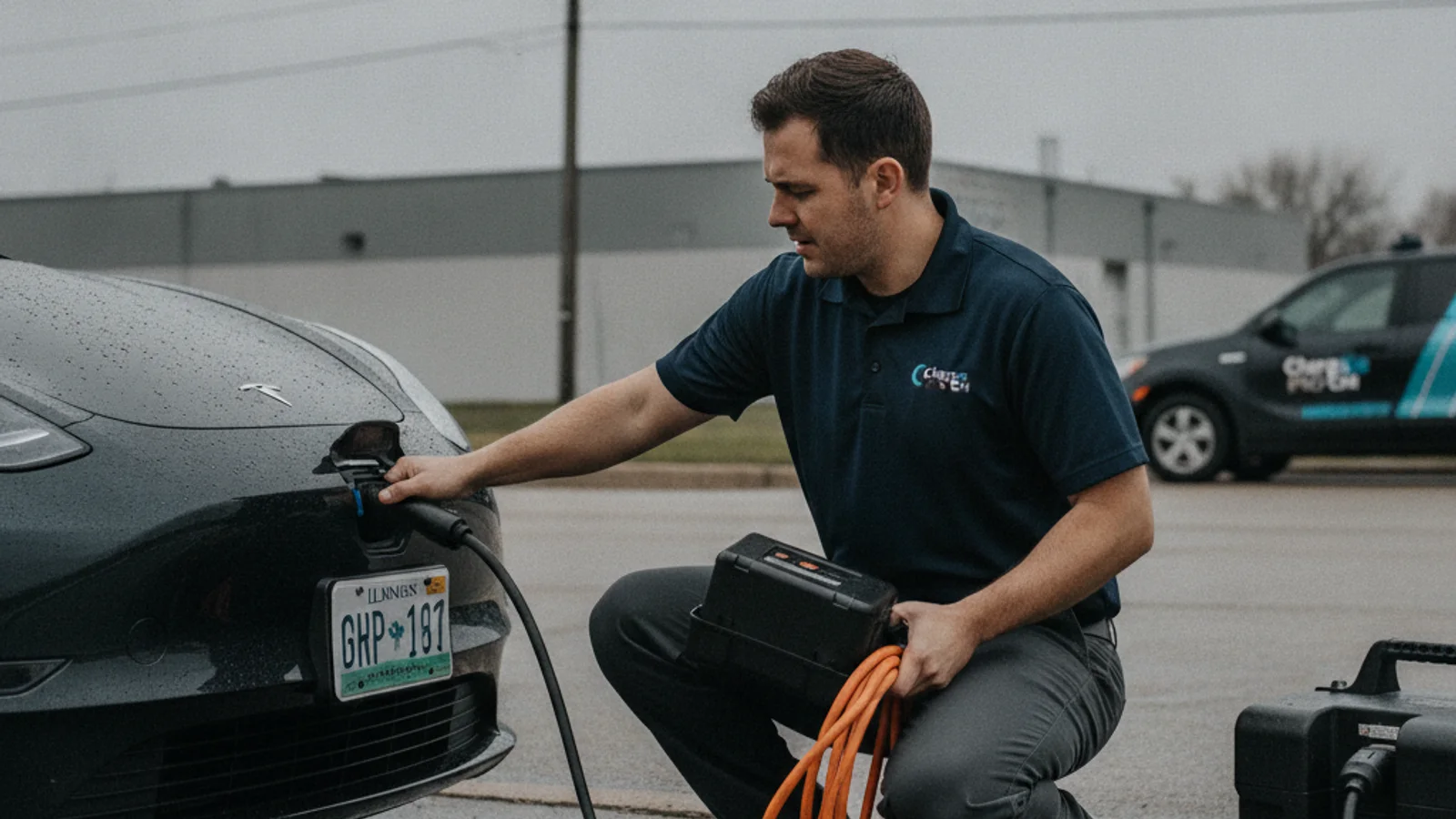
This is house wiring, not a job for a mobile boost
Charge Pro CHI is a referral line. We match stranded drivers with independent mobile rescue operators. We don’t pull permits. We don’t open panels. We don’t install wall boxes. Operators we connect you with bring a 240V Level 2 source. They typically add 10 to 20 miles of range. That takes 15 to 30 minutes of charging. That’s charging time, never an arrival time. The operator quotes you before starting. The operator bills you directly. For the breaker, you want a licensed electrician.
Why pre-1980 houses trip a wall box
Level 2 charging is a long, steady load. A dryer cycles on and off. A wall box does not. Older service was sized for lights, a range, and maybe a window unit. It was not sized for a garage circuit that sits high for hours.
Census ACS 2019-2023 figures, read 2026-09-18, make the split obvious. In Cicero, 90.2% of housing is pre-1980. Berwyn is 90.0%. Evergreen Park is 87.7%. Oak Park is 78.6%. Wilmette and Chicago Heights both sit at 74.3%. Skokie is 72.0%. Evanston is 71.2%. Chicago is 68.6%. Park Ridge is 67.1%. Homewood is 66.5%. Highland Park, in Lake County, is 60.6%. That’s a lot of older Cook County housing on original or lightly updated service. A new wall box on that panel is where breakers start opening.
Newer tracts look different. Huntley, in McHenry County, is only 3.8% pre-1980. Plainfield is 6.7%. New Lenox is 7.9%. Gurnee is 9.5%. Algonquin is 10.1%. Naperville is 11.7%. Orland Park is 11.8%. Bolingbrook is 12.3%. Carol Stream is 14.2%. Schaumburg is 15.9%. It isn’t a promise. A shared garage circuit in a newer house will still trip.
If you live in Cicero or Oak Park, tell the electrician the house age. Our Cicero home-charging guide covers houses that struggle to take a wall box.
What the trip timing usually means
Don’t treat every trip as one fault. The clock on the trip is the clue.
It opens the moment you plug in
That’s often a ground fault, a wet receptacle, or a damaged EVSE. Moisture in an outdoor NEMA 14-50 can make protection open on purpose. So can water in the cable plug. Dry the outlet and the connector before you try again. If a dry plug still trips, stop.
It holds, then opens after a stretch of charging
That’s the overloaded-circuit pattern. Shared garage circuits do this a lot. A freezer, heater, or second EV on the same run will stack load. The usual fix is a dedicated circuit sized for that charger. That’s licensed electrical work. It isn’t a tighter breaker.
It only trips when something else is on
Write down what else was running. Combined load is the story. An electrician can isolate the charger. Leave the panel cover on.
It only happens outside after rain or snowmelt
Water in the box is enough. Uncovered backyard receptacles take spray and slush. If the trip returns on a dry day, call an electrician.
Your cable trips, and another unit doesn’t
Then the house circuit may be fine. Wall units and portable cables fail. An internal fault can open the breaker every time it delivers power. If you’ve already reset twice, leave the breaker off.
Two ground-fault systems on one run
Many Level 2 units already watch for ground faults inside the box. Some homes also have a GFCI breaker or receptacle on that same run. Two devices on one circuit can nuisance-trip. EVSEs send a small test current to earth to confirm a ground path. An external GFCI can read that trickle as a leak. That’s a known equipment interaction. Electricians often hardwire the station instead of using a plug-in GFCI. What your city requires was not confirmed in our research. Ask the electrician who sees the panel. Confirm permit rules with your city or county building department before anyone starts.
A quick pattern chart
| Pattern | Likely cause | Who handles it |
|---|---|---|
| Opens at plug-in, every session | Ground fault, moisture, or a bad EVSE | Electrician, or test a different EVSE once |
| Opens after a stretch of charging | Undersized or overloaded circuit | Electrician |
| Opens only with other loads on | Shared circuit | Electrician |
| Opens outdoors after rain or melt | Wet outlet or connector | Dry it, then electrician if it repeats |
| Opens with your cable, not another unit | Faulty EVSE or cable | Maker support or a replacement unit |
What you can check without opening the panel
Reset once. Watch what happens. If it trips again, leave it off.
Look at the outlet face and the cable plug. Corrosion, standing water, and cracked housings are stop signs.
Note how long it ran. Immediate, a few minutes, or a longer stretch: write it down.
Note other loads on that run. A shared garage is a different job than a dedicated circuit.
Don’t keep flipping the same breaker. It’s opening for a reason. Repeated resets can hide heat that gets worse.
Don’t pull the panel cover. Don’t retighten lugs. Don’t swap the breaker to see if it’s weak.
Keep the car moving while the house gets sorted
The electrical work runs on the electrician’s calendar. Older Cook County stock may need a new dedicated run. We could not confirm fees, amp ratings, or permit rules for any city here. Your electrician sets the scope. Your city or county building department sets the permit. We could not confirm which utility publishes EV service rules for each suburb. Read the name on your bill. Call that utility and ask before anyone orders a panel change.
You still need miles in the meantime. That’s the gap mobile EV charging fills. An operator brings 240V to the driveway, the curb, or the lot. They don’t land a new circuit in your house. If a wall box in Aurora has already failed, the same idea applies. Get the car off empty. Fix the house on its own timeline. Read when an Aurora home charger fails. Compare home 240-volt charging and a mobile boost. Start with 240-volt EV charging at home versus a mobile boost.
Tell the electrician the house age and the trip timing. We serve Chicagoland. If your city is on the Chicago-area hub, the rescue idea stays the same. Operators bring 240V to the car. They quote before they start. They don’t work on your panel.
Frequently asked questions
Is it unsafe to keep resetting a breaker that trips on the charger?
Yes. A breaker that keeps opening is protecting the circuit. Overload, moisture, and ground faults are all real conditions. If it trips more than once or twice, leave it off. Call a licensed electrician for the circuit.
Can a bad EV charging cable trip the house breaker?
Yes. A fault inside the cable or EVSE can open the breaker on every session. That can happen on a correctly sized circuit. A different charger on the same outlet helps you tell equipment from wiring.
Does Charge Pro CHI install or repair home EV chargers?
No. Charge Pro CHI is a referral line for mobile rescue. We don’t wire circuits, install chargers, or pull permits. For a breaker or wiring problem, you need a licensed electrician. The operators we connect you with can still add range at the car.
Call Charge Pro CHI at (858) 925-5546 if the car is stuck and the wall box is down. An operator quotes you before any charging starts.