Allstate roadside assistance for EVs will jump a dead 12V and tow an empty pack. It doesn’t put range into the traction battery where you stalled. If you’re an Allstate member in Chicagoland, that’s the split that matters.
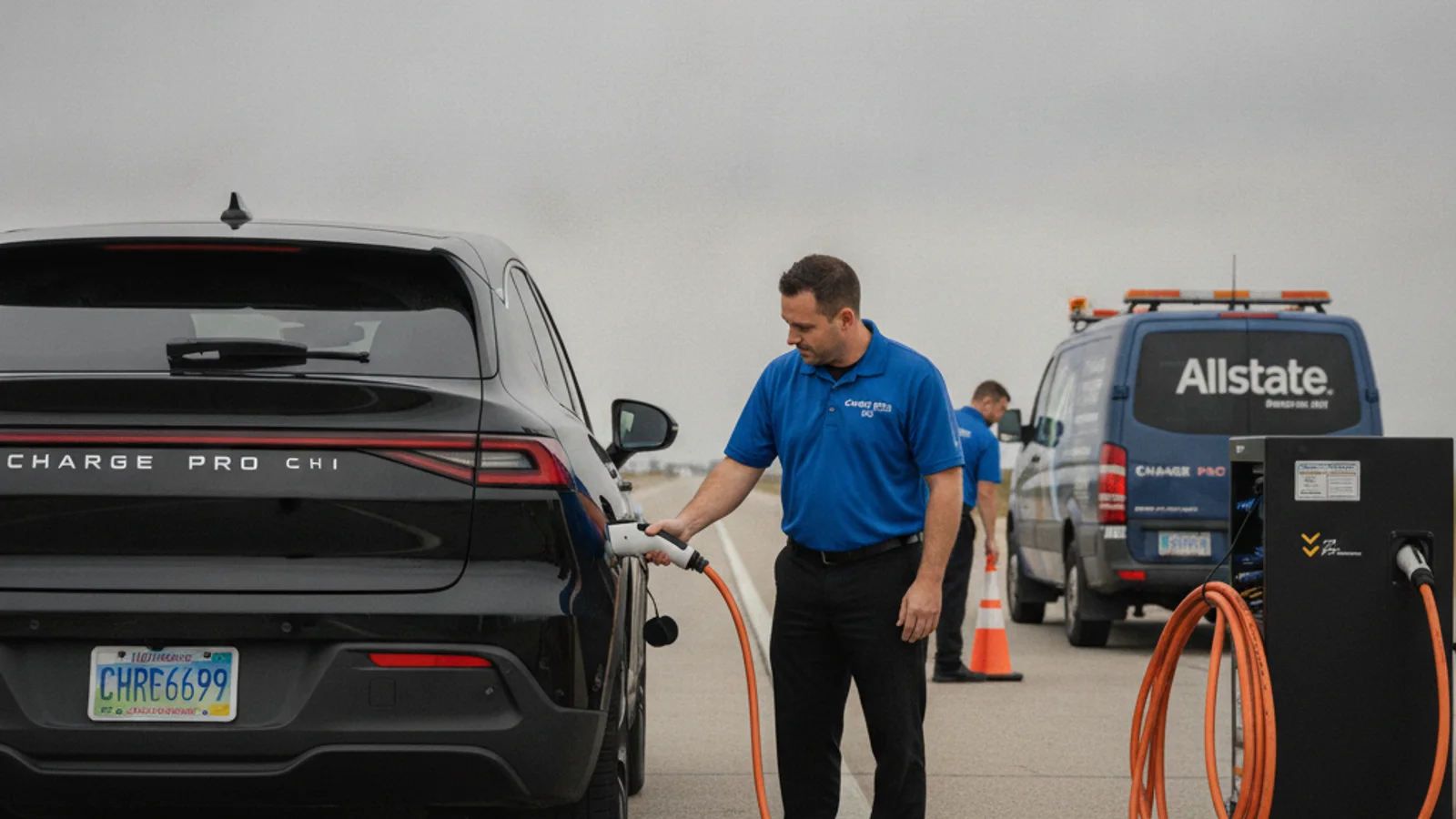
Two stalls, two Allstate outcomes
Your EV can fail in two ways that look the same from the curb. The screens stay dark and the doors may not wake. You still can’t merge back into traffic on the Kennedy.
One failure is the small 12V battery. It runs the computers, the locks, and the cabin screens. Our guide on whether roadside help can jump an EV walks that path. Allstate’s roadside add-on treats this like a gas car. Allstate Motor Club sends a contracted provider to try a jump on site.
The other failure is an empty high-voltage pack. The car itself is sound, just out of usable range. Allstate’s standard roadside benefit doesn’t carry portable charging gear. The next step is a tow to a shop or a plug. The tow moves the car toward power, not power toward the car.
That’s the coverage pattern Illinois members should expect. Confirm every line on your own declarations page. Tiers differ, and Allstate can change the printed wording.
What the Motor Club actually sends
Allstate sells roadside as an add-on through Allstate Motor Club. You still get tire changes, lockouts, fuel delivery, jumps, and tows. Fuel delivery does nothing for an EV pack. A jump does nothing for an empty traction battery.
The truck that arrives is a contracted provider, not an Allstate charger van. Ask the dispatcher whether they’re sending a jump, a flatbed, or both. Most EVs need a flatbed so the drive motors stay off the pavement. Say the word flatbed out loud on that call. Don’t assume the first truck is the right one.
Check your own towing limit before you stall
Allstate offers more than one roadside tier on auto policies. Towing distance and any per-tow cap change with that tier. No figure on this page would match every Cook County or DuPage policy. Open your documents and read the roadside schedule. Then call Allstate and ask two direct questions. Ask what towing distance your tier covers. Ask whether a separate cap applies per tow.
Get those answers at home in Oak Park or Wheaton. The shoulder of the Reagan Tollway is a poor place to learn the limit.
A tow still leaves you sitting for a charge
A clean tow doesn’t refill the pack on its own. You still wait at the drop while the car takes power. If the first open stall’s a slower Level 2 post, that session runs long. Dispatch, the ride, and the charge stack together. A problem that’s only about energy turns into a long wait.
That sequence is laid out in the hidden costs of towing a dead EV. The pattern holds for Allstate the same way it holds for other carriers. Geico’s EV roadside page shows the same jump-or-tow split.
Chicago’s housing stock shapes where the stall happens. About 68.6% of Chicago homes were built before 1980. Oak Park sits older, at 78.6% pre-1980 stock. Cicero and Berwyn both sit above 90% pre-1980 housing. Those blocks mean tight street parking, alleys, and shared lots. A flatbed needs swing room that a mobile EV charge often doesn’t need.
Housing in the newer west suburbs reads differently. The ACS puts Naperville’s pre-1980 housing share at 11.7%. The ACS puts Plainfield’s pre-1980 housing share at 6.7%. The ACS puts Schaumburg’s pre-1980 housing share at 15.9%. Driveways and office parks along I-90 are common stall sites there. Allstate can still only jump or tow. You still need an operator quote for a roadside boost.
Your policy may cover the miles of the tow. The wait after the drop’s still your afternoon. The operator quotes the boost before any cable goes in.
What a mobile boost does on the same block
Charge Pro CHI is a referral line, not a tow shop. We match stranded drivers with independent local operators. Those operators bring a 240V Level 2 source to the car. Teslas take a native NACS plug from that source. Other brands use a CCS or J1772 adapter. A typical session adds 10 to 20 miles of range. That takes 15 to 30 minutes of charging. That window is charging time, never an arrival time.
The operator quotes the job before work starts. The operator then bills you directly for that work. You leave on the miles you just took on. You skip the flatbed, the drop, and the second wait.
That call fits an empty pack on Lower Wacker. It also fits a stall on the Dan Ryan or in Gurnee. A dead 12V is another fit for the same call. The same operators can jump or replace that battery on site. They handle Tesla and every major EV brand.
See our AAA versus mobile charge guide for the same split.
Keep Allstate for the jobs it already handles
Keep the Allstate add-on on the policy. It’s the right call for a flat or a lockout. Use it when the EV’s damaged, not empty. Save the operator quote for a car that only needs energy. A Northbrook commute or a Joliet run doesn’t force a permanent pick.
If the pack’s empty anywhere we serve, start with out-of-charge recovery. You can also call Charge Pro CHI at (858) 925-5546. You’ll get an operator quote before anything starts.
Frequently asked questions
Does Allstate roadside assistance charge an EV on site?
No, the standard benefit doesn’t charge an EV on site. An empty pack is a tow to a place you can plug in.
Who shows up when I call Allstate for an EV?
Allstate Motor Club dispatches a contracted provider to you. It’s the same network used for gas vehicles.
Do I still need an operator quote if I have Allstate?
Yes, when the real need’s a roadside charge. Your policy may cover the tow itself. It doesn’t put miles into the pack where you sit.