After a freeze in Chicagoland, an EV often won’t start. That’s usually the 12V battery, not the pack. A local operator can often jump that small battery. Jumper cables can’t refill an empty traction pack. Tell the operator what the car showed last.
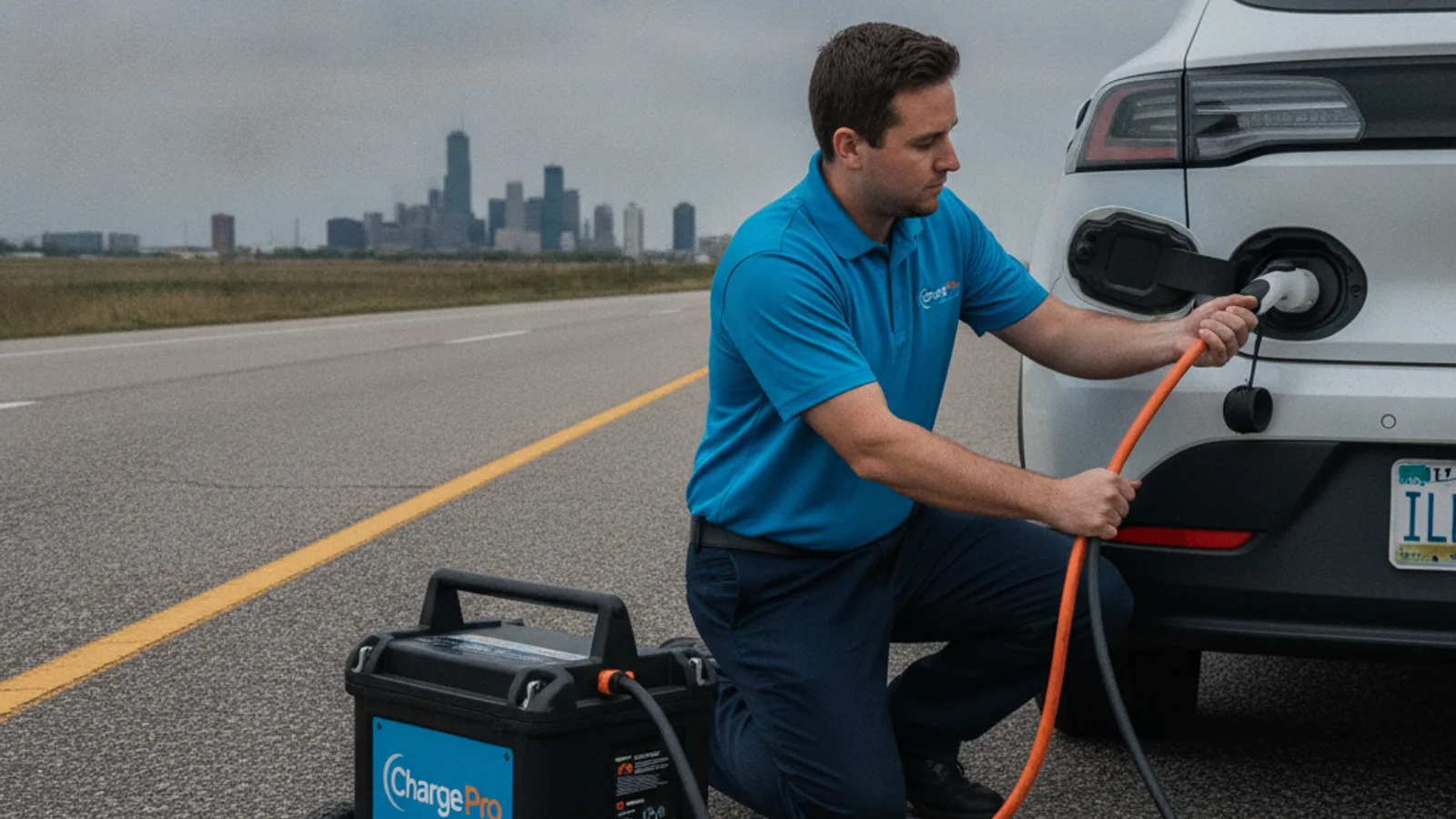
After a freeze here, it’s usually the 12V
People search “can you jump start an EV” after a dark dash. That’s the right question to bring to an operator. The useful answer is which battery actually quit.
Your EV still has two separate energy stores. The high-voltage pack is what moves the car. The 12V battery wakes computers, locks, and contactors. A freeze here hits that small battery first. The traction pack can still hold driving miles.
That’s the usual morning stall after a freeze. You parked last night with a healthy charge. By dawn the cabin screens stay fully blank. Drive won’t engage when you try to start. Locks may act odd, or the fob goes ignored. That’s a 12V jump, not a pack fill.
Older Cook County housing makes the overnight sit harsher. Oak Park’s ACS data shows 78.6 percent of homes built before 1980. Evanston sits at 71.2 percent pre-1980 housing. Cicero and Berwyn both sit near 90 percent. Cars there often rest in tight attached garages. The 12V spends the whole night in the cold.
Newer towns to the west don’t change the diagnosis. Huntley’s pre-1980 housing share is 3.8 percent. Plainfield’s pre-1980 share is 6.7 percent. Naperville’s pre-1980 share is 11.7 percent. Detached garages and driveways only help a little. They still don’t save a weak 12V battery.
The Kennedy, the Dan Ryan, and Lower Wacker see the same split. Cook, Lake, DuPage, Kane, Will, and McHenry all get this freeze. County lines don’t change which battery actually failed.
How a 12V fail looks versus an empty pack
Don’t stop the call at “the car is dead.” That phrase covers two very different jobs.
A 12V fail has a look you can report. The display stays dark, or else it flickers. The car often doesn’t see the key fob. You can’t shift the car into drive at all. You still had range on the screen last night. You weren’t hunting a charger the night before. See what happens when an EV’s 12-volt battery dies for the signs.
An empty pack looks like the opposite case. The car still wakes and shows a display. The display shows little or no driving range. You already knew you were running low on miles. You were already looking for a public plug. That’s a charge request, not a jump request. A 12V jump won’t put those miles back.
Every major EV here still uses a 12V or similar battery. Tesla, Ford, Chevy, Hyundai, Kia, Rivian, BMW, and Audi all do. The 12V access points change by model and year. The operator should confirm the exact car first. Tesla owners can use pack versus 12V. That page still doesn’t replace the owner’s manual.
If you aren’t sure which battery failed, say so. Don’t guess just to speed up the call. The wrong label can send the wrong equipment.
What to tell the operator
Four facts matter more than the word jump. Give the full make, model, and model year. Read each warning text exactly as it’s printed. Report the last charge percent you actually saw. Name the exact place where the car sits.
Saying Tesla in Chicago is too thin to dispatch. Try 2021 Model Y on Lower Wacker instead. Add screens dark and the last percent you saw. A 2023 Ioniq 5 in a Schaumburg garage is usable too. So is a Bolt in a Berwyn alley after the freeze.
Don’t paraphrase an alert as a dead battery. Read that alert back to them word for word. If several warnings stacked up, report each one. If the screen is black, say that plainly.
Then describe what the actual start attempt does. Nothing may light up on the dash at all. The car may not see the key fob. It may refuse to go into drive altogether. Those are observations, not a full diagnosis yet. The independent operator still has to look on site.
Location needs a street, a garage, or an expressway marker. Chicagoland isn’t one single dispatch zone for operators. A stall on the Eisenhower in Downers Grove is one job. A stall on Randall Road in Elgin is another. A stall on the Jane Addams isn’t I-55. Saying the suburbs doesn’t get anyone to the car.
Also say how and where the car is sitting. A gated deck downtown isn’t a driveway in Glen Ellyn. A curb spot in Cicero isn’t an open lot in Gurnee. A low garage in Oak Park can block a van. Street parking in Evergreen Park can limit where a truck stands. Mention gates, ramps, height bars, and live traffic.
If it’s a Tesla 12V, start at Tesla 12V battery jump. Other brands still get a model check first. Use how to jump start an electric car in winter for clip-on order. Follow your manual if the two sources disagree. Don’t copy a procedure written for another car.
When a jump is the wrong ask
A 12V jump can’t refill the traction pack. If the display was already at zero, ask for a charge. Don’t ask for jumper cables in that case.
The operators we connect you with can bring 240V Level 2 to the car. Teslas use a native NACS plug on site. Other EVs use a CCS or J1772 adapter. That visit typically adds 10 to 20 miles of range. Charging time is usually 15 to 30 minutes. That’s time on the plug, never an arrival time. Mobile EV charging explains what actually shows up.
A jump may also not fit the warning. Collision damage, smoke, heat, or a burning smell change the job. Tell the operator those facts in plain words. Don’t turn those facts into your own diagnosis.
Tight access can stop a jump as well. Some 12V posts sit where a van can’t reach. Some cars sit behind a locked gate or arm. Some highway shoulders aren’t a safe workplace here. The operator has to say if they can take it.
Jump, charge, or tow is a site-and-vehicle call. Our charge, jump, or tow guide maps the branches. Charge Pro CHI doesn’t pick that service branch. The matched operator still reviews the car on site. They quote you before any of the work starts. You pay that operator directly for the work.
How Charge Pro CHI connects you
Charge Pro CHI is a referral line for Chicagoland. We match stranded EV drivers with independent local operators. The pros we connect you with are licensed and insured. We don’t jump batteries, charge packs, or tow. We own no trucks and no rescue equipment. We hold no contractor license for this work. We set no prices for the operator’s visit.
You call us with the stall details first. We pass that request to an independent operator. That operator may treat it as a 12V jump. They may talk through a Level 2 boost. They may say the car needs a flatbed.
You’ll contract with that operator, not with us. Ask them to explain the planned work first. Confirm what they’ll do on site with you. If your manual doesn’t support a roadside jump, they should say so.
Keep the owner’s manual in reach if you can. Model-year changes matter on a 12V job. A newer Tesla with a lithium 12V isn’t an older lead-acid unit. Pages on this site don’t override the booklet in the glovebox.
EV roadside assistance is the page for this no-start. Use it when you need a local operator after a freeze.
If the car won’t wake this morning
Call when the EV won’t start and you need a mobile operator. They’ll sort jump, charge, or tow on site. Have the model, the alert, the last charge, and the exact spot ready.
Call (858) 925-5546 and we’ll connect you with a local EV rescue operator. They quote you before they start any work. They bill you directly for the visit itself.