A Cadillac Escalade IQ won’t start after overnight street parking for a simple reason. The 12V died. The traction pack is almost always still fine.
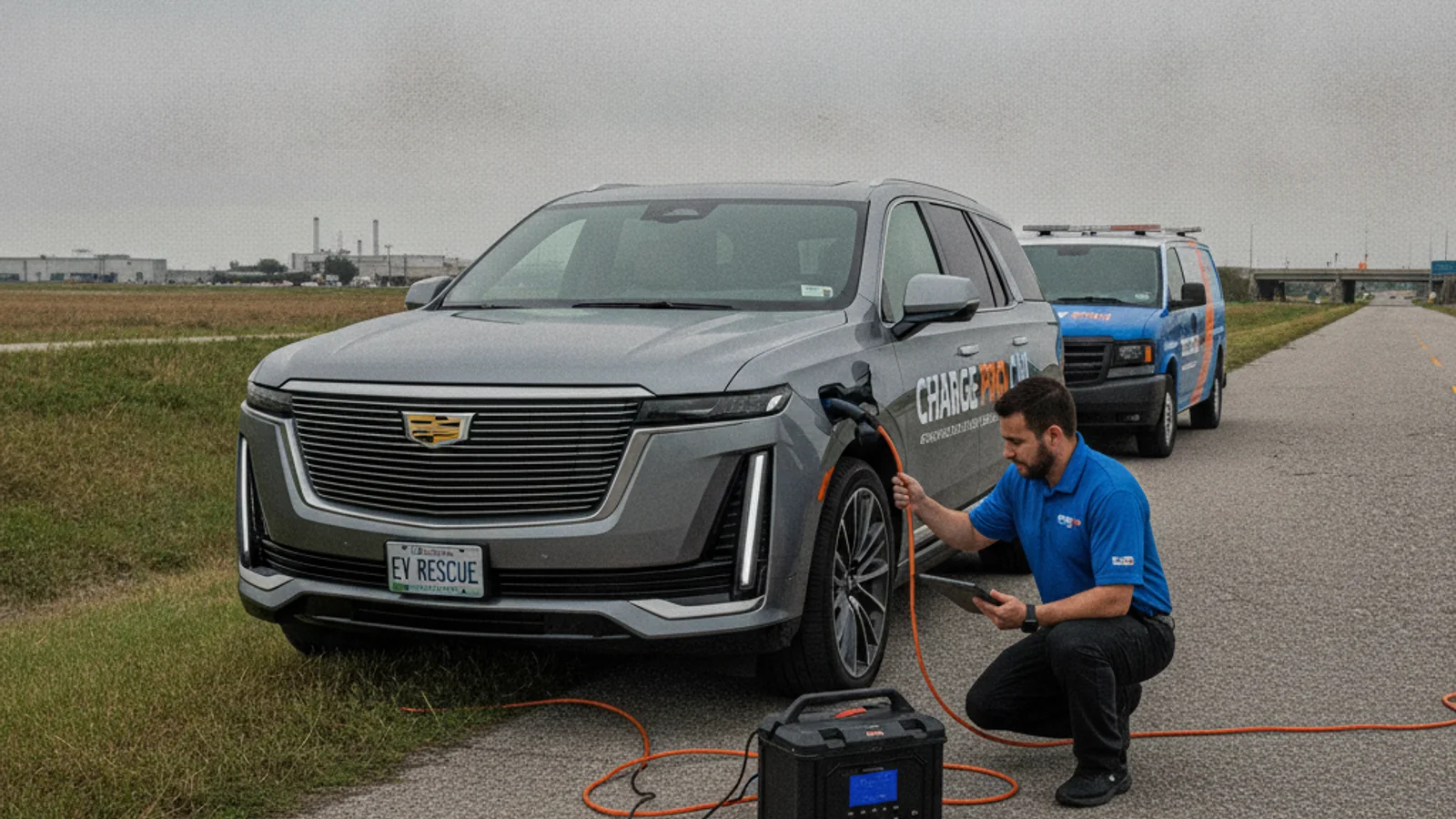
Start with the 12V, not the giant pack
The Escalade IQ is a full-size EV with a huge Ultium pack. Long-range trims are rated around 450 miles. The electrical system is 800 volts. DC fast charging is built for up to 350 kW. None of that matters if the accessory battery is flat.
The 12V wakes every computer in the SUV. Those computers close the contactors that connect the main pack. No 12V means no contactors and no start. The truck sits dark even when the pack is full.
Gas Escalade owners know a weak battery as a slow crank. This one goes silent. No crank, no click, no dash. It looks like a failed truck. It usually isn’t.
Why overnight street parking knocks it out
Chicago has about 2.7 million people. Roughly 68.6% of city housing was built before 1980. A lot of those buildings have no garage. An Escalade IQ doesn’t fit a tight alley stall. It spends the night at the curb.
Cabin cameras, the phone app, and locks keep drawing from the 12V. A healthy cell handles eight or ten hours of that. An aging one doesn’t. Winter nights in Chicagoland make a weak 12V fail sooner than a mild night. The chemistry doesn’t like the cold. The truck still looks fine when you park it. By morning the fob is silent.
Evanston and Skokie follow a similar pattern. About 71.2% of Evanston housing predates 1980, and Skokie is about 72.0%. Street parking and older lots are normal there. The SUV sits, the 12V sags, and you come out to nothing.
The North Shore looks different on paper. Northbrook, Glenview, Wilmette, and Highland Park have more driveway and garage space. The Escalade IQ is a fit in those towns. It still sits for days between school runs and weekend trips. A parked luxury EV with always-on features drains the 12V, garage or not.
Schaumburg office parks add a weekday version. The truck arrives at work and sits until evening. Long idle plus a weak 12V looks like a no-start. That’s what you find when you walk back.
A five-step check before you call a flatbed
Work through these in order. Stop when the truck wakes.
1. Separate a dead 12V from an empty pack. If the dash lights and range reads near zero, the pack is empty. That’s a boost job. A mobile EV charge typically adds 10 to 20 miles. That happens in 15 to 30 minutes of charging. That is charging time. It isn’t an arrival time. If the dash is black and the fob is dead, stay on the 12V path.
2. Rule out the fob battery. Swap the coin cell in the key if you have a spare. A dead fob can mimic a dead truck. If the interior still doesn’t respond from the door pad, it isn’t the fob.
3. Listen and look. No dome light, no locks, no powered eTrunk: the 12V is likely fully flat. Doors unlock but the start button does nothing: the 12V is low, not gone. A screen that boots then dies often needs a 12V power cycle.
4. Open the eTrunk the hard way if you have to. Cadillac’s front trunk is the eTrunk, about 12 cubic feet under the hood. Many trims use a powered hood. That hood needs 12V to open. If it’s fully dead, use the manual eTrunk release in the owner’s manual. Don’t assume a tow is the next step.
5. Jump the marked posts, not the battery. GM’s Ultium trucks use a marked positive post and a nearby chassis ground. Confirm the exact spots for your model year in the manual. Connect a lithium jump pack. Wait 60 to 90 seconds. Then press start. Give the modules time to come up.
If the dash comes up and then shows a high-voltage service warning, stop jumping. That’s a dealer scan, not another boost.
| What you see | Likely cause |
|---|---|
| Fob dead, no dome light, eTrunk stays shut | 12V fully flat |
| Doors unlock, start button does nothing | 12V low. A jump often wakes it. |
| Screen boots, then dies, then repeats | Modules need a 12V power cycle |
| Dash is fine, range near zero | Empty pack. You need a boost. |
| Starts, then a high-voltage service warning | Ultium fault. Needs a dealer scan. |
This Cadillac is closer to a Hummer than a Lyriq
The Escalade IQ uses GM Ultium battery tech. It doesn’t share the Lyriq’s platform. It rides on BT1, the full-size truck and SUV architecture. That’s the same family as the GMC Hummer EV and the Chevy Silverado EV.
The Lyriq sits on BEV3 with the Chevy Blazer EV. Chemistry and 12V logic are similar across Ultium. The physical layout is not. Jump points and the eTrunk line up with the truck side. So does the ride height.
A Lyriq that won’t start is still usually the 12V. The checks just live in a smaller shell. A Hummer EV and a Silverado EV are the closer cousins under the hood.
Oak Park curbs versus a Naperville garage
Oak Park’s housing is older than Chicago’s on average. About 78.6% of units there were built before 1980. Street parking and tight lots are the norm. An Escalade IQ that sat through a cold night often needs the 12V. That’s true on those Oak Park blocks. It doesn’t need a charger first.
Naperville is the other end of the housing mix. Only about 11.7% of its housing predates 1980. Garages are common. The SUV may not be the daily driver. A week without a trip still drains the accessory battery. The pack can read full. The truck still won’t wake.
None of that means a missing charger down the block. It means the accessory battery gave out while the truck slept.
What to skip so you don’t make it worse
Don’t keep stacking jumps. If it dies again the next morning, the 12V is finished. Replacement on site is the next step. See EV 12V replacement signs and on-site help.
Don’t tow until you know which battery failed. A vehicle this size is awkward on a flatbed. Confirm 12V versus an empty pack first.
Don’t assume the main pack failed because the truck is new. A new Escalade IQ can still have a weak 12V. It may have sat too long on a lot or in a driveway.
What the operator we send can do
Charge Pro CHI is a referral line. It matches you with independent mobile rescue operators across Chicagoland. It doesn’t own trucks. It doesn’t employ technicians. The operator quotes you before any work starts and bills you directly.
For a dark Escalade IQ, the operator can jump the 12V on site. They can replace it there too. If the pack is actually empty, they bring a 240V Level 2 source. GM Ultium vehicles use CCS. Operators carry a CCS or J1772 adapter for non-Tesla EVs. Native NACS is there for Teslas. Typical on-site charging adds 10 to 20 miles of range. That takes 15 to 30 minutes of charging time.
The non-Tesla EV rescue path covers Ultium trucks and SUVs. The operator can tell you whether the 12V recovered before you spend a tow.
Frequently asked questions
How do you jump start a Cadillac Escalade IQ?
Open the eTrunk with the fob or the interior release. If the powered hood stays shut, use the manual release in the owner’s manual. Jump the marked positive post and a chassis ground. Wait 60 to 90 seconds, then press start.
Can an Escalade IQ refuse to start with a full pack?
Yes. The Ultium pack and the 12V accessory battery are separate systems. A full traction battery does nothing if the 12V can’t wake the modules. That’s why an Escalade IQ can show plenty of range. It can still sit dark at the curb.
What if a jump doesn’t bring it back?
If the SUV still won’t start after a proper 12V jump, look deeper. A high-voltage service warning points the same way. That’s beyond a weak accessory battery. It needs a dealer scan. The operator we send can confirm whether the 12V recovered before you commit to a tow.
If the Escalade IQ is still dark after those checks, call (858) 925-5546. An operator can quote a 12V jump or a mobile boost. That’s before anyone hooks a winch.