A Chevy Silverado EV that won’t start is usually a 12V problem. The Ultium pack can still show a healthy range number. That small battery boots the computers and closes the contactors. When the 12V is flat, the truck stays dark. Fleet trucks along the I-55 belt hit this after a night on a job. A long sit in the cold does it too.
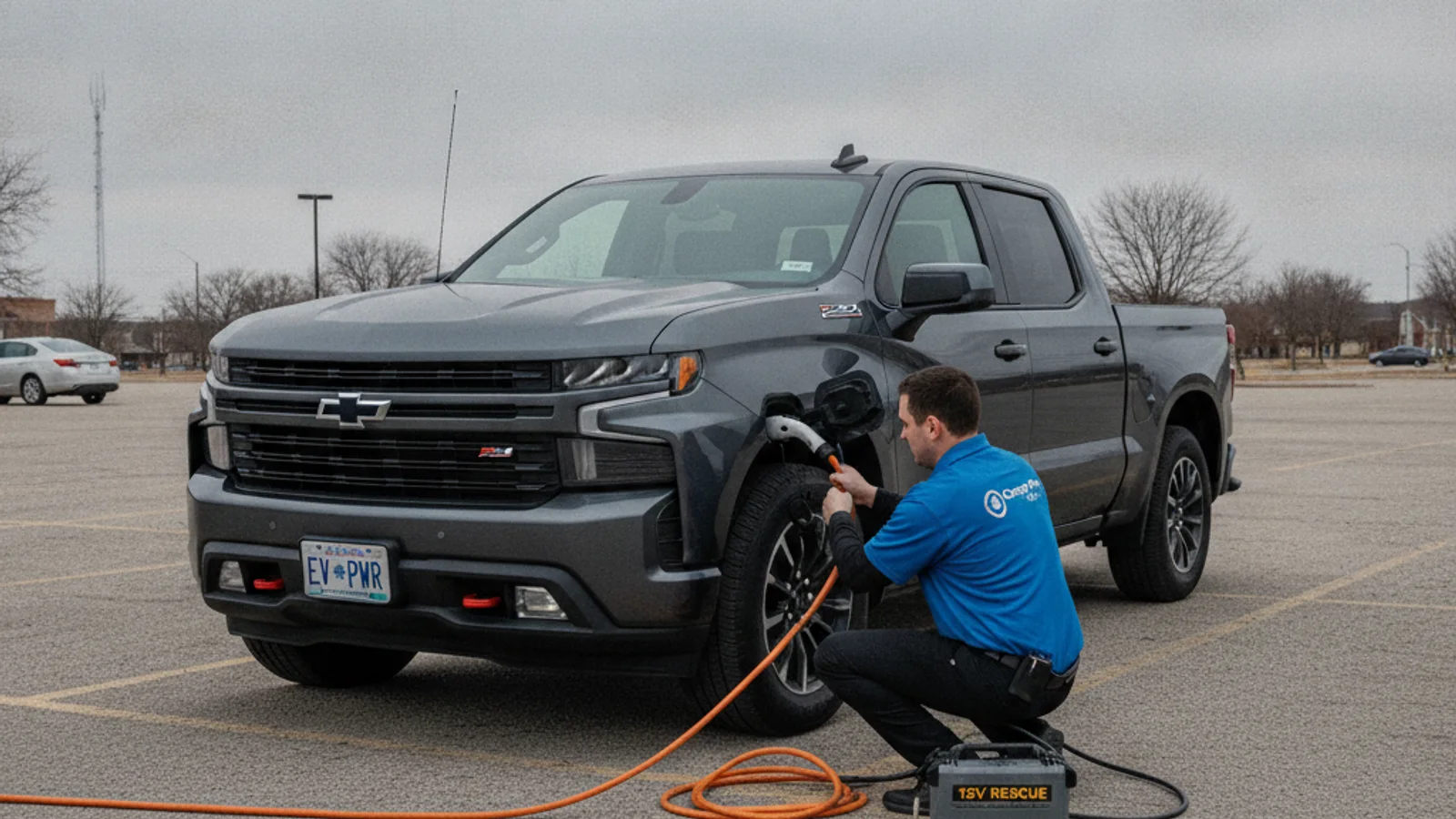
Start with the 12V, not the Ultium pack
Treat a Silverado EV no-start as a dead 12V until you prove otherwise. The 12V runs the low-voltage electronics that wake the truck. Those electronics then bridge to the high-voltage Ultium pack. If the 12V can’t hold voltage, that handshake never finishes. Nothing turns on, even when the main battery is fine.
You’re looking at two batteries that do different jobs. The pack moves the truck, and the 12V turns it on. Mix those up and you’ll hunt a charger you don’t need.
A truck parked for weeks will slowly drain the 12V. A worn 12V near the end of its life does the same. A DC-DC converter that isn’t topping it off will too. Every EV uses a DC-DC converter to step pack voltage down. It holds the small battery around 12 to 14 volts while the truck sits. When the converter or the battery starts failing, you get a dark cabin. The truck won’t respond to the fob or the dash.
A jump gets you moving again for the moment. A worn 12V will strand you again within days.
What a dead 12V looks like in the cab
The pattern is the same across these trucks. Doors stop unlocking and the screens stay dark. The truck won’t shift into drive at all. The range readout can still look generous from the pack.
The 12V feeds many modules at once. A low-voltage event on this platform isn’t tidy. You don’t get one clean message from the truck. You get a pile of unrelated warnings instead. That stack is a classic weak-12V signature on this platform.
Don’t try to clear it by restarting over and over. Restoring 12V voltage is what actually settles the modules. If the truck was recently serviced, don’t pull 12V terminals to force a reset. GM is clear about a poorly timed 12V disconnect. It can turn a simple jump into a dealer visit. When you’re guessing, stop and get a diagnosis.
Fleet sits on the I-55 belt are hard on that battery
This platform is a work truck first. Accessory loads are part of a normal shift. Crews leave a Silverado EV overnight on a job. Lights, tools, or a job box may sit on the eTrunk outlets. The 12V takes that draw while the cab is empty. The Ultium pack can still sit high. The small battery is the one that pays.
Trailering adds another drain on the same 12V. Extra accessory power stays on for the whole pull. A marginal 12V may not recover once the truck is back at the yard. The next morning’s no-start can look sudden. It usually isn’t a surprise after that load.
Cold is the local piece in this metro. A weak 12V fails faster after a freeze. The pack can still read strong the next morning. The truck still won’t wake for the drive. That’s the stall that looks like a dead EV and isn’t. You’re not hunting miles in that moment.
Census figures show Cicero’s housing stock is old. ACS 2019-2023 figures put pre-1980 stock at 90.2 percent. Berwyn sits at 90.0 percent on the same measure. Plenty of those blocks mean curb parking or a tight older garage. Alarm and connectivity modules keep drawing all night. A fleet truck left on the street still sits on that parasitic load.
Chicago’s housing stock is old as well. Pre-1980 stock is 68.6 percent in the ACS figures. A lot of city overnight parking is open-air. That doesn’t empty the Ultium pack by itself.
Bolingbrook’s housing stock is a different mix. Only 12.3 percent of housing there predates 1980. Plainfield is 6.7 percent on that same cut. Newer Will County streets have more attached garages. The 12V can still die in a closed garage.
Joliet is the big Will County city on this belt. The 2024 population estimate is 151,837 people. Romeoville’s 2024 estimate sits at 41,177 people. Chicago’s 2024 estimate is 2,721,308 people in the city. I-55 carries work trucks through all of that mix. A dark Silverado EV after a job is usually the 12V. It’s not an empty pack in most of those stalls.
If the pack really is empty, treat it as a range stall. Our guide for an empty EV pack on I-55 is the other path. Confirm the range readout before you call for the wrong help.
Where GM hid the 12V, and why the eTrunk traps you
The Silverado EV’s 12V sits under the hood inside the eTrunk. It’s on the passenger side, under a plastic cover held by a few tabs. That’s simple if you still have power.
The eTrunk release is electric on this truck. The fob, dash button, and fascia button all need 12V. When that battery is dead, the lid you need stays shut. Hummer EV and Porsche Taycan owners run into the same kind of frunk lockout.
Don’t pry the fascia to force the lid. Don’t wedge tools under the sealed lid. GM already put a mechanical cable in the cab for this. That’s the path that still works when every button is dead.
Pull the gray cable, then get to the terminals
Look under the dash on the driver’s side, down near the lower left. There’s a gray release cable with a loop at the end. It’s in the same spot a hood release would sit on a gas truck.
Pull the cable twice in a firm motion. The eTrunk releases with no electrical power at all. It can take a moment to find on the first try. It’s tucked up under the dash on purpose. It still works with the truck completely dead.
Once the eTrunk pops, lift the passenger-side plastic cover. That exposes the 12V battery and its terminals. A flathead screwdriver helps if the tabs are stiff. Go slow so you don’t crack the cover.
Jump it in the right order, then wait
You’ll see the terminals once the cover is off. The negative terminal is a 10mm bolt connection. The positive terminal sits right next to it.
Clip a jump pack or donor-vehicle positive clamp to positive first. Then clip negative to the Silverado’s negative terminal, or to unpainted metal nearby. Give it a minute before you try to power the truck on.
If it doesn’t wake on the first try, leave the pack connected. A deeply discharged 12V sometimes needs a slower trickle. It has to hold enough charge to finish the handshake.
Winter makes that wait more common here. Cold weather thickens the same 12V problem. Our winter jump-start guide covers the cable order in full. Read it before you clip on in the cold.
After it starts, don’t assume you’re done. Drive it and let the DC-DC converter try to refill the 12V. Keep extra eTrunk loads off until you know the 12V is holding. If it dies again in a few days, the battery is finished. Our on-site 12V replacement signs walk through that next step. We don’t publish a dollar figure here. Confirm the current quote with the shop or the operator before you pay.
Symptom to likely cause
| Symptom | Likely cause |
|---|---|
| Dashboard completely dark, doors won’t unlock | 12V fully discharged |
| eTrunk won’t open with fob or dash button | 12V too low to power the electric release |
| Multiple unrelated warning lights stack at once | 12V voltage dropped low enough to confuse several modules |
| Truck won’t shift into drive despite a full range readout | 12V can’t sustain the handshake to the Ultium pack |
| Repeated no-starts within days of a jump | 12V has failed and needs replacement |
If you’ve already jumped this truck more than once in a few weeks, stop. Replacement is the real path at that point. Another jump only resets the clock by a few days.
A quick order of checks before anyone tows it
Work through this list in order first. It keeps a 12V stall from turning into a flatbed.
First, look at the range or pack readout if any screen still wakes. Plenty of range plus a dark truck points at 12V. Zero range is a pack problem, not the 12V.
Second, try the fob and the door handles. No response is more 12V than a drivetrain fault.
Third, find the gray eTrunk cable and pop the lid. Don’t wait on the fascia button to work.
Fourth, jump the terminals in the order above. Wait a minute before you hit power.
Fifth, if it wakes, watch whether it stays awake. A repeat failure means replacement, not another cable set.
Sixth, if you can’t reach the cable, stop. If you’re not safe where you sat, wait for help. Get an operator to the truck instead of working in a live lane.
A tow should be the last call. You can’t undo a rushed hookup on a large EV.
Same GM truck family, different lid
The Hummer EV uses a similar eTrunk idea. If you’ve driven both, the lockout will feel familiar. Our Hummer EV 12V no-start guide covers that truck’s path.
Don’t copy this cable location onto a Ford or a Tesla. Those layouts aren’t shared across brands at all. The Silverado EV steps above are for this GM truck.
What a local operator does, and what we don’t
Charge Pro CHI is a referral line only. We match stranded EV drivers with independent local mobile rescue operators. We don’t hold a trade license for this work. We don’t own trucks or rescue equipment of our own. We don’t employ technicians on our own payroll. We don’t set prices, and we don’t publish hours.
The operator quotes you before any work starts. They bill you directly for the visit.
On a non-Tesla EV rescue, the operator can jump the 12V. They can talk you through the manual eTrunk cable if you haven’t found it. They can also judge whether the battery is holding. They can say if it needs replacement so you’re not calling again.
If the pack is empty instead, that’s a different visit. Operators bring a 240V Level 2 source to the car. They use a native NACS plug when it fits. A CCS or J1772 adapter covers non-Tesla EVs. That typically adds 10 to 20 miles of range. The charging time is 15 to 30 minutes. That’s charging time, never an arrival time.
A dark Silverado EV with range still showing is usually the jump. Tell the operator the dash is dark and the eTrunk won’t pop. That keeps the dispatch on the 12V path.
If the stall is in Joliet, the same match applies. It also applies in Bolingbrook, Cicero, and Romeoville. We serve the whole Chicagoland metro. The operator on the phone still sets the quote.
Call (858) 925-5546 when you want that referral. Confirm availability and the quote with the operator before they start.
Frequently asked questions
Why won’t my Chevy Silverado EV start if the range still looks fine?
Range comes from the high-voltage Ultium pack only. The 12V is what actually boots the truck. If that small battery is dead, the startup sequence never finishes. A 12V jump is usually what brings it back.
Where is the 12V, and how do I open a dead eTrunk?
It’s in the eTrunk, passenger side, under a plastic cover on tabs. The electric release won’t work with a dead 12V. Pull the gray looped cable under the driver’s dash twice. The lid then pops open with no power.
Should I keep jumping it, or replace the 12V?
One jump can be enough if the battery still holds. Repeated no-starts within days mean it’s done. Replace it instead of stacking more boosts. Let the operator or a shop confirm it on a tester.