A Cadillac Lyriq that won’t start after a garage sit is usually a dead 12V. Long Chicagoland sits flatten that small battery, not the Ultium pack. The pack can still hold range while Ready never comes. Check the 12V before you call a tow.
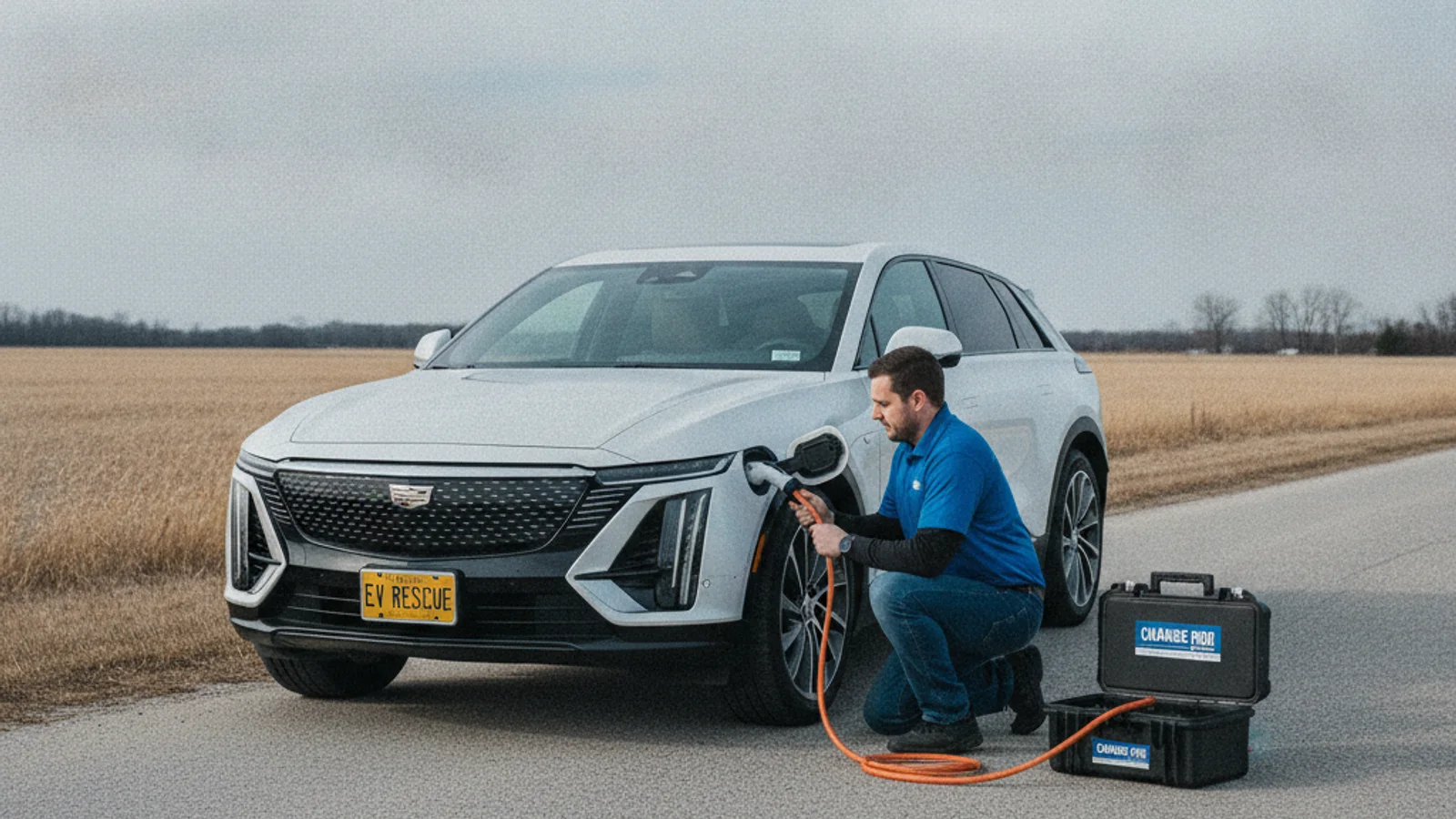
Long garage sits are how Lyriqs go quiet here
A Lyriq that sat Friday through Monday is the local no-start pattern. The traction pack often still looks fine in myCadillac. The 12V spent the weekend keeping modules awake. By Monday the screen is dark, the fob is mute, and Ready never comes.
Chicago’s housing is old enough to make those sits routine. ACS 2019-2023 puts pre-1980 housing at 68.6% of the city. Oak Park is 78.6%, Evanston is 71.2%, and Wilmette is 74.3%. Evergreen Park is 87.7%, Cicero is 90.2%, and Berwyn is 90.0%. Tight attached garages on those blocks hold a Lyriq still for days. The car doesn’t have to be empty to refuse Ready. It only has to sit through a cold stretch.
Newer suburbs don’t cancel that same 12V failure. Naperville’s pre-1980 share is 11.7%, Gurnee is 9.5%, Plainfield is 6.7%, and Huntley is 3.8%. The garages are often larger, but the chemistry is the same. A cold week in a two-car garage still flattens a weak 12V.
Schaumburg and Arlington Heights add long workday dwell. The car sits through an office stretch, then another. Orland Park and Tinley Park add weekend sits after a mall or a show. Highland Park and Northbrook add North Shore weekend parking. The 12V still ticks down while the car stays still.
Sort a dead 12V from an empty pack
Every Lyriq runs two batteries, and the Ultium pack turns the motors. The 12V runs locks, lights, and the 33-inch display. It also wakes the computers that close the high-voltage contactors. Those computers never wake if the 12V is gone. A full pack can’t jump that gap by itself.
Total darkness and a silent fob usually mean the 12V is fully dead. Doors that still unlock with a black screen often mean a low 12V, not an empty one. A screen that flashes on and dies can be a module boot loop. A normal screen with Service EV System points at Ultium, not a blank 12V. A charge-port locked icon is a latch fault.
myCadillac or OnStar can still show a healthy state of charge. That number is the pack, not a 12V test. Treat it as one data point, then look at the cabin. What happens when an EV 12-volt battery dies maps the same split on other EVs.
If the household also has an Escalade IQ, start that one the same way. The Cadillac Escalade IQ no-start checks follow the 12V-first order too.
Open the frunk and jump the right posts
The Lyriq’s 12V sits in the front trunk. Look toward the driver’s side under a plastic cover. There’s no gas-car hood to lift on this car. Use the interior frunk release if the cabin still has power. The key fob can pop it when a little 12V remains.
A fully dead 12V kills the electric latch. The owner’s manual describes an emergency frunk release. That cable runs along the driver’s side of the frunk floor, behind the front bumper cover. Use the manual the first time, and don’t pry the lid.
Jump on the dedicated bus bar, not the battery posts. The positive post wears a red cap on top. The negative is a bare bolt on the nearby driver’s-side chassis rail. Connect a quality jump pack there, wait 60 to 90 seconds, then press start.
Modules need that pause to come up cleanly. In winter the same jump order still applies. How to jump start an electric car is the cold-weather version of this habit.
When Ready drops even though the 12V looks fine
Some Lyriqs still refuse after a clean jump. The Ultium battery management system can hang after a long park. An interrupted over-the-air update can leave a module stuck. A charge session that quit early can do the same.
That hang doesn’t look like a black cabin. The 33-inch display may come up, then die. The car may enter Ready, roll a few inches, then drop out. The dash may show a Service EV System warning. The app can still read pack charge correctly.
A 12V power cycle can clear a software hang. Open the frunk and disconnect the negative 12V terminal. Wait a full two minutes, then reconnect the cable. Listen for relays as modules come back, then try a normal start.
That reset clears volatile memory in the modules. It doesn’t repair a failed hardware part. If high-voltage warnings return, stop and hold there. Don’t force a charge session on a car throwing active Ultium faults.
A latched charge port can fake a no-start
The Lyriq won’t go Ready if it thinks the charge port is still latched. The locked-port icon is the tell on the display. Check the door, the cable, and any ice around the inlet. Winter slush on Chicago, Oak Park, and Evanston streets finds that port. Clear the latch before you assume the 12V died.
If a public session ended badly, the car can sit in a protective state. The pack may still have range while the car still won’t drive. Confirm the port is open, then try the power cycle. If the warning stays, skip another charge attempt and get a dealer scan.
Older garages and street parking in Oak Park make overnight sits common.
Try this order before a wrecker
Stay with the car if it’s in a safe spot, then work down the list.
- Kill leftover loads. Dome lights or a plugged-in accessory left on can flatten a 12V during a long sit.
- Try the fob from a few feet, then use the owner’s manual if you need backup entry.
- Get into the frunk with the interior release, the fob, or the emergency cable.
- Jump the bus bar, wait 60 to 90 seconds, and attempt start.
- If the screen loops or Ready drops, disconnect the negative for two minutes.
- If the port icon is locked, clear the latch, then retry.
- Only then choose a 12V jump, a pack boost, or a tow.
An actually empty pack is a different job. Independent local operators bring a 240V Level 2 source to the car. On a Lyriq they use a CCS adapter. Charging time is typically 15 to 30 minutes. That usually adds 10 to 20 miles of range. That’s charging time, never an arrival window.
Non-Tesla EV rescue covers GM Ultium cars, including the Lyriq, Blazer EV, and Equinox EV. Charge, jump, or tow walks that choice without a price.
Orland Park long-dwell parking is the suburban version of a long sit.
Collar counties sit the car just as long
DuPage mixes housing ages across the county. Wheaton is 35.2% pre-1980, Downers Grove is 41.3%, and Elmhurst is 56.6%. Kane County adds Aurora at 33.1% pre-1980 and Elgin at 41.5%, plus longer Fox River commutes. Joliet, Bolingbrook, and Romeoville sit on long southwest runs. A Lyriq can sit there from morning until evening. Crystal Lake and Huntley sit farther northwest. The 12V tracks how long the car slept, not which county line you crossed.
Unheated older garages in Cook County soak overnight. The 12V works to keep modules alive in that cold. If you plugged in at home and still woke to a dead car, confirm the wall unit actually ran first. Then treat it as a 12V or session fault before you blame the pack.
Park Ridge, Skokie, Glenview, and Des Plaines sit on that same inner-ring pattern. Pre-1980 shares there run 67.1%, 72.0%, 40.3%, and 58.8%. A Lyriq that sat in those garages overnight in January is a 12V suspect first.
What a local operator can do on site
Charge Pro CHI is a referral line for stranded drivers. It matches you with independent local mobile rescue operators. It doesn’t own trucks, employ technicians, or hold a trade license. It doesn’t set prices or publish hours either. The operator quotes you before work starts and bills you directly.
On a Lyriq no-start, on-site work can include a 12V jump or replacement. A 240V boost is the path if the pack is actually empty. Operators handle Tesla and every major EV brand. They bring a native NACS plug. CCS or J1772 adapters cover non-Tesla EVs, including GM.
They can’t clear a dealer-level Ultium hardware fault. They also can’t promise a clock time for arrival. If Service EV System returns after a clean power cycle, get the car to a Cadillac dealer. Don’t keep jumping a 12V that dies again the next morning without asking why.
When a tow is still the right call
Tow if you can’t open the frunk and you can’t jump. Tow if the car is in a live lane and the scene isn’t safe. Tow if high-voltage warnings persist after the reset. Confirm EV tow steps with the operator on the call. Don’t drag the car on its wheels.
If the only problem is a dark 12V in a driveway, a jump is the smaller intervention. That’s true in Skokie, Park Ridge, and Glenview. It’s true in a Naperville or Aurora garage after a week away. Save the wrecker for a car that can’t be made Ready.
Call (858) 925-5546 when you want Charge Pro CHI to connect you with a local operator. Say it’s a Cadillac Lyriq that won’t start. Mention whether the screen is dark, whether the fob still works, and how long the car sat.
Frequently asked questions
How do you jump-start a Cadillac Lyriq
Use the frunk jump posts, not the 12V battery clamps. Pop the frunk with the interior release or the fob if it still has life. If the latch is dead, use the emergency release in the owner’s manual. Find the red-capped positive on the bus bar and the chassis ground bolt. Connect the jump pack, wait 60 to 90 seconds, then press start.
Can a Lyriq refuse Ready with a charged Ultium pack
Yes, a dead or low 12V blocks the high-voltage system even when the app shows range. A BMS hang can do the same with a 12V that still looks fine. Disconnect the negative 12V terminal for two minutes, reconnect, and retry. If Service EV System returns, that’s dealer diagnostics, not another roadside charge.
Why does the 33-inch screen go black on a no-start
That display runs on the 12V system, not the traction pack. When the auxiliary battery is empty, the controller has no power, so the screen stays dark. Dome lights and locks fail for the same reason. A screen that flashes and dies is more often a boot loop. A screen that looks normal with a service warning is pointing at Ultium, not a blank 12V.