A Hummer EV that sat through a Chicago workday can still show range. Then it won’t wake in the driveway. When a GMC Hummer EV won’t start, check the 12V first. An empty Ultium pack is rarely the cause. That small battery boots the computers and closes the high-voltage contactors. When it drops, the cabin stays black. Handles, screens, and drive systems all stay asleep.
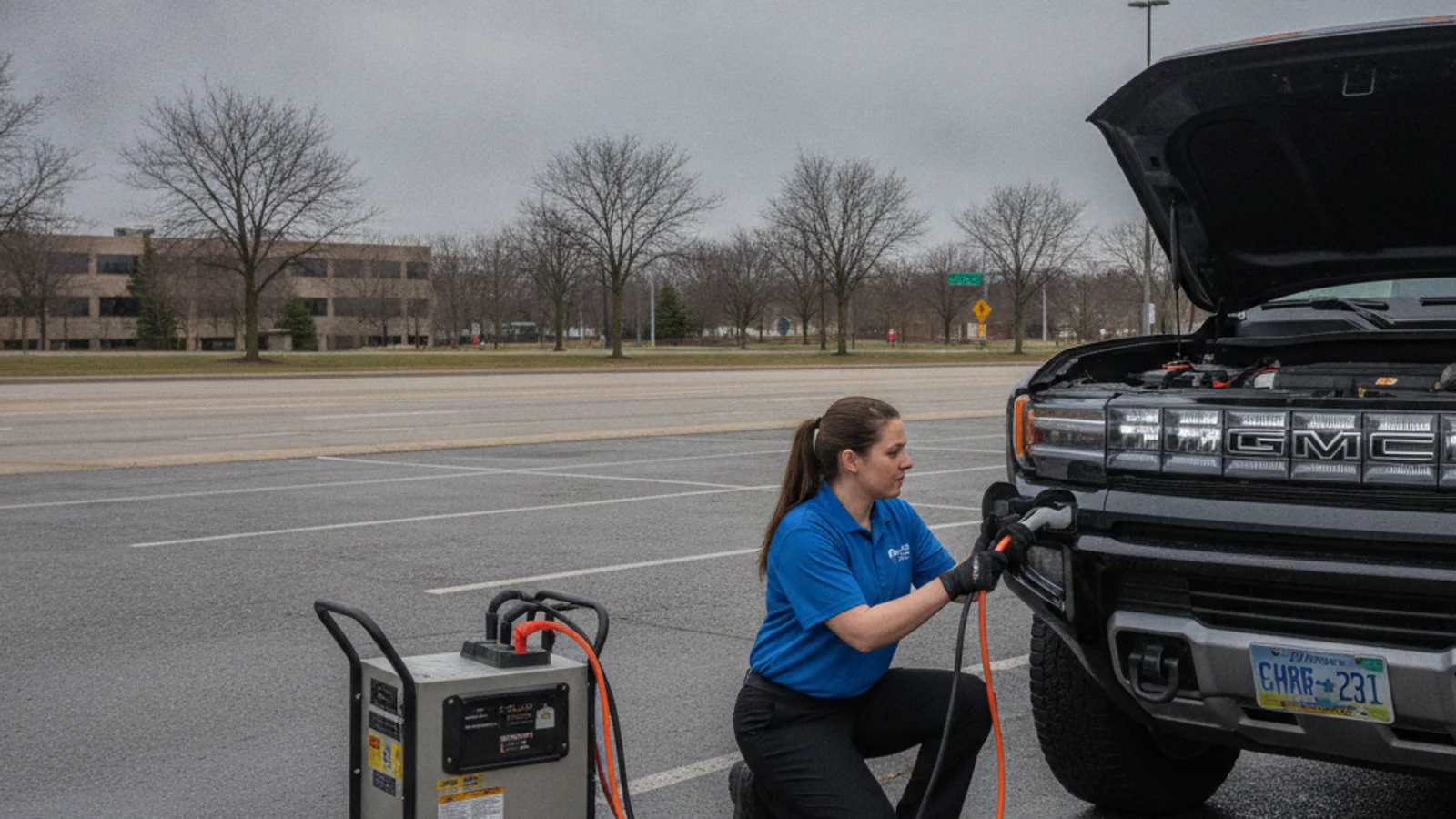
Large GM EVs fail this way across Chicagoland before the pack is empty. Cold sits, long parking, and a tired 12V do it. The range number in the app can still look healthy. The truck still won’t boot after that sit. Start with the 12V on a dark cabin. Don’t assume the Ultium pack is the problem.
Two batteries, and only one wakes the truck
The Hummer EV has a high-voltage Ultium pack and a 12V battery. They don’t share the same job at all. The pack moves the truck down the road. The 12V runs the low-voltage electronics that let the pack come online. If the 12V can’t hold voltage, that handshake never completes. The contactors stay open on a dead 12V. The dash stays dead until that battery wakes.
Yesterday’s range reading can look fine for that reason. It was the big pack talking, not the 12V. It wasn’t the battery that powers the brain. Treat a dark Hummer EV as a 12V problem until you prove it isn’t. What you see when an EV 12V dies covers that split in plain terms.
A truck parked for weeks will slowly drain the 12V. So will a 12V that’s simply worn out. You get the same result either way here. The cabin is dark and unresponsive. The truck won’t wake for a drive. A jump can get you moving again. A 12V near the end of its life will strand you again within days.
How local parking actually drains it
Chicago’s 2024 population estimate is 2,721,308. About 68.6% of the city’s housing was built before 1980. Oak Park sits at 78.6% pre-1980. Cicero is 90.2%, and Berwyn is 90.0%. Evanston is 71.2% pre-1980 as well. Those older blocks mean tight garages and trucks that sit between trips. Alarm loads and sleeping modules still draw from the 12V. They don’t draw from the Ultium pack at rest.
Newer suburbs change the buildings, not the failure. Naperville’s pre-1980 share is 11.7%. Gurnee is 9.5% pre-1980 housing. Huntley is 3.8% on that same measure. Schaumburg is 15.9% pre-1980. Office-park lots there let a Hummer EV sit from morning until evening. Wheaton, Elmhurst, and Plainfield have plenty of attached garages. A weak 12V still dies in those bays. You just don’t see it until you need to leave.
Northbrook, Highland Park, Glenview, and Wilmette see these large GM EVs often. They sit in driveways between weekend trips. Kane County adds Aurora, Elgin, Geneva, Batavia, and St. Charles. Will County adds Joliet, Bolingbrook, Romeoville, and New Lenox. Lake County adds Waukegan, Libertyville, and Gurnee. McHenry County adds Crystal Lake, Algonquin, and McHenry. Long commuting days nibble the 12V overnight. They don’t empty the pack first.
Workplace parking around Elk Grove Village and Hoffman Estates does the same. So do long dwell lots in Orland Park and Tinley Park. Palatine, Arlington Heights, Mount Prospect, and Des Plaines sit on that northwest pattern. Downers Grove and Oak Lawn add the same overnight sit after a commute. A Hummer EV that drove yesterday can still refuse to boot. A cold overnight sit is enough.
Skokie, Park Ridge, and Oak Park add older garages on pre-1980 blocks. Waukegan’s housing is 54.0% pre-1980, with a different mix than Gurnee in the same county. None of that changes the electrical path. The 12V still fails first on these trucks.
The “conditions unable to shift” message
Hummer EV owners often see “conditions unable to shift” before a full no-start. Other electrical warnings can stack with it. GMC’s spec puts a resting 12V at 12.4 to 12.8 volts. A running 12V system should sit near 14.4 to 14.8 volts. Drop below that resting window and the modules start arguing. You get shift errors and screens that won’t load. You can also get a truck that won’t wake.
Don’t keep cycling it through those warnings. A weak 12V won’t hold voltage under load. Restarting the infotainment doesn’t restore that voltage. A jump or a 12V charge is what clears the errors.
Slow the doors until the 12V is alive
The Hummer EV’s power doors index the glass. The window drops slightly when you open the door. It rises again as the door closes. That keeps the glass off the roof seal at an angle. The indexing needs 12V to run. With the battery dead, it doesn’t run.
Close a door the usual way and the glass can hit trim. The top of the window can strike the sky panel or the A-pillar. It can chip or crack that glass. Treat every door as a manual door until the 12V is jumped. Ease it shut with your hands. Don’t let the last swing slam.
That’s the first move in a tight Chicago garage. It’s also the first move in a Schaumburg stall when you’re late. The dark cabin is the cue to slow down. Slow the doors before you hunt the battery. Then wake the truck.
The eTrunk lockout, and the pull loop
GMC put the 12V in the front trunk, the eTrunk. It’s on the passenger side under a plastic cover with three tabs. That’s easy with power still on. It’s a lockout without it. The eTrunk release is electric. A dead 12V kills the button and the fob.
There’s a mechanical release in the cabin. Sit in the driver’s footwell. Look left of the brake pedal, up behind the wiring harness. You’ll find a silver wire with a loop. Pull that loop until it gives. You should hear the eTrunk pop. It takes a little feel the first time. It needs no electrical power at all.
Once the lid is up, lift the plastic cover by those three tabs. The 12V and its jump terminals are under it.
Clamp order that actually wakes it
You’ll see two terminals under the cover. The positive post sits under a red sliding door. Flip that door and clamp on. The negative terminal is to the left, next to a green connector. Clamp positive to positive first. Then clamp negative to the ground terminal. Pause before you try to wake the truck.
If a small jump pack can’t raise a deeply discharged Hummer EV, switch tools. Use an AGM-rated charger on those terminals. About an hour on the 12V often brings enough voltage to attempt a start. Keep the same clamp order the whole time. For the full safety sequence, use our guide to jump starting an EV in winter.
Skip using another EV as a donor unless you already know that setup. The Hummer EV is a large low-voltage load. A dedicated jump pack or an AGM charger is the cleaner path.
Symptom to likely cause
| Symptom | Likely cause |
|---|---|
| Dashboard completely dark, doors unresponsive | 12V fully discharged |
| ”Conditions unable to shift” message | 12V below the 12.4 to 12.8V resting range |
| eTrunk won’t open with fob or button | 12V too low to power the electric release |
| Window strikes trim when a door is closed | 12V dead, window indexing not running |
| Repeated no-starts within days of a jump | 12V has failed and needs replacement |
If this Hummer EV has needed more than one jump in a short stretch, stop repeating the same rescue. A 12V that won’t hold a charge needs replacement. Our EV 12V replacement guide covers the signs. It also covers what on-site help looks like.
GM’s other electric trucks follow the same low-voltage pattern. The GMC Sierra EV emergency charging guide covers that platform. A Silverado EV no-start is usually the 12V path too. A healthy pack still can’t boot the truck without a working 12V.
What a local operator does
Charge Pro CHI is a referral line. We match stranded EV drivers with independent local mobile rescue operators. We don’t hold trade licenses. We don’t own trucks or equipment. We don’t employ technicians. We don’t set prices. We don’t promise when someone will arrive. The operator quotes you before starting and bills you directly.
The operators we connect you with are licensed and insured. They jump or replace a dead 12V on site. They can also bring a 240V Level 2 source. That’s for an Ultium pack that’s actually empty. That boost typically adds 10 to 20 miles of range. Charging time is usually 15 to 30 minutes. They handle Tesla and every major EV brand, including the Hummer EV.
On a non-Tesla EV rescue call, an operator can use the manual eTrunk release. The same is true on an EV roadside assistance call. They can jump the 12V and check whether it’s holding. We serve Chicagoland. If the truck is dark, don’t force a door shut.
Call (858) 925-5546 to reach Charge Pro CHI. That’s the number for a match with a local operator. They quote before they start.
Frequently asked questions
Why won’t my GMC Hummer EV start even though the range looks fine?
The range figure comes from the high-voltage Ultium pack. That’s separate from the 12V system that actually boots the truck. If the 12V is dead or too weak, startup can’t finish. The main pack’s charge doesn’t matter in that moment. A 12V jump almost always brings the truck back.
How do I open the eTrunk if the 12V battery is dead?
Look in the driver’s footwell, left of the brake pedal and up behind the wiring. There’s a silver wire with a loop. Pull the loop until it gives. The eTrunk will pop open mechanically. No electrical power is required for that pull. The 12V sits on the passenger side under a three-tab cover.
Why shouldn’t I close the doors normally when the 12V is dead?
The Hummer EV’s power doors index the windows with 12V power. The glass drops a bit on opening and rises on closing. With the battery dead, that indexing doesn’t run. Closing a door at normal speed can make the window strike trim. That hit can be the sky panel or the A-pillar. Close doors slowly and manually until the 12V is jumped.