Your Chevy Bolt sat through a failed public session. It still needs a charge to get home. This is a J1772 car, not a Tesla. The screen stayed blank on the cluster. Or it showed Unable to Charge. Work the checks below in order. If the stall still won’t talk to the car, stop. A mobile 240-volt boost with a J1772 adapter is the next move.
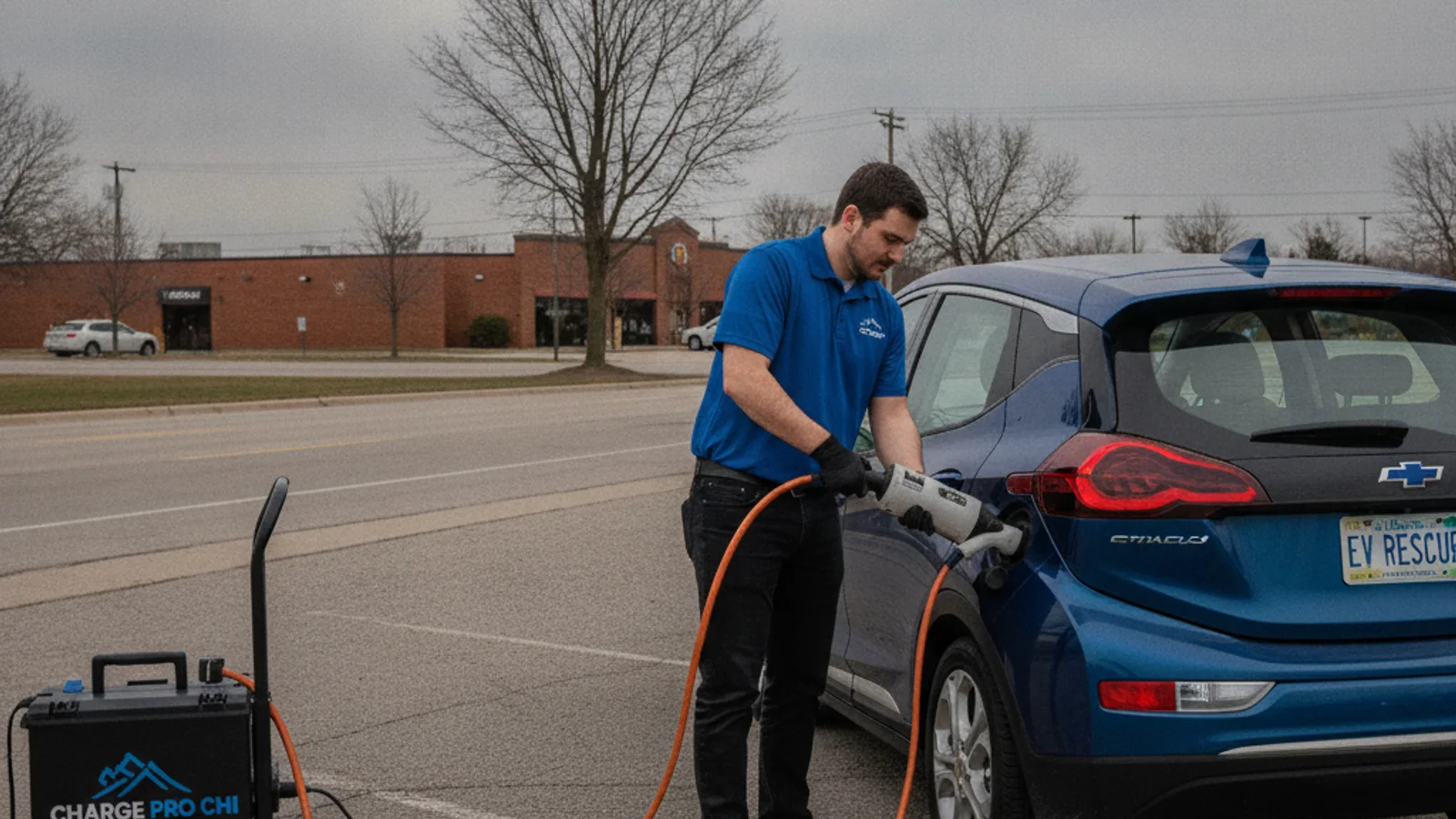
A failed stall still leaves you needing a J1772 boost
A dead session isn’t a dead Bolt. The handshake failed between car and stall. The pack may still have range left. Or the pack is low and the pedestal never started. Those are different problems with the same next step. They share one AC port, and that’s J1772. Many DC stalls use CCS on a Bolt. Know which plug you’re holding before you wait.
Charge Pro CHI is a referral line for this metro. We match stranded drivers with independent local operators. The operators quote you before they start, and they bill you directly. This brand owns no trucks and employs no technicians. It doesn’t set prices or promise an arrival.
The pattern repeats across Chicagoland lots and curbs. A public session stops in Chicago after a Loop errand. It stops in Evanston after a lakefront stop. It stops in Naperville at the end of a DuPage commute. It stops in Joliet on a Will County lot. You still have to get home from there. A J1772 mobile boost is how a Bolt leaves when the stall won’t.
Tell the stall apart from the car
Charging is a three-way deal every time you plug in. You’ve got the pedestal, the Bolt, and the power feeding both. One of those three is the problem. Find which one before you assume the pack is finished.
At a public stall, unplug the handle and reseat it until it clicks. Try the next handle on the same cabinet if there’s one. Then try another cabinet in the same lot if you can roll. A dark pedestal is the pedestal, not your car. A live pedestal that still won’t start is often the handshake. It can also be the Bolt’s 12-volt system refusing to wake.
Home is a different test than a lot. In an Oak Park garage, check the wall connector first. In a Wheaton driveway, do the same walk-around. Confirm the cable’s seated at the car and at the box. Walk to the breaker panel and look for a trip. A tripped breaker is a boring cause, and it’s a common one. Reset it once and watch. If it trips again, stop using that circuit. That’s a house electrical problem, not a reason to keep resetting.
A spare cable is a useful home test if you’ve got one. A cable can fail with no visible nick in the jacket. Level 1 overnight talks to the car one way. Level 2 on a wall box uses a different talk. DC fast charge uses a third protocol. A fail on one level doesn’t prove a fail on the others. Read EV charging levels for stranded drivers before you pick the next plug.
If the handle says connected and nothing flows, you’re not alone. Walk through a public charger that is connected but not charging.
Also check the car’s own charge settings before you blame the stall. A schedule can hold the session until a set hour. A charge limit can sit at a percent you already passed. A cabin precondition can look like charging when the pack isn’t taking much. Toggle the schedule off and try a plain start. If the session begins, the hardware was never the problem.
What Unable to Charge is actually saying
Unable to Charge is a blanket, not a diagnosis. The Bolt and the stall never finished the safety talk. The car won’t take power until that talk completes, and that’s by design. Pack protection will refuse a dirty or unstable feed rather than risk the cells.
A few triggers show up again and again on this car. The stall never offered a clean handshake to the onboard charger. The charge port latch is dirty, wet, or iced from slush. The 12-volt system never woke the high-voltage contactors. The onboard charger saw a power wobble and shut the session down.
You may find more specific codes if you dig in the menus. A missing code isn’t a missing problem. Cycle the stall if it’s safe and you’re not in traffic. Unplug, wait, then plug back in and watch the cluster. If the same banner returns on a second stall, the car is now the suspect.
Chevy’s other EVs throw similar walls on the same hardware family. The Chevy Equinox EV won’t charge checks overlap with this list if you drive both.
Quiet the car, then try the plug again
Charge-module software gets stuck after a messy handshake. A short power-down often clears it. This isn’t a factory service procedure, and it isn’t a repair. It’s the same idea as restarting a phone that froze on a screen.
Park, then unplug so the session is fully ended. Power the Bolt fully off with the button. Open the driver’s door and close it so modules drop. Wait a few minutes so volatile memory can clear. Power the car back on, then plug in again. Watch for the charge telltale on the cluster and at the port.
Stay with the car while you do this reset. Use a legal, visible spot, not a live lane. Hazard lights belong on if you’re on a shoulder of a limited-access road. That includes the Kennedy, the Eisenhower, and the Jane Addams. Don’t stand in a live lane to fiddle with a port. The Dan Ryan and the Reagan Tollway follow the same rule. Get out of traffic first, then reset.
If the banner returns after the restart, move on to the 12-volt. Repeating the same restart won’t create a handshake the hardware can’t make. Two tries is enough on the shoulder.
The 12-volt battery is the quiet gate
The big pack moves the car. The small 12-volt battery wakes the computers that let charging start. Relays, latches, screens, and the charge-port door all lean on that little battery. When it’s weak, the Bolt can look bricked even with range on the display. The pack can still show miles. The car still won’t take a plug.
Watch for a short list of tells before you assume the pack is empty. Interior lights fade or flicker when you open a door. Door locks hesitate or cycle twice. The cluster stays dark when you press start. A seated handle gets ignored by the port with no click and no lights.
On a Bolt the 12-volt sits under the hood. It’s usually on the driver’s side. You can look at the terminals without taking the car apart. Corrosion and loose clamps are worth a look in winter salt. A multimeter is the honest test if you’ve got one. A battery well below a normal rest voltage is tired. Jumping or swapping that battery on an EV is easy to get wrong. Sensitive modules sit on that circuit. If you’re not sure, don’t guess with a gas-station pack.
The operators we connect you with jump or replace a dead 12-volt on site. That’s often the whole job, and the high-voltage pack never needed a tow. There’s a longer note on EV 12V replacement signs and on-site help.
Older housing, newer Bolts, and a wall box that never starts
Chicago’s housing stock is old. That shows up at 2 a.m. on a silent wall box. About 68.6% of Chicago homes were built before 1980. Oak Park sits at 78.6% pre-1980. Cicero is 90.2%. Berwyn is 90.0%. Those shares come from the Census ACS 2019-2023 tables. They explain overnight fails that look like a Bolt problem. A wall box on a crowded two-flat panel isn’t a Naperville garage. Only 11.7% of Naperville housing is pre-1980. Aurora and Elgin see the same overnight fail.
If the house never started the session, the Bolt may be fine. Check the breaker on the labeled EV circuit. Check the outlet if you’re on a 120-volt cord in an older bungalow. Feel the plug for heat after a few minutes. Unplug if it’s hot, and leave it unplugged. A hot outlet is a house problem. Stop using it until an electrician looks at that circuit.
When the wall box is the problem, you still have to move the car. A mobile EV charging stop gets you off the driveway first.
Long dwell lots, lakefront parking, and a tollway crawl
Bolts die in boring places more than they die on the shoulder. A mall garage in Schaumburg after a long shift is one. Orland Park or Tinley Park parking after a long dwell is another. A lakefront lot in Wilmette or Highland Park is a third. Office parks in Elk Grove Village and Hoffman Estates catch the same end-of-day stall. You come out to a car that won’t take a plug.
A crawl on the Dan Ryan burns range you thought you had. So does the Bishop Ford near Oak Lawn. So do I-55, I-80 in Will County, and the Reagan Tollway. Lower Wacker is a special kind of stuck. You can’t leave the car to hunt another stall. Randall Road through Kane County is the same kind of corridor. Don’t limp on a failed handshake until you stop in a live lane.
Gurnee, Waukegan, and Libertyville add Lake County cold on top of the same stall. Crystal Lake and Huntley do too. A Bolt that charged last week can refuse a plug after a hard freeze.
When a mobile J1772 boost is the better call
A tow moves the car to a different parking space. It doesn’t start a charge on the Bolt. If the Bolt won’t accept a plug, a dealer drop often wastes the trip. The 12-volt jump could’ve happened in the lot.
Call for a mobile boost in a short list of cases. The stall failed and you can’t roll to another one. The 12-volt looks weak and you don’t want to guess. The pack is too low to shop another pedestal. You’re in a place you can’t leave, like a shoulder or a gated garage.
The operators we send bring a 240-volt Level 2 source to the car. For a Bolt they use a J1772 connection. That’s the native AC inlet on this car. Typical charging time adds about 10 to 20 miles of range. That’s in 15 to 30 minutes of charging. That’s charging time, not a clock on the truck. It isn’t a promise of when someone arrives. The operator quotes you before starting.
Non-Tesla EV rescue is the path for a Bolt or any non-Tesla. The truck isn’t a Supercharger. It’s a rolling Level 2 source with the right adapter for this inlet. How that truck is set up is covered in what’s an EV charging truck.
What to tell the operator so they bring the right kit
Say it’s a Chevy Bolt, not a generic EV. Say whether the cluster is dark or lit. Say whether the handle clicked and the car still refused. Say whether you already tried a second stall. Mention ice, slush, or a hot wall outlet if that’s the scene.
Stay with the car if you can do it safely. Send a pin drop for the garage level. Cook, Lake, DuPage, Kane, Will, and McHenry are in the service area. The match is local operators, not a branded fleet.
If the 12-volt comes back and the pack still won’t take power, stop. That’s dealer territory, not a roadside boost. A boost won’t rewrite a failed onboard charger.
If the checks didn’t start a session
You tried a second handle and a second cabinet. You looked at the 12-volt under the hood. The Bolt still won’t charge. Call Charge Pro CHI at (858) 925-5546. We connect you with a local operator who quotes you before starting. They bring the J1772 lead, the 12-volt kit, or both. You get a quote and a plan to roll again.